



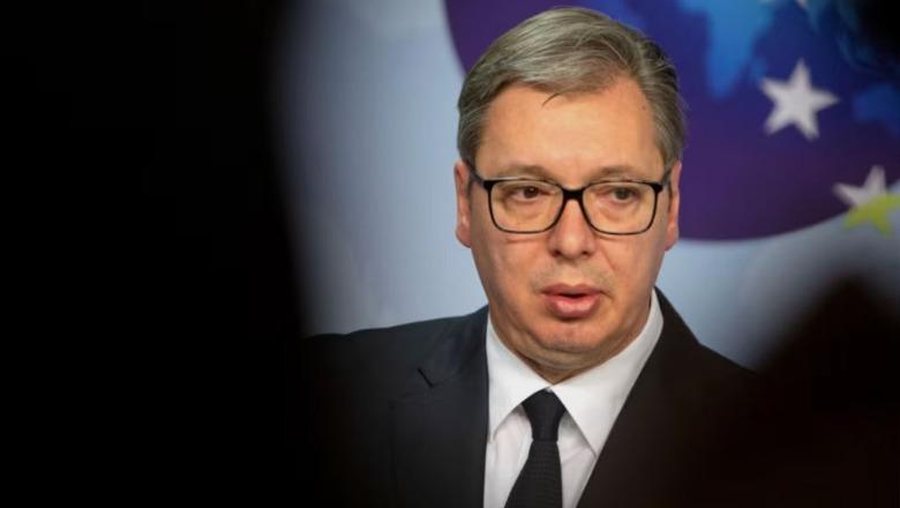
WASHINGTON, Aug 27 — Two bipartisan members of the U.S. House Foreign Affairs Committee introduced legislation on Thursday that would increase pressure on Serbian President Aleksandar Vučić over corruption, democratic standards and Belgrade’s relations with Russia, China and Iran.
Republican Representative Joe Wilson and Democratic Representative Bill Keating proposed sanctions and visa restrictions against individuals deemed responsible for undermining democratic processes, peace, stability or territorial integrity in the Western Balkans.
The measure directly raises concerns about Serbia under Vučić, including allegations of excessive force against anti-government protesters, the handling of corruption allegations and the country’s relationships with governments Washington considers strategic adversaries.
The initiative comes as Serbia heads toward parliamentary and presidential elections expected in October and as questions grow over whether the vote will meet international standards for fairness and political competition.
“Under President Vucic, Serbia has deliberately drifted further from Rule of Law and nearer to enemies of freedom like War Criminal Putin, the Chinese Communist Party, and the terrorist regime in Tehran,” Wilson said in a statement reported by The Hill.
He said the Serbian public “deserves better” after nearly two years of protests triggered by the November 2024 collapse of a railway station canopy that killed 16 people.
Protesters have portrayed the disaster as evidence of deeper problems involving corruption, public procurement and government accountability.
Keating said democracy, rule of law and anti-corruption efforts should remain central to relations between Washington and Belgrade.
The legislation also calls for greater scrutiny of Serbia’s ties with Moscow, Beijing and Tehran.
Strategic dialogue could also come under pressure
The proposed legislation goes beyond individual sanctions.
It would require the U.S. secretary of State to address four areas in Washington’s strategic dialogue with Serbia: relations with Russia, China and Iran; conditions for free and fair elections; corruption and public procurement reform; and democratic governance, media freedom and freedom of assembly.
If the administration failed to certify progress to Congress, the legislation calls for ending the strategic dialogue or cutting funding associated with it.
That would represent a notable shift only weeks after Washington and Belgrade held their first strategic dialogue in July, an initiative widely viewed as an upgrade in bilateral relations.
The bill says the United States has an interest in a Serbia that is democratic, sovereign, committed to regional stability and anchored in Euro-Atlantic institutions.
A challenge to Vučić’s relationship with Trump
The congressional initiative also exposes a potentially important split in Washington.
Vučić has cultivated relatively warm ties with U.S. President Donald Trump and his political circle. He publicly praised Trump earlier this year and Donald Trump Jr. visited Belgrade twice in 2026.
Trump has also repeatedly highlighted the 2020 Washington agreement between Serbia and Kosovo as part of his foreign-policy record.
But Wilson and Keating are signalling that bipartisan concern over Serbia’s internal political trajectory could increasingly complicate that relationship.
Their legislation places democratic standards, corruption and foreign influence at the centre of U.S.-Serbia relations rather than treating geopolitical cooperation alone as sufficient.
Elections could become the next test
Vučić announced in July that he planned to resign within weeks and said parliamentary and presidential elections would be held on either Oct. 18 or Oct. 25.
The approaching vote is likely to sharpen international scrutiny.
The Hill cited Freedom House as rating Serbia “partly free” and saying the ruling Serbian Progressive Party had eroded political rights and civil liberties through pressure on independent media, opposition parties and civil society.
Against that backdrop, the Wilson-Keating bill sends a clear political warning: Washington’s engagement with Belgrade may increasingly depend not only on Serbia’s foreign-policy positioning, but also on the conduct of its elections, its response to protests and its handling of corruption.