


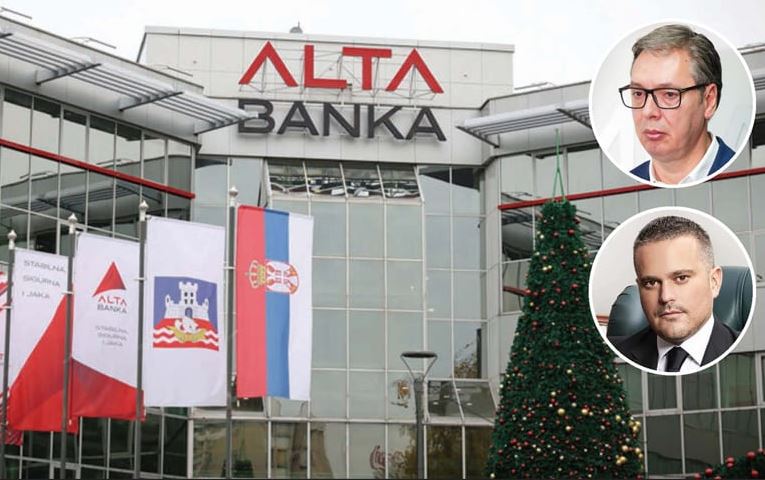
Serbia’s central bank has revoked Alta Banka’s operating licence just days after media reports alleged that money linked to politically connected businesses was being transferred from Serbia to North Macedonia and Russia. The bank’s collapse has also raised questions about its operations in North Macedonia and alleged business connections involving US-sanctioned individuals.
BELGRADE/SKOPJE, Oct. 31 (BalkanView) – Serbia’s central bank has revoked the operating licence of Alta Banka, triggering bankruptcy proceedings and suspending its payment services, days after reports alleged that the lender was transferring substantial funds to companies in Skopje and Moscow following Serbia’s parliamentary elections.
The National Bank of Serbia (NBS) announced the decision overnight, saying its executive board had withdrawn the licence of Alta Banka a.d. Belgrade.
The bank confirmed on Saturday that payment cards, domestic and international transfers, and branch operations had been suspended.
Alta Banka told Serbian broadcaster N1 that reimbursement of insured deposits would begin on Monday, November 2, in accordance with procedures established by the relevant authorities.
Under Serbia’s deposit insurance system, eligible deposits are protected up to 50,000 euros per depositor per bank.
The Deposit Insurance Agency is expected to be appointed bankruptcy administrator through a court decision.
The central bank’s decision comes amid allegations about the bank’s financial transactions, ownership connections and regional expansion. However, the available announcements do not establish that the licence was revoked because of the alleged transfers, and no official finding of money laundering has been presented in the supplied reports.
Allegations of capital transfers to Skopje and Moscow
On October 28, North Macedonian news outlet Publikum reported allegations that Alta Banka had begun transferring substantial amounts of money from accounts belonging to private individuals and companies in Serbia to foreign bank accounts.
Citing reporting by Serbian Times, Publikum said the transfers allegedly accelerated after the October 25 parliamentary elections, when it became clear that President Aleksandar Vučić’s Serbian Progressive Party (SNS) was losing power.
According to an unnamed banking source cited in the report, some of the transfers were directed towards legal entities in Moscow and Skopje, where the bank and associated individuals were said to have ownership interests in the banking and insurance sectors.
The source alleged that the transactions involved companies and individuals close to the outgoing Serbian administration seeking to move funds abroad before the incoming Student List assumed power.
The report also alleged that bank employees had been threatened against disclosing information about the transactions.
BalkanView has not independently verified these allegations. The reports provided do not include transaction records, account details, transfer amounts or documentary evidence establishing the origin and destination of the funds.
Serbian lawyer demanded urgent central bank intervention
Serbian lawyer Ivan Ninić publicly raised concerns about the alleged transfers and said he had requested urgent supervision by the National Bank of Serbia.
According to Publikum, Ninić warned that public-sector depositors could face serious financial exposure unless the central bank conducted an extraordinary inspection.
He called for temporary restrictions on transfers to related parties abroad.
Radomir Saičić, identified in the report as an academic and a leader of the victorious Student List, also warned about the potential removal of state capital and official archives during Serbia’s political transition.
The subsequent withdrawal of Alta Banka’s operating licence has intensified questions about the institution’s financial condition and whether regulators had identified irregularities.
But the available information does not show whether Ninić’s request prompted the central bank’s action or whether the alleged cross-border transactions formed part of its investigation.
North Macedonian banking connections under scrutiny
The controversy has particular significance for North Macedonia because of Alta Banka’s expansion into the country’s banking sector.
Publikum reported on October 31 that Alta Banka had acquired Stopanska Banka Bitola in 2025.
The reported acquisition followed earlier announcements that the Serbian banking group, controlled by businessman Davor Macura, intended to take over the North Macedonian lender.
Stopanska Banka Bitola had previously been associated with North Macedonian businessman Orce Kamčev, who was sanctioned by the United States.
The developments raise questions about the relationship between Alta Banka’s Serbian operations and its banking interests in North Macedonia, including the potential implications of the Serbian regulator’s decision.
However, the revocation of the Serbian bank’s licence does not, by itself, establish that its North Macedonian banking operation is insolvent or that depositors there face the same restrictions.
The supplied material also references a statement by ALTA Banka in Bitola saying that it remained liquid and continued operating without disruption.
The two jurisdictions’ regulatory and deposit-protection arrangements must therefore be distinguished.
Earlier warnings about US-sanctioned business networks
Concerns about Alta Group’s regional business connections had surfaced months before the Serbian bank lost its licence.
In August 2025, North Macedonian opposition politician Ivan Veličkovski alleged that companies linked to Kosovo Serb businessmen Zvonko Veselinović and Milan Radoičić appeared in the ownership network of Serbia’s Alta Group.
Both men have been sanctioned by the United States.
Radoičić, a former vice-president of the Kosovo Serb political party Serbian List, has been linked to the September 2023 armed attack in Banjska, northern Kosovo.
According to the earlier report, Veličkovski claimed that Alta Group, through a company called Alston, had acquired ownership of a 1,550-square-metre construction project previously associated with business partners of Veselinović and Radoičić.
He also alleged that Macura’s business rise was closely connected to Vučić and warned that Alta Banka’s planned expansion into North Macedonia posed potential national security risks.
Veličkovski argued that the transaction could facilitate the redirection of financial flows from Belgrade to Skopje during a period of political instability in Serbia.
He warned that North Macedonia risked becoming a regional destination for questionable capital and called for stronger legislation addressing assets linked to internationally sanctioned individuals.
These were political allegations, not established findings of criminal conduct by Alta Banka or its North Macedonian operations.
Political controversy spreads to Skopje
The bank’s collapse has also entered North Macedonia’s domestic political debate.
On October 31, the opposition Social Democratic Union of Macedonia (SDSM) called for prosecutorial action against Prime Minister Hristijan Mickoski and central bank governor Trajko Slaveski.
SDSM alleged that Alta Banka’s collapse exposed a broader regional network of politically connected financial interests.
The accusations remain unproven, and the supplied reports contain no evidence establishing criminal responsibility by Mickoski or Slaveski.
The controversy nevertheless increases pressure on North Macedonian financial authorities to clarify the regulatory status of the local banking operation and address concerns about possible cross-border financial exposure.
What happens to depositors?
For customers of Alta Banka in Serbia, the immediate priority is recovering their savings.
The bank said insured deposit payments would begin on Monday, November 2.
Eligible deposits are protected up to 50,000 euros per depositor per bank, while claims above that threshold will be handled under the applicable bankruptcy procedures.
Customers have been unable to use the bank’s payment cards, conduct domestic or international transfers, or access branch services following the licence withdrawal.
The available statements do not specify the total number of affected depositors or the value of deposits covered by insurance.
Unanswered questions about Alta Banka’s collapse
The closure leaves several important questions unresolved: why Serbia’s central bank revoked the licence, whether suspicious cross-border transactions occurred, and whether any such transfers involved companies or individuals connected to politically exposed or sanctioned persons.
The relationship between the Serbian bank’s collapse and its North Macedonian operations also requires regulatory clarification.
For now, Serbia has confirmed the withdrawal of Alta Banka’s licence and the start of the insured-deposit reimbursement process.
The more serious allegations concerning politically connected money transfers, sanctions-linked business networks and potential financial misconduct have not been independently established.