


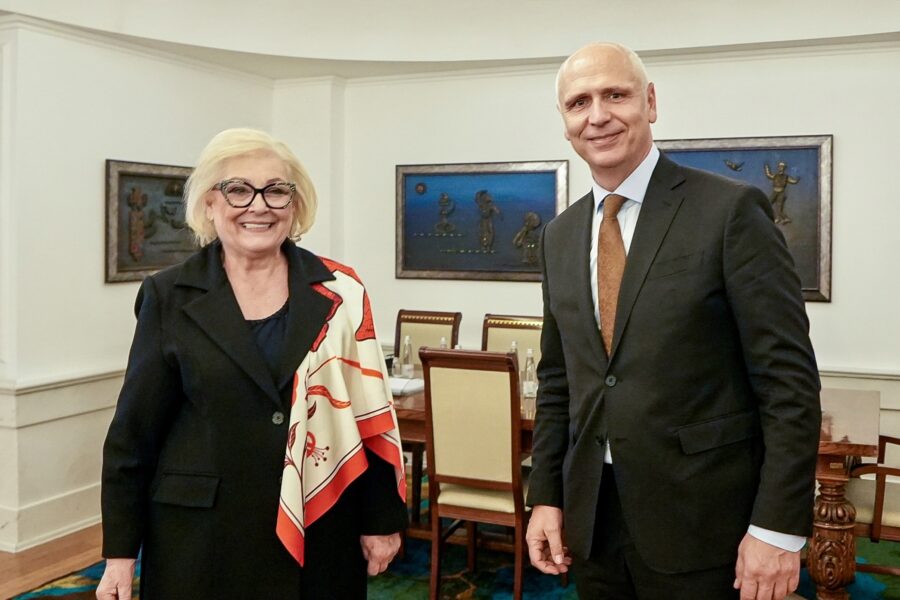
Regional Cooperation Council Secretary General Amer Kapetanović has called for faster implementation of economic integration agreements during meetings with Kosovo’s new president and foreign minister, warning that the success of regional cooperation must be measured by what citizens and businesses can actually achieve.
PRISTINA/BREZOVICA, Nov. 18 — Regional Cooperation Council (RCC) Secretary General Amer Kapetanović met Kosovo President Justina Shiroka-Pula and Foreign Minister Glauk Konjufca in Pristina on Wednesday, calling for stronger regional cooperation and faster implementation of commitments designed to bring the Western Balkans closer to the European Union.
The meetings focused on regional developments, economic integration, connectivity and the implementation of agreements under the Common Regional Market, a framework intended to facilitate the movement of people, goods, services and capital across the six Western Balkan economies.
Kapetanović said regional cooperation should produce concrete improvements for citizens and businesses rather than remain limited to political declarations.
“Regional cooperation is ultimately measured by what it delivers for people and businesses. The RCC will continue bringing institutions together, helping develop common solutions and supporting implementation so that agreed commitments translate into visible results across the region,” Kapetanović said.
Kosovo’s new president discusses regional integration
During his meeting with newly appointed President Justina Shiroka-Pula, Kapetanović discussed political and economic developments across the Western Balkans, the region’s European integration prospects and the importance of sustained participation in regional initiatives.
He emphasised that political commitments needed to be translated into practical cooperation capable of improving economic opportunities and strengthening connections among the six economies.
The discussions also addressed the role of regional cooperation in supporting the Western Balkans’ gradual integration with European structures and standards.
According to the RCC, Shiroka-Pula praised the organisation’s contribution to regional cooperation and reaffirmed support for its future priorities.
Foreign Minister Konjufca discusses regional commitments
Kapetanović also met First Deputy Prime Minister and Minister of Foreign Affairs and Diaspora Glauk Konjufca.
Their discussions focused on regional priorities, implementation of existing commitments and continued cooperation between Kosovo’s institutions and the RCC.
Economic integration, regional connectivity and closer alignment with the European Union were among the central issues addressed.
Konjufca expressed support for the RCC’s work and its efforts to advance regional initiatives.
The meetings came as Western Balkan governments face growing pressure to accelerate implementation of agreements intended to reduce barriers to trade, investment and mobility.
From the Common Regional Market to the EU Single Market
Later, Kapetanović participated in the Brezovica Economic Forum 2026, joining a panel titled “From the Common Regional Market towards the EU Single Market.”
He argued that the Common Regional Market should increasingly be assessed according to measurable results rather than the number of agreements, strategies and action plans adopted by regional governments.
Kapetanović highlighted regional roaming arrangements and progress related to the Single Euro Payments Area (SEPA) as examples of how economic integration can deliver practical benefits before countries formally join the EU.
“We have shown we can walk the talk. Now we need to run with it. The measure of this agenda will be what people and businesses can do tomorrow that they cannot do today,” Kapetanović said.
His remarks underscored the importance of accelerating implementation of regional initiatives that could reduce costs, simplify business transactions and improve access to services across borders.
Regional leaders and international institutions join discussion
The panel was moderated by Dardan Sejdiu, Executive Director of the Balkan Green Foundation.
Other participants included Mimoza Kusari-Lila, Minister of Industry, Entrepreneurship, Trade and Innovation; Besar Durmishi, Minister of Economy and Labour; and Nik Gjeloshaj, Deputy Prime Minister for Economic Policy and Minister of Economic Development.
The discussion also featured former Minister of Tourism and Economy Gaudencio Luis Costa, Sergiy Maslichenko of the European Bank for Reconstruction and Development (EBRD), and Pranvera Kastrati, Director of the CEFTA Secretariat.
The participation of government representatives, regional institutions and international financial organisations reflected the broad economic agenda associated with the Common Regional Market.
The initiative aims to strengthen regional competitiveness, attract investment, facilitate trade and prepare Western Balkan economies for deeper integration into European markets.
Regional cooperation faces a delivery test
The RCC has repeatedly called for a shift from political commitments to implementation, arguing that the credibility of regional integration depends on tangible results.
The Common Regional Market is intended to help businesses operate more easily across borders, reduce administrative obstacles and support economic growth.
Progress in areas such as digital connectivity, roaming and payments has demonstrated the potential benefits of cooperation, although further implementation remains necessary.
Kapetanović’s visit to Pristina and participation in the Brezovica forum reinforced the message that regional economic integration and European integration should advance together.
For the RCC, the central question is no longer only what Western Balkan governments are prepared to agree on, but how quickly those agreements can improve daily life.