


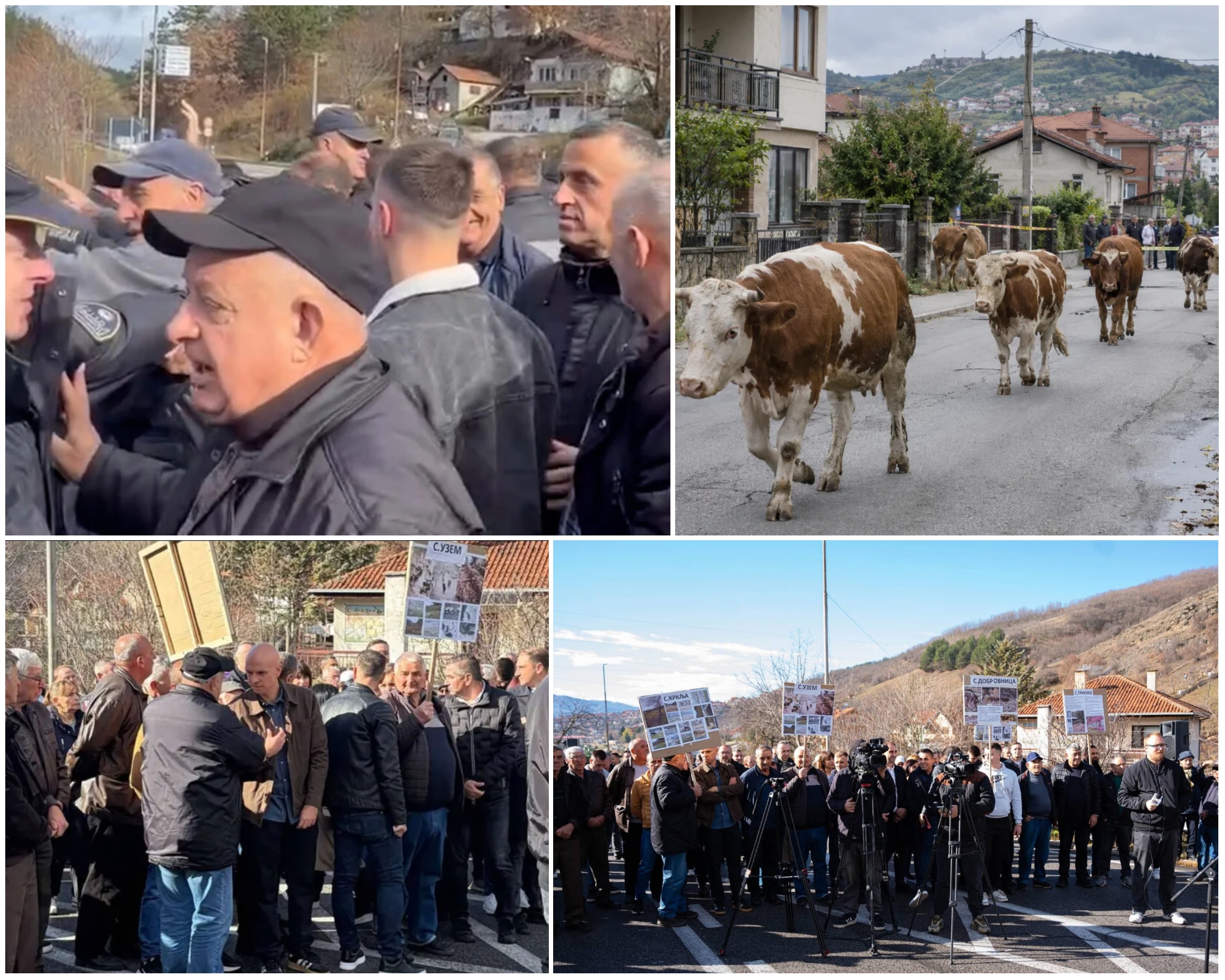
Residents of Kriva Palanka have taken to the streets after years of complaints about free-roaming cattle damaging crops, entering residential areas and threatening public safety. Authorities face mounting pressure to enforce livestock seizure orders dating back to 2024.
KRIVA PALANKA, North Macedonia, Nov. 21, 2026 (BalkanView) — Residents of a northeastern North Macedonian town blocked a major road on Saturday in protest against an estimated 1,000 free-roaming cattle, with scuffles breaking out between demonstrators and police as frustration mounted over years of unsuccessful efforts to resolve the problem.
Protesters in Kriva Palanka, near the Bulgarian border, demanded the immediate enforcement of orders to seize the animals, which residents say have destroyed agricultural crops, damaged private property and created safety risks in streets and residential neighbourhoods.
Police deployed a cordon along the Kriva Palanka–Deve Bair road and St. Joachim of Osogovo Street to secure the demonstration.
Several protesters were involved in pushing and shoving with police officers, although the circumstances of the confrontation remained unclear.
The Interior Ministry said the protest ended without any serious disturbance of public order.
The demonstration marked an escalation of a dispute that has persisted for years, despite administrative decisions ordering the removal of the cattle.
Residents demand action after years of damage
The protest was organised under the slogan “For safety, property protection and enforcement of the law.”
Residents from Kriva Palanka and surrounding villages accused the authorities of failing to protect their homes, farmland and livelihoods.
They say cattle have repeatedly entered agricultural fields, destroyed crops and wandered through populated areas, raising concerns about traffic accidents and the safety of pedestrians.
Local media have also reported cattle entering a schoolyard, prompting additional concerns about children’s safety.
The estimated number of animals has reached approximately 1,000, according to local authorities and reports surrounding the dispute. The figure has not been independently verified through a recent livestock count.
For residents, however, the immediate concern is not the precise number of animals but the continued presence of uncontrolled livestock in public spaces.
The protesters demanded that government agencies implement existing administrative decisions rather than announce further measures that remain unenforced.
Mayor joins protesters and demands enforcement
Kriva Palanka Mayor Sashko Mitovski joined the demonstration, pledging to support residents until the authorities enforce the law and remove the cattle covered by seizure orders.
Mitovski said the relevant administrative decisions had been issued more than two and a half years ago but had still not been implemented.
He has repeatedly called for intervention by national institutions, arguing that the municipality cannot resolve the situation without coordinated government action.
Municipal Council President Mile Trajkovski warned that residents could resort to more disruptive protests unless the authorities take concrete steps.
Opposition lawmakers Ljupcho Nikolovski of the Social Democratic Union (SDSM) and Borislav Krmov of the Left party also attended the demonstration.
The dispute has generated political accusations over institutional responsibility, although no formal finding of wrongdoing has been established.
Why have seizure orders remained unenforced?
The protest followed several weeks of renewed institutional efforts to resolve the livestock problem.
On November 2, Kriva Palanka’s municipal crisis headquarters met to discuss the situation.
The following day, the municipality publicly announced a recommendation that the government declare a 30-day state of crisis over the uncontrolled movement of cattle.
The municipal authorities also called on the Food and Veterinary Agency to prepare an operational plan and enforce final administrative decisions dating from 2024.
On November 18, criminal complaints, a submission to the State Commission for the Prevention of Corruption and a request for extraordinary inspection were filed in connection with the dispute.
The filings do not establish criminal or administrative responsibility, which would require findings by the competent authorities.
The central question remains why previously issued livestock seizure orders have not been carried out.
Government prepares action plan
Representatives of the Agriculture Ministry, other competent institutions and the Kriva Palanka municipality held a coordination meeting on November 19 to discuss a permanent solution.
According to media reports, an action plan has been proposed for consideration at a government session on Tuesday.
The reports did not establish whether the plan would immediately lead to the removal of the animals, how the operation would be organised or where seized livestock would be accommodated.
The authorities must also address veterinary oversight, animal welfare and the practical requirements of handling a potentially large number of cattle.
An association of sheep breeders has reportedly offered to help care for the animals, suggesting that agricultural organisations could play a role in finding a workable solution.
No final arrangement for the cattle’s removal and accommodation has been confirmed.
A local crisis raises questions about institutional accountability
The dispute has attracted widespread media attention because of its unusual scale and the persistence of the problem.
What began as complaints about cattle wandering through streets and farmland has developed into a confrontation over the enforcement of administrative decisions and the responsibilities of national and local institutions.
The municipality has sought emergency intervention, residents have taken to the streets and government agencies have held coordination meetings.
Yet the animals remain at the centre of the dispute.
Saturday’s protest ended without serious public disorder, according to police, but residents have made clear that their demands remain unresolved.
With a government action plan expected to be considered next week, attention is now turning to whether the authorities can move beyond meetings and decisions to the actual removal and management of the cattle.