


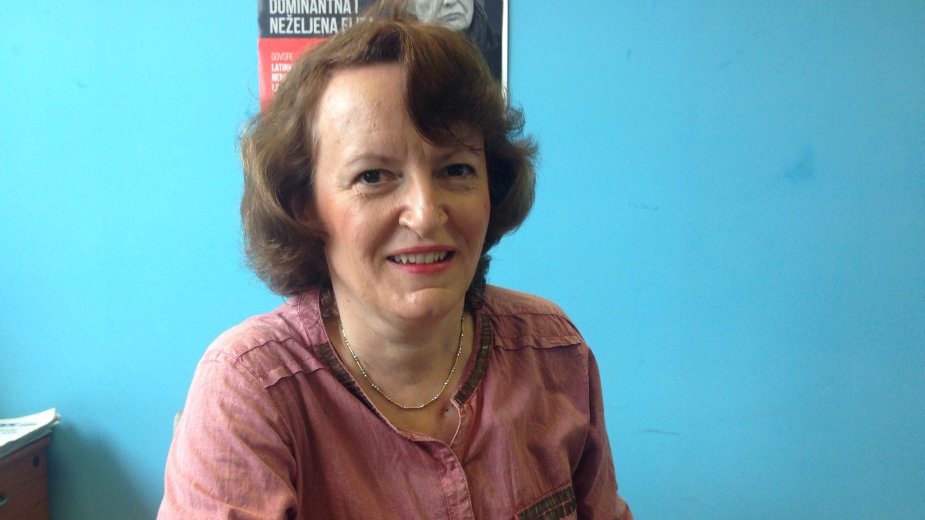
Serbia could become a more democratic, better-governed country after the fall of Aleksandar Vučić’s government, but the transition will be neither quick nor easy, says Safeta Biševac, an editor and columnist at the independent Serbian daily Danas.
In an interview with BalkanView, Biševac discusses the challenges facing Serbia following the Student List’s electoral victory, including efforts to dismantle the political system built during Vučić’s 14 years in power, tackle corruption and organized crime, and restore the rule of law.
She expects the new leadership to adopt a more constructive approach toward neighboring countries, including North Macedonia, and to pursue reforms that could bring Serbia closer to the European Union.
However, Biševac does not anticipate significant changes in Belgrade’s official position on Kosovo or a dramatic shift in Serbia’s relations with Russia and China.
While she hopes the new government will restore democratic institutions and respect for citizens, she warns that Serbia’s economic dependencies and longstanding political positions will limit the scope of its foreign policy changes.
BalkanView: What will Serbia look like after these elections?
Safeta Biševac: I hope it will be a much better and more orderly country. I do not expect changes to come quickly or easily, but I believe there are enough qualified and capable people among the lawmakers who will form the majority in the next Serbian parliament, representing the “Student List – Students Win,” to pull Serbia out of the deep crisis into which Aleksandar Vučić’s previous government brought it.
During his 14 years in power, Vučić boasted that he had strengthened, built and developed Serbia, claiming that we were living in a “golden age” and that we had never lived better.
In reality, he turned the country into an almost complete autocracy, a personal and family fiefdom.
He brought state institutions under his own control and that of his Serbian Progressive Party, while lucrative contracts and the country’s resources were, in practice, handed over to foreign investors and domestic oligarchs.
His propaganda threatened to turn us into a “European North Korea.”
My expectations are actually very modest. I do not expect grand projects or miracles. I simply want a more orderly and civilized country whose government respects its own citizens.
That alone would represent an enormous change compared with the country governed by the former president.
BalkanView: What foreign policy will the new government pursue toward the West and the East?
Safeta Biševac: The priority of the next government, which will be formed by the Student List, will be domestic policy.
Fighting crime and corruption, establishing the rule of law, rebuilding state institutions, particularly the judiciary, improving healthcare and education, and protecting the environment and natural resources will all be priorities.
Foreign policy will not be at the top of the agenda.
This may disappoint some people abroad, but I do not believe there will be dramatic changes, at least not initially.
However, fighting crime and corruption, strengthening the rule of law, democratization and media freedom are all part of the Student List’s program.
If they seriously commit to implementing these objectives, Serbia will move closer to the European Union, potentially allowing accession negotiations, which have almost stalled, to resume.
That would also mean closer relations with the West.
Nevertheless, Serbia cannot afford to turn its back on Russia and China because, quite simply, it is economically dependent on these countries.
I would like the next government to pursue a stronger pro-Western policy, but that is not realistic.
Serbia will not impose sanctions on Russia because we are simply dependent on Russian gas, while the status of the Serbian oil company NIS remains unresolved.
BalkanView: How will Belgrade’s relations with neighboring countries, including North Macedonia, develop?
Safeta Biševac: Aleksandar Vučić managed to put Serbia at odds with almost all its neighbors.
Judging by statements from parliamentary candidates and prominent figures within the Student List, improving relations with neighboring countries will be high on their agenda.
Within Serbia itself, the Student List has brought members of the majority population closer to minority communities and has genuinely encouraged a new, modern form of “brotherhood and unity.”
I therefore hope they will apply the same approach to relations with neighboring countries.
Of course, in the Balkans, occasional disagreements and minor disputes cannot be avoided, but I do not expect Belgrade to become a source of instability.
I believe a clear indication of the direction the future government’s regional policy will take came from the Student List’s leading candidate, Dr. Ilija Srdanović.
He recently told Croatian media that the new government would not exploit unresolved issues or historical grievances for day-to-day political purposes, and that cooperation with the wider world must be built through good relations with neighboring countries.
Attitudes toward North Macedonia and the Macedonian people have traditionally been friendly in Serbia, and the next government will certainly continue that policy.
BalkanView: What will the next Serbian government’s position on Kosovo be?
Safeta Biševac: The Student List adheres to Serbia’s Constitution, which considers Kosovo part of Serbia, and there will almost certainly be no change in that regard.
Academician Radomir Saičić, one of the Student List’s “leaders” — or, more precisely, one of its most prominent figures — who is expected to receive an important position in the next government, has repeated positions similar to those held by Vučić.
According to him, Kosovo is a temporarily occupied territory.
He has criticized agreements signed by the previous government concerning the withdrawal of Serbian institutions, the Serbian dinar, vehicle registration plates and personal identification documents.
However, I do not expect Serbia’s next government to incite unrest or engage in armed conflicts.
They know that such actions would benefit neither Serbia nor Kosovo Serbs.
Moreover, some political representatives of Kosovo Serbs have been linked to organized crime, and their activities will undoubtedly be the subject of future investigations.
Serbia will certainly continue to support Kosovo Serbs, primarily through financial assistance, but not the Serbian List party.
It would be surprising if the next government failed to investigate what happened to the enormous sums of money that official Belgrade sent as assistance to Kosovo Serbs.
How much of that money reached the people it was intended for, and how much may have ended up in the pockets of Serbian List leaders?