


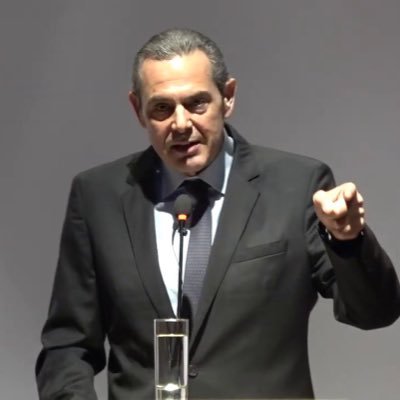
Athens, August 29 (BalkanView) – Former Greek Defence Minister Panos Kammenos has paid tribute to Ratko Mladić following the death of the former Bosnian Serb military commander, calling him a friend and an “Orthodox patriot” and rejecting the description of him as the “Butcher of Bosnia”.
“I bid farewell to my friend General Mladić; he was an Orthodox Patriot, never a ‘butcher’ — he left standing and proud, he never knelt; they took their revenge on him to the very end,” Kammenos said.
The remarks add a Greek dimension to the widening regional controversy over the legacy of Mladić, whose death has triggered sharply contrasting reactions across the Balkans.
Mladić was serving a life sentence after being convicted by the international war crimes tribunal of genocide in Srebrenica, crimes against humanity and war crimes committed during the 1992-1995 war in Bosnia and Herzegovina. His conviction and life sentence were upheld on appeal in 2021.
Kammenos, a nationalist politician who led the Independent Greeks party, served as Greece’s defence minister between 2015 and 2019.
Greek Cypriot critic condemns Kammenos tribute
Kammenos’ remarks also prompted a strongly worded response from Georgios Konstandi, who identified himself as a citizen of Greek Cypriot origin and criticised the former minister for paying tribute to a convicted war criminal.
“Your post, in which you paid tribute to the convicted war criminal Ratko Mladić, not only returns us — all Greeks — to the blood-soaked lands left by the heavy legacy of the 1990s, but reveals to all of Europe that, despite the immense efforts of a portion of its citizens to build a more developed future, Greece still withers in the barbarity of a blind hatred,” Konstandi wrote.
He said that hatred was grounded in what he described as the “lowbrow notion of the ‘clash of civilizations’”.
Konstandi also levelled broader criticism at Athens and Nicosia.
“As long as the Greek and Cypriot governments continue, directly or indirectly, to support the perpetrators of the genocide and other atrocities in Bosnia and Herzegovina, the burden of complicity that my generation must bear grows ever heavier,” he wrote.
That assertion represents Konstandi’s political assessment; the statement provided no evidence establishing current Greek or Cypriot government support for perpetrators of atrocities in Bosnia and Herzegovina.
Mladić’s death revives regional divisions
The exchange illustrates how Mladić’s death has revived arguments extending well beyond Serbia and Bosnia.
Political controversy has already spread across several Balkan countries, with some politicians and public figures praising Mladić or presenting him as a Serbian military hero, while others have condemned such statements as glorification of a convicted war criminal.
The divide is particularly sensitive because Mladić’s responsibility is not merely a matter of competing historical interpretations.
International judges convicted him of genocide for the 1995 Srebrenica massacre, in which more than 8,000 Bosniak men and boys were killed, as well as crimes linked to the siege of Sarajevo and other wartime atrocities.
Kammenos’ description of Mladić as an “Orthodox Patriot” introduces another dimension to the debate by invoking a shared religious identity.
Konstandi’s response challenges precisely that framing, arguing that religious or civilisational solidarity should not override responsibility for crimes established by international courts.
More than three decades after the Bosnian war, the exchange demonstrates that the battle over how its perpetrators are remembered remains politically potent — and is not confined to the states that emerged from Yugoslavia.