


A draft EU budget for 2028–2034 earmarks €30.9 billion for a broad enlargement and European neighbourhood programme, while defence, competitiveness and Ukraine take centre stage. For North Macedonia, Albania, Serbia, Montenegro, Kosovo and Bosnia and Herzegovina, the central question is how much funding will actually reach the region — and under what conditions.
BRUSSELS, Nov. 21 (BalkanView) – The European Union is preparing to negotiate a €1.58 trillion seven-year budget that could reshape its relationship with the Western Balkans, placing greater emphasis on defence, economic competitiveness and geopolitical security while leaving the precise financial allocations for aspiring EU members unresolved.
A 53-page draft of the European Council’s conclusions, prepared ahead of a special summit scheduled for November 26–27, outlines spending priorities for 2028–2034 and signals a potentially significant shift in how Brussels intends to finance enlargement.
The document proposes €30.927 billion for the Enlargement and Europe pillar, part of a wider €142.183 billion Global Europe instrument.
However, the allocation is not reserved exclusively for the Western Balkans. The draft does not specify how much would be available to North Macedonia, Albania, Serbia, Montenegro, Kosovo or Bosnia and Herzegovina.
That distinction is crucial for governments across the region, which rely on European financial assistance to support infrastructure, economic development, institutional reforms and preparations for eventual EU membership.
Where the €1.58 trillion would go
The draft establishes four major spending categories, with the largest share directed towards economic cohesion, agriculture and related policies inside the EU.
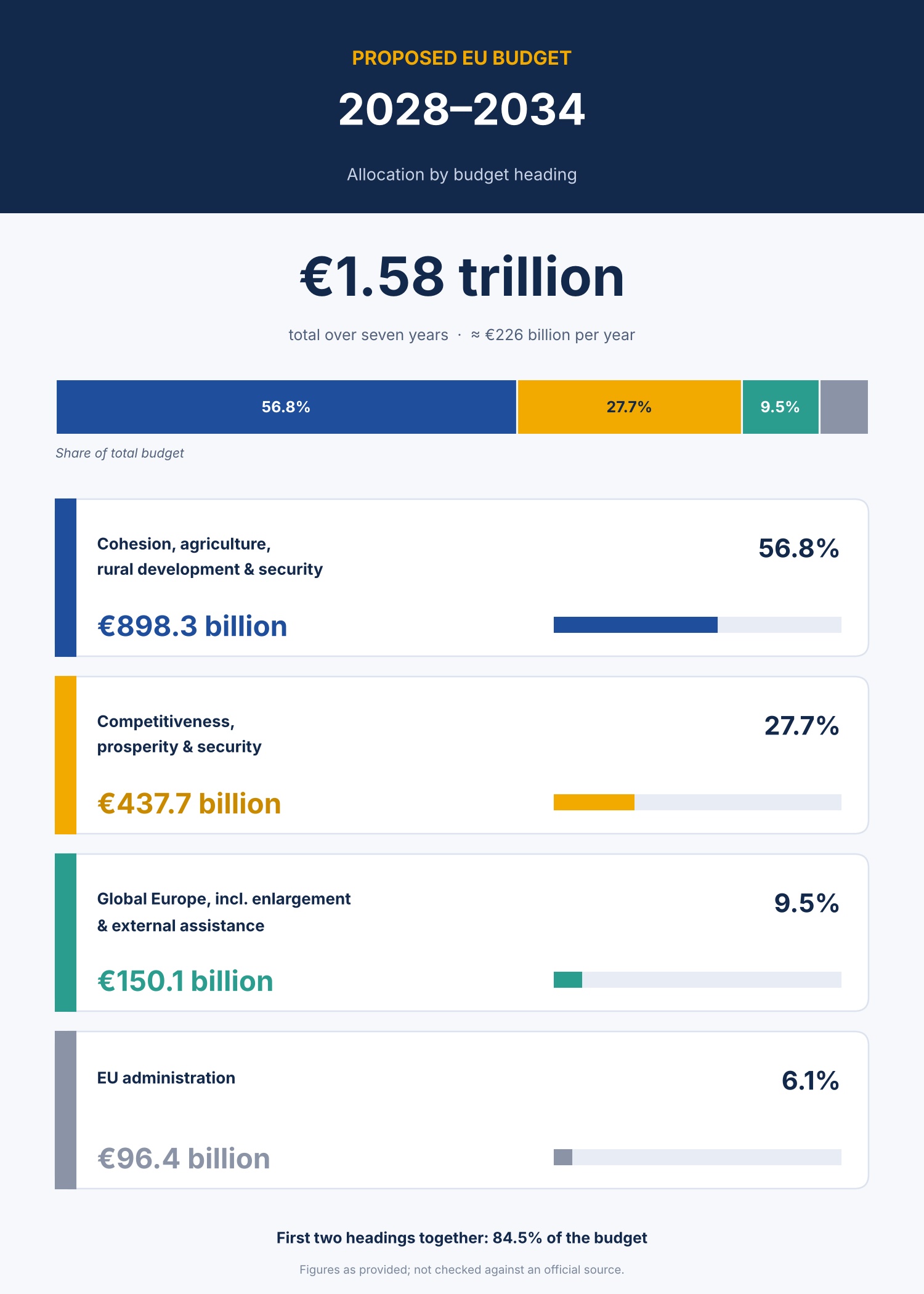
The proposed budget illustrates the scale of the financial difference between EU membership and candidate status.
EU member states would benefit from extensive cohesion and agricultural financing, while Western Balkan countries would continue to depend primarily on external assistance programmes and their eligibility for individual EU initiatives.
For countries such as North Macedonia, where accession has been delayed by political disputes despite years of negotiations and reforms, the distinction has significant economic implications.
€30.9 billion for enlargement — but how much for the Balkans?
The draft’s most relevant provision for the Western Balkans is the €30.927 billion indicative allocation for the Enlargement and Europe pillar.
This funding sits within the Global Europe instrument, which is intended to support candidate and potential candidate countries, neighbourhood policy, development cooperation and other international priorities.
The wider instrument would receive €142.183 billion, distributed across several geographic and thematic pillars.
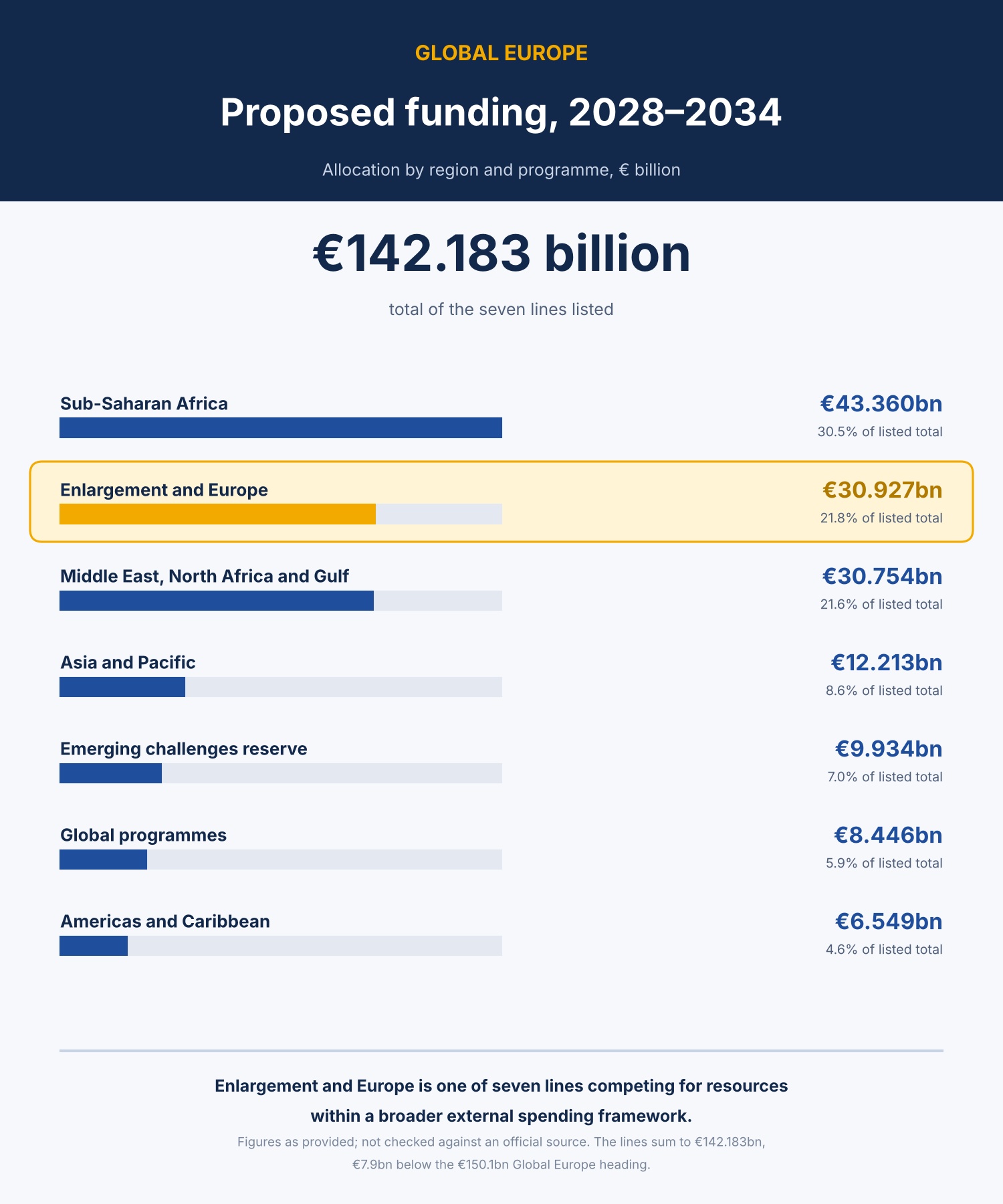
Although €30.9 billion is a substantial allocation, it cannot be interpreted as a dedicated Western Balkans fund.
It also cannot be divided among the six Western Balkan economies to calculate national entitlements, because the draft provides no such distribution.
The unresolved question is whether the eventual financial framework will provide predictable, long-term support for accession reforms or allow resources to shift towards other geopolitical priorities.
North Macedonia: A prolonged accession process carries an economic cost
For North Macedonia, the proposed framework highlights the financial importance of EU membership.
As a candidate country, North Macedonia can receive pre-accession assistance and participate in eligible EU programmes, but it does not have the same access to mainstream cohesion and agricultural funding as member states.
The draft envisages €697.544 billion for National and Regional Partnership Plans within the EU’s principal cohesion and agriculture fund.
Of that amount, at least €195.024 billion would be dedicated to less-developed regions, while at least €261.012 billion would support agricultural incomes.
These provisions concern EU member states, not candidate countries.
The financial implications of delayed accession therefore extend beyond the pace of political integration.
They also concern access to investment instruments designed to reduce regional inequalities, modernise agriculture, support employment and improve infrastructure.
For North Macedonia, the draft raises a fundamental question: will the next EU budget provide stronger financial convergence before accession, or will the gap between member states and candidates remain substantial?
The document does not provide a definitive answer.
Albania and Montenegro: Could faster accession change the financial equation?
The budget proposal also carries implications for Albania and Montenegro, whose accession trajectories could affect their eligibility for EU funding during the 2028–2034 period.
The draft explicitly states that the financial framework would be revised in the event of new EU accessions.
This provision matters because a country joining the EU during the seven-year budget cycle would move into a different financial and institutional relationship with Brussels.
However, the document does not identify which candidate countries might join, when accession could occur or how much additional financing they would receive.
For Albania and Montenegro, the possibility of membership during the next budget period makes the timing of accession potentially consequential.
For North Macedonia, Serbia, Bosnia and Herzegovina and Kosovo, the implications would depend on their individual progress and the EU’s political decisions.
The budget itself does not establish an accession timetable.
Serbia, Kosovo and Bosnia: Reforms and political conditions remain central
The draft proposes a more performance-oriented approach to EU spending.
Within the EU’s internal partnership plans, disbursements would depend on the achievement of milestones, targets or outputs.
For external assistance, the Global Europe instrument would also support policy-based loans to partner countries implementing performance-based plans.
Although these provisions do not establish a uniform funding formula for the Western Balkans, they indicate the importance Brussels attaches to measurable results.
For Serbia, Kosovo and Bosnia and Herzegovina, where political and institutional challenges continue to complicate European integration, the design of future assistance will be especially important.
The document does not specify individual reform conditions for these countries, nor does it announce any new sanctions or funding suspensions.
Nevertheless, its emphasis on performance, financial oversight and strategic priorities suggests that future assistance could be increasingly tied to implementation rather than political commitments alone.
Defence receives billions as enlargement competes for attention
One of the most striking elements of the draft is the prominence of security and defence.
The proposed European Competitiveness Fund would receive €160.963 billion, including €77.855 billion for resilience, security, the defence industry and space.
A further €13.961 billion is envisaged for military mobility within the Connecting Europe Facility.
The draft also provides for a €27.104 billion European Peace Facility, financed outside the main EU budget.
Together, these provisions illustrate the EU’s determination to strengthen its security capabilities.
For the Western Balkans, this shift has two possible implications.
First, the region’s strategic importance could increase as the EU seeks stronger transport connections, energy security, resilient infrastructure and defence cooperation.
Second, enlargement financing may face greater political competition from defence and other strategic priorities.
The draft does not establish that Western Balkan countries would automatically qualify for these defence funds. Participation would depend on the specific programme rules and, in some cases, separate agreements.
Ukraine receives a separate financial commitment
Ukraine occupies a prominent position in the proposed financial framework.
The draft establishes a Ukraine Reserve of up to €88.869 billion for 2028–2034, intended to support accession preparations and longer-term reconstruction through financial assistance and loan-related mechanisms.
This reserve would operate through arrangements distinct from the main Global Europe allocation.
The document also allows additional support for Ukraine from certain external spending programmes while calling for predictable assistance to other partners.
For Western Balkan governments, the significance is not that Ukraine’s reserve is directly deducted from their allocation.
Rather, the proposal shows that the EU is organising its next budget around multiple enlargement, reconstruction and security commitments.
The challenge for the Western Balkans will be to ensure that their accession-related needs remain visible within those competing priorities.
Research, education and media: Opportunities beyond enlargement funding
Not all potential opportunities for the Western Balkans fall within the enlargement pillar.
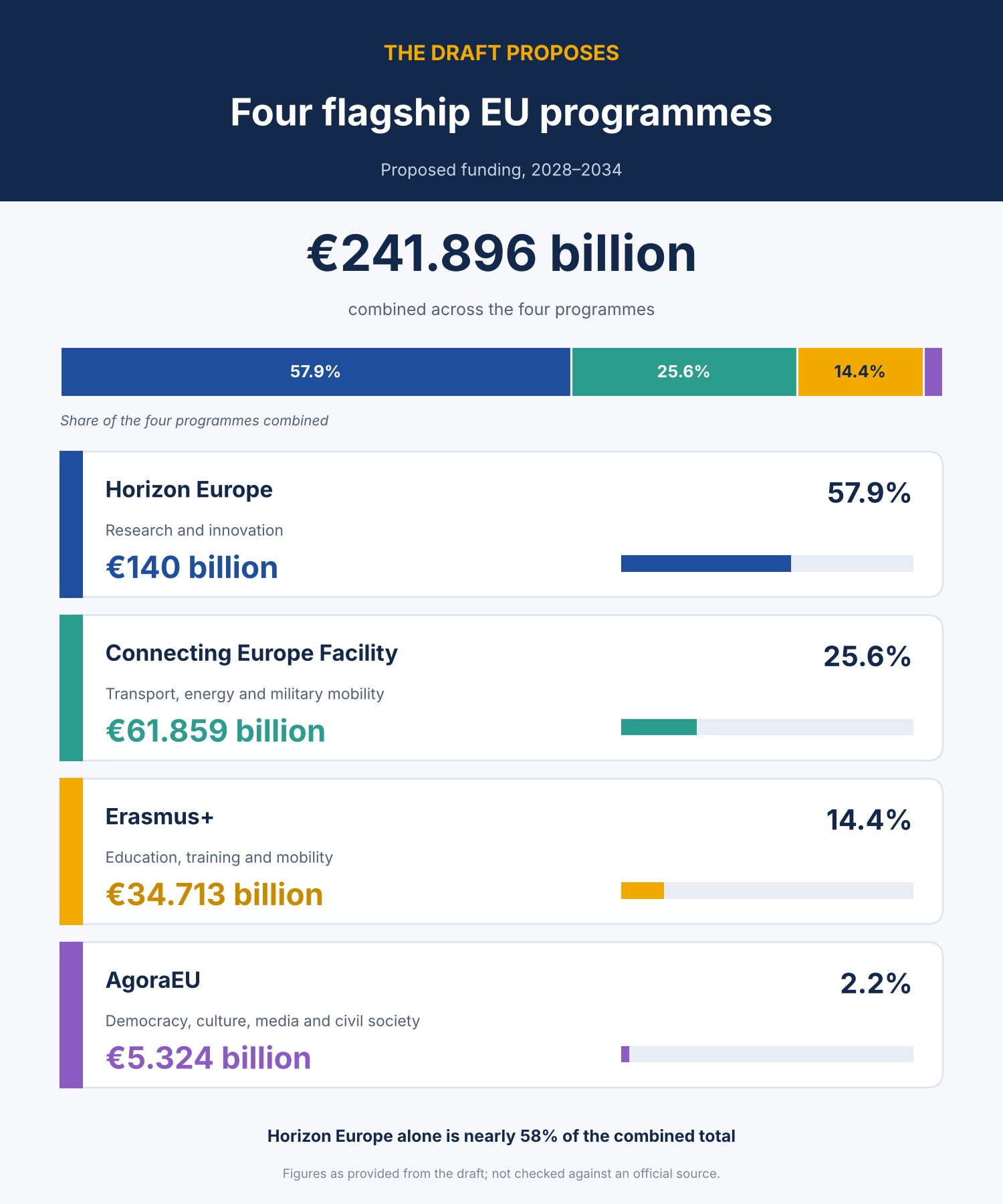
These programmes could be relevant to universities, research institutions, civil society organisations, independent media and businesses in the Western Balkans, depending on their eventual participation and eligibility arrangements.
For North Macedonia and other regional economies, access to research partnerships and educational mobility could help address structural weaknesses in innovation, skills and institutional capacity.
The proposed AgoraEU programme is particularly relevant to media freedom, democratic participation and civil society.
However, the €5.324 billion figure covers several policy areas and should not be presented as a dedicated fund for journalism or Western Balkan organisations.
The document does not provide country-level allocations for these programmes.
A proposed digital tax could reshape Europe’s technology economy
The draft also contains a significant proposal for financing the EU budget.
It calls for a new revenue source based on an annual contribution equivalent to 3% of the net turnover generated from certain digital activities by large companies.
The measure would apply to companies exceeding both an EU annual digital turnover threshold of €50 million and a global annual turnover threshold of €750 million.
The activities covered would include online advertising, online marketplaces and the monetisation of user data.
The proposal could have implications for major technology platforms operating across Europe, including those serving Western Balkan markets.
But the document does not establish that the tax would apply directly to advertising revenue generated in non-EU Western Balkan countries.
That would depend on the eventual legislation and its territorial scope.
The European Council draft calls for agreement on the relevant directive in 2027, meaning the measure remains subject to legislative negotiations.
The political test: Will enlargement remain a strategic priority?
The proposed financial framework reflects a European Union confronting several simultaneous challenges: military security, industrial competitiveness, migration, climate change, agricultural pressures and support for Ukraine.
Enlargement remains part of the EU’s external strategy, but the Western Balkans do not receive a clearly identified regional allocation in the draft conclusions.
For governments in Skopje, Tirana, Belgrade, Podgorica, Pristina and Sarajevo, this creates three immediate priorities: securing predictable financial assistance, improving access to EU programmes and demonstrating progress on reforms that could influence future funding.
The draft also reveals a broader structural reality.
While EU members would continue to benefit from extensive internal investment and agricultural programmes, candidate countries would remain dependent on separate instruments until accession changes their status.
For North Macedonia, this distinction is particularly significant after years of political obstacles to membership.
For Albania and Montenegro, the possibility of joining during the next budget cycle could make the financial consequences of accession more immediate.
For the region as a whole, the negotiations will test whether the EU’s declared commitment to enlargement is matched by sufficiently predictable financial resources.
The special European Council meeting on November 26–27 will discuss draft conclusions, but their appearance on the negotiating agenda does not mean that the next seven-year budget has been approved.