



WB, Nov. 22 (Balkan View) – Albania and North Macedonia inaugurated a joint border control system on Sunday, marking a step towards closer regional integration, while territorial disputes, political instability and demands for institutional accountability continued to challenge countries across Southeast Europe.
Albanian Prime Minister Edi Rama and North Macedonian Prime Minister Hristijan Mickoski opened a new integrated checkpoint at Qafë Thanë/Kjafasan, designed to reduce border waiting times, facilitate trade and strengthen connectivity along the strategically important Corridor VIII.
Meanwhile, Montenegro faced growing pressure to clarify its territorial dispute with Croatia, thousands demonstrated in Zagreb over the death of a psychiatric hospital patient, and Serbia’s competition watchdog reopened its examination of a major acquisition involving independent media outlets.
Elsewhere, Greece and Israel are discussing additional military agreements, Bosnia and Herzegovina is experiencing fresh political developments in Republika Srpska, and Bulgaria is seeking closer economic relations with Saudi Arabia.
ALBANIA AND NORTH MACEDONIA: Rama and Mickoski Open Joint Border Checkpoint, Promising Faster Travel
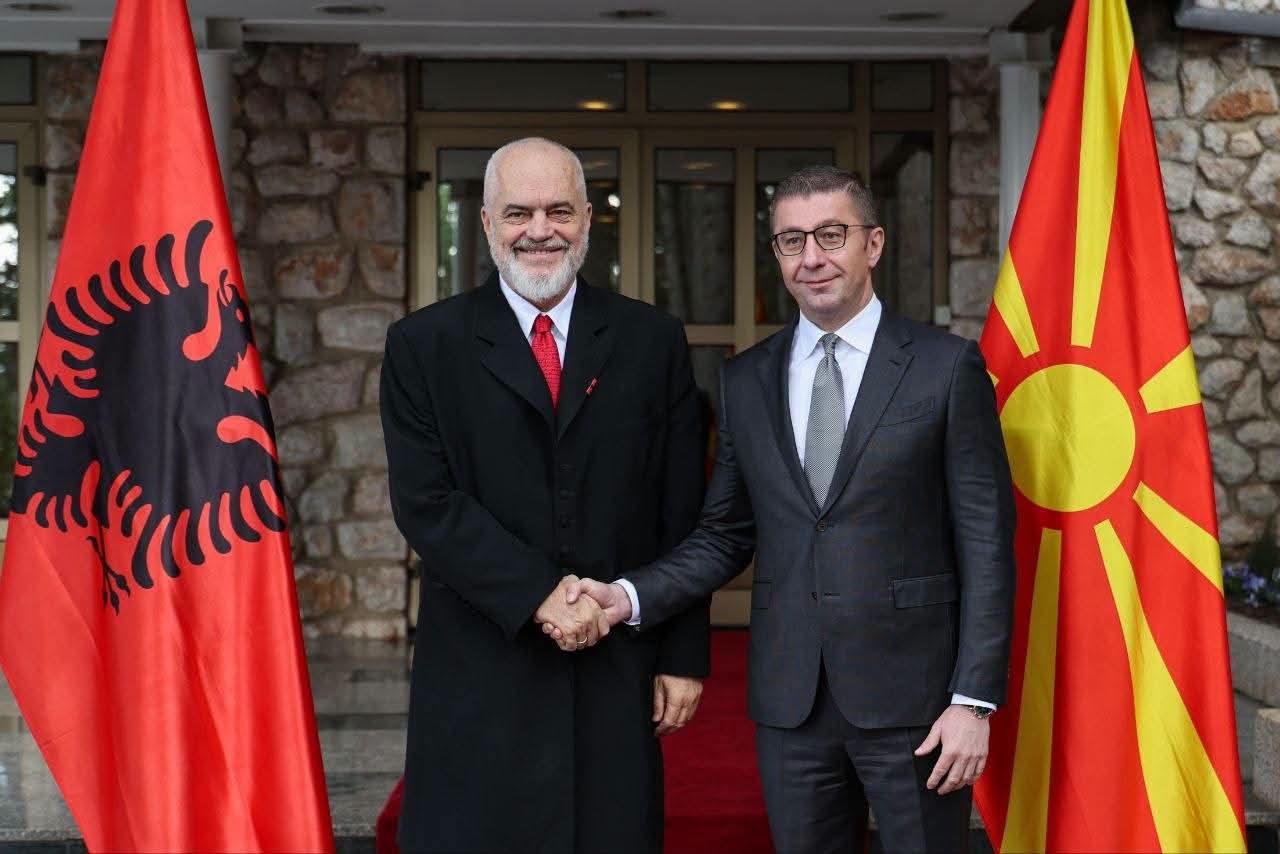
Albanian Prime Minister Edi Rama and North Macedonian Prime Minister Hristijan Mickoski inaugurated a joint border control system at Qafë Thanë/Kjafasan on Sunday, introducing a simplified procedure intended to accelerate the movement of passengers and goods between the two countries.
The system, known as the One Stop Shop, allows border authorities from both countries to coordinate checks at a single location, reducing duplicated procedures and potentially shortening waiting times.
The initiative forms part of regional efforts to improve economic connectivity and facilitate the movement of people and goods ahead of further European integration.
Speaking at the ceremony, Rama described the agreement as a practical improvement for millions of travellers and said the longer-term objective should be the elimination of border controls between countries pursuing EU membership.
Mickoski said the arrangement would strengthen economic, tourism and social ties, particularly around Lake Ohrid and the wider cross-border region.
Both leaders also emphasised the importance of Corridor VIII, a transport route connecting Albania, North Macedonia and Bulgaria that has acquired growing strategic importance for the European Union and NATO.
The inauguration coincided with Albanian Alphabet Day, celebrated on November 22, adding symbolic significance to the bilateral meeting.
Ahmeti Meets Rama as Albanian Leaders Discuss EU Integration and Regional Cooperation
Ali Ahmeti, leader of North Macedonia’s opposition Democratic Union for Integration (DUI), met Albanian Prime Minister Edi Rama on Sunday to discuss regional cooperation, European integration and issues of common interest.
The meeting took place in Struga on Albanian Alphabet Day, a holiday commemorating the standardisation of the Albanian alphabet at the 1908 Congress of Manastir.
Ahmeti said discussions addressed cooperation between Albania and North Macedonia, the European integration process and broader political developments affecting Albanians in the region.
The meeting also came against the backdrop of continuing debates over implementation of the Ohrid Framework Agreement and North Macedonia’s stalled progress towards EU membership.
Albania’s ‘Grandmother of the Revolution’ Becomes Symbol of Anti-Government Protests
An elderly woman participating in anti-government demonstrations in Tirana has attracted widespread attention after footage showed her approaching a line of riot police and placing stickers reading “Rama, leave” on officers’ shields.
The images circulated widely on social media and were reported by regional news outlets, with protesters describing the woman as the “grandmother of the revolution.”
Her participation has become a recognisable feature of demonstrations demanding political accountability and government change.
The protests have included criticism of Prime Minister Edi Rama’s administration, with demonstrators accusing the government of failing to address their concerns.
The woman’s actions have drawn attention to the participation of older citizens in Albania’s political demonstrations.
NORTH MACEDONIA: Opposition Warns Pension Changes Could Threaten Retirement Savings
North Macedonia’s opposition Social Democratic Union (SDSM) has accused the government of preparing legislative changes that could undermine the country’s second-pillar pension system.
The party said proposed amendments to the Law on Pension and Disability Insurance would remove a provision specifying the transfer of 6% of pension contributions into mandatory privately managed pension funds.
SDSM warned that deleting the provision without an alternative legal arrangement could redirect contributions towards the state pension fund and create uncertainty for future retirees.
The opposition also alleged that approximately €50 million in contributions had not been transferred to second-pillar funds in recent months.
SDSM called on Prime Minister Hristijan Mickoski to explain the proposed changes and clarify their possible impact on pension savings.
The allegations and their financial implications have not been independently established. The proposed amendments do not, by themselves, confirm that existing pension savings will be confiscated or that mandatory private pension accounts will be abolished.
The dispute has brought renewed attention to the long-term sustainability of North Macedonia’s pension system.
MONTENEGRO: Croatia Border Dispute Raises New Questions Over EU Accession
Montenegro’s civic coalition Stega – European Club 28 has called on the government to clarify which section of its land border with Croatia it considers disputed and identify the legal documents supporting its position.
The demand comes amid renewed disagreements between Podgorica and Zagreb over border delimitation, including questions connected to the Prevlaka peninsula at the entrance to the Bay of Kotor.
The coalition criticised what it described as vague and confrontational political statements, arguing that unresolved territorial questions should be addressed through international law, documentation and negotiations.
Montenegro and Croatia have operated under a provisional border arrangement established in 2002, but the agreement has not produced a permanent settlement.
Croatian officials have signalled that unresolved bilateral issues could affect Montenegro’s progress towards EU membership.
As an existing EU member, Croatia participates in decisions requiring unanimous approval during Montenegro’s accession process.
The dispute has therefore gained significance as Montenegro seeks to complete the remaining stages of its membership negotiations.
CROATIA: Thousands Protest Psychiatric Hospital Death, Demand Accountability
Thousands of demonstrators gathered in Zagreb over the weekend to demand accountability following the death of 32-year-old Kristian Josip Periš at a psychiatric hospital.
Protesters assembled in the Croatian capital on Saturday evening, calling for an investigation into the circumstances of his death and stronger safeguards for patients receiving psychiatric treatment.
The case has generated public anger following the emergence of disturbing footage reportedly showing the patient’s treatment while restrained by hospital personnel.
Demonstrators carried symbolic white pillows and demanded greater transparency, improved oversight and changes to procedures governing the use of restraint in psychiatric institutions.
The protests have placed renewed scrutiny on Croatia’s healthcare system and the responsibility of medical institutions to protect vulnerable patients.
The gathering was among the most prominent public demonstrations in Croatia over healthcare accountability in recent weeks.
SERBIA: Competition Watchdog Reopens Review of Independent Media Takeover
Serbia’s Commission for the Protection of Competition has reopened its examination of a proposed acquisition involving Adria News, the media group associated with several prominent independent news outlets.
The transaction concerns European Future Media Investments, a fund linked to Portugal’s Alpac Capital, and media brands including N1, Nova, Danas and Radar.
The commission had previously approved the transaction in June but has now suspended implementation of that decision while it re-examines the case in light of new information.
The European Democratic Party welcomed the move, describing it as an important development for media pluralism and independent journalism in Serbia.
The proposed ownership changes have attracted attention because the affected outlets include some of the country’s most prominent sources of independent reporting and government scrutiny.
The renewed examination does not establish wrongdoing by the companies involved. Regulators must determine whether the transaction complies with applicable competition rules.
The case comes amid broader concerns about media ownership, editorial independence and the concentration of influence in Serbia’s information market.
GREECE: Athens and Israel Discuss New Defence Agreements Worth Up to €1 Billion
Greece and Israel are holding advanced discussions on additional defence agreements potentially worth up to €1 billion, according to Greek and Israeli media reports.
The negotiations reportedly involve electronic warfare equipment, long-range missile systems and possible expansion of the International Flight Training Centre at Kalamata Air Base in southern Greece.
The training facility is operated by Israeli defence company Elbit Systems under a long-term agreement signed in 2021.
The latest discussions follow an approximately €3 billion agreement signed in August for the development of Greece’s multilayered Achilles Shield air defence system.
Athens has been modernising its military capabilities amid security concerns in the eastern Mediterranean.
The negotiations reflect the expanding strategic relationship between Greece and Israel, particularly in defence technology, military aviation and regional security cooperation.
No final agreement on the additional procurement package has been announced.
Greek Police Foil Alleged School Shooting Plot by 14-Year-Old
Greek police have prevented an alleged school shooting plot involving a 14-year-old student who investigators say had planned to attack classmates after experiencing bullying.
Authorities detained the teenager after discovering indications that he had been researching school shootings and considering an armed attack.
Investigators are examining the circumstances surrounding the alleged plan, including the teenager’s online activity and access to weapons.
Police have not identified evidence linking the case to terrorism or ideological extremism.
The incident has prompted renewed concern about bullying, school safety and the identification of threats involving minors.
BOSNIA AND HERZEGOVINA: Constitutional Court Rejects Restrictions on Wartime Army Insignia
Bosnia and Herzegovina’s Constitutional Court has ruled that authorities in Republika Srpska cannot prohibit the display of insignia associated with the wartime Army of the Republic of Bosnia and Herzegovina.
The ruling addresses the legal status of symbols originating from the country’s wartime institutions and their continued recognition under Bosnia’s constitutional framework.
The court referred to constitutional continuity provisions governing the legal status of the Republic of Bosnia and Herzegovina and its institutions.
The decision comes amid continuing disagreements over historical interpretation, wartime symbols and the division of authority between Bosnia’s state institutions and its two entities.
Questions surrounding symbols and historical memory remain politically sensitive more than three decades after the Bosnian war.
Branko Blanuša Resigns as SDS Leader Amid Internal Party Divisions
Branko Blanuša has resigned as president of the Serb Democratic Party (SDS), one of the principal opposition parties in Bosnia’s Republika Srpska entity.
Blanuša cited persistent internal disagreements, disputes among party officials and difficulties implementing decisions taken by party bodies.
His departure creates a leadership vacancy at a time of political uncertainty in Republika Srpska.
The SDS has been seeking to strengthen its opposition role against the Alliance of Independent Social Democrats (SNSD), the party associated with Milorad Dodik.
The resignation is expected to prompt internal consultations over the party’s future leadership and political direction.
Republika Srpska Continues Consultations on Formation of New Government
Political consultations continued in Banja Luka on Sunday over the selection of a prime minister-designate to form a new government in Republika Srpska.
Entity President Savo Minić held meetings with representatives of political parties as part of the constitutional process for nominating a candidate.
The consultations follow political developments involving the SNSD and its partners, which are seeking to establish the composition of the next entity government.
The selection of a prime minister-designate requires formal nomination and subsequent consideration by the Republika Srpska National Assembly.
The process is taking place against the backdrop of continuing disputes over political authority and relations between the entity and Bosnia’s state institutions.
BULGARIA: Radev Seeks Saudi Investment as Sofia and Riyadh Explore Direct Flights
Bulgarian Prime Minister Rumen Radev has highlighted Saudi Arabia as a potential strategic investment partner during talks in Riyadh.
Radev met Saudi Crown Prince and Prime Minister Mohammed bin Salman as Bulgaria sought to strengthen economic cooperation and attract investment in infrastructure, energy and technology.
Bulgarian officials also discussed the possibility of establishing direct flights between Sofia and Riyadh.
Transport cooperation and potential connections between Middle Eastern and European logistics networks were among the subjects raised during bilateral discussions.
The Bulgarian government views cooperation with Saudi Arabia as an opportunity to diversify investment sources and improve the country’s international economic connectivity.
No confirmed launch date for direct flights has been announced.
Bulgarian Orthodox Church Mourns Death of Metropolitan Gavriil
Metropolitan Gavriil of Lovech, a senior member of the Bulgarian Orthodox Church, died on Sunday at the age of 76 following a brief illness.
He had led the Lovech diocese for more than 25 years and was a prominent figure in the church’s senior leadership.
The Holy Synod announced his death, while the municipality of Lovech declared three days of mourning.
Church authorities are preparing funeral and memorial arrangements, with religious ceremonies expected to begin on Monday.
His death leaves a vacancy in the leadership of the Lovech diocese.
Bulgaria Issues Orange Weather Warning Ahead of Strong Winds
Bulgarian meteorological authorities issued a Code Orange warning for several districts ahead of strong winds forecast for Monday, November 23.
The National Institute of Meteorology and Hydrology warned of potentially hazardous conditions that could affect transport, infrastructure and outdoor activities.
Residents in affected areas have been advised to follow official weather forecasts and exercise caution.
The warning comes as Bulgaria prepares for a period of unsettled weather across parts of the country.