


Serbia’s growing arms procurement and rising defence spending are raising concerns among security experts about a potential “miscalculation” that could destabilise the Western Balkans, according to analysts and regional officials.
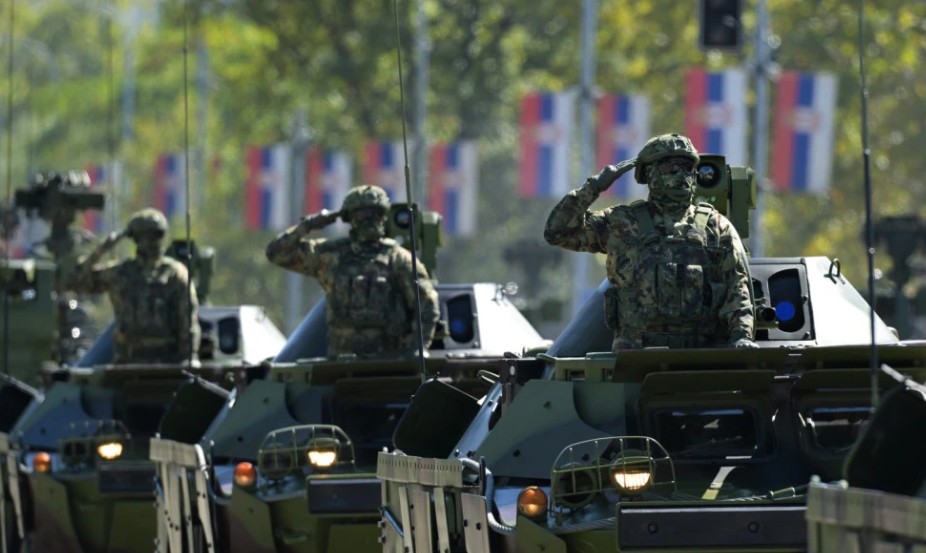
Although it formally declares military neutrality, Serbia has become the highest defence spender in the Western Balkans and is rapidly modernising its armed forces with equipment sourced from both East and West, including China, Russia, the United States and France.
President Aleksandar Vučić has publicly confirmed that Serbia has integrated Chinese-made weaponry into its air force, including CM-400AKG air-to-surface missiles deployed on Russian-made MiG-29 fighter jets, a combination he has described as enhancing strike capabilities.
Regional reactions have been sharp. Croatia, a NATO and EU member state, has described Serbia’s procurement of Chinese missile systems as a destabilising factor and evidence of an emerging arms race in the Balkans. Kosovo has also accused Belgrade of hegemonic ambitions toward its neighbours.
In March 2025, Croatia, Albania and Kosovo signed a defence cooperation agreement, which President Vučić has characterised as a direct security threat to Serbia, alleging without evidence that the pact is aimed against Belgrade.
“They are not preparing to defend, but to attack,” Vučić said in a statement broadcast by Serbian state media, again without providing evidence. The governments in Zagreb, Pristina and Tirana have repeatedly rejected such claims.
Security experts say the rhetoric and military build-up are increasing mutual perceptions of threat in a region still shaped by the legacy of the 1990s wars.
“The acquisition of long-range strike capabilities changes the perception of the balance of power and increases the risk of escalation through misinterpretation,” said for RFE/RL Redion Qirjazi, a security analyst, adding that the region could enter a “security spiral” in which each move triggers countermeasures.
Serbia spent about $2.2 billion on defence in 2024, according to the Stockholm International Peace Research Institute (SIPRI), significantly more than regional NATO members Albania and Croatia.
Vučić has repeatedly compared Serbia’s military modernisation with Croatia’s acquisition of Rafale fighter jets from France, framing the developments as part of a regional power balance rather than an arms race.
Analysts say Serbia’s strategy reflects a broader effort to maintain strategic flexibility by engaging with both Western and non-Western partners. Following Russia’s invasion of Ukraine, Belgrade expanded procurement from China, including air defence systems and drones, while continuing to purchase Western equipment.
Experts warn that the combination of political rhetoric, military modernisation and unresolved bilateral disputes — particularly between Serbia and Kosovo — increases the risk of unintended escalation.
“Even without a deliberate intent for conflict, miscalculation becomes more likely when trust is low and military capabilities are rapidly changing,” said Katarina Gjokiq, a researcher at SIPRI.
She added that political narratives framing neighbouring states as threats contribute to public anxiety and reduce space for regional dialogue mechanisms.
The European Union has urged Serbia to align its security policy with its EU accession path, while NATO has continued limited cooperation with Belgrade despite its military ties with China.
Meanwhile, Serbia continues to position itself as a multi-vector security actor, maintaining cooperation with both NATO and China, a strategy analysts say increases its diplomatic leverage but also complicates regional security dynamics.
The Western Balkans remain one of Europe’s most sensitive security environments, where analysts warn that even small incidents could escalate rapidly if misread by political or military actors.