


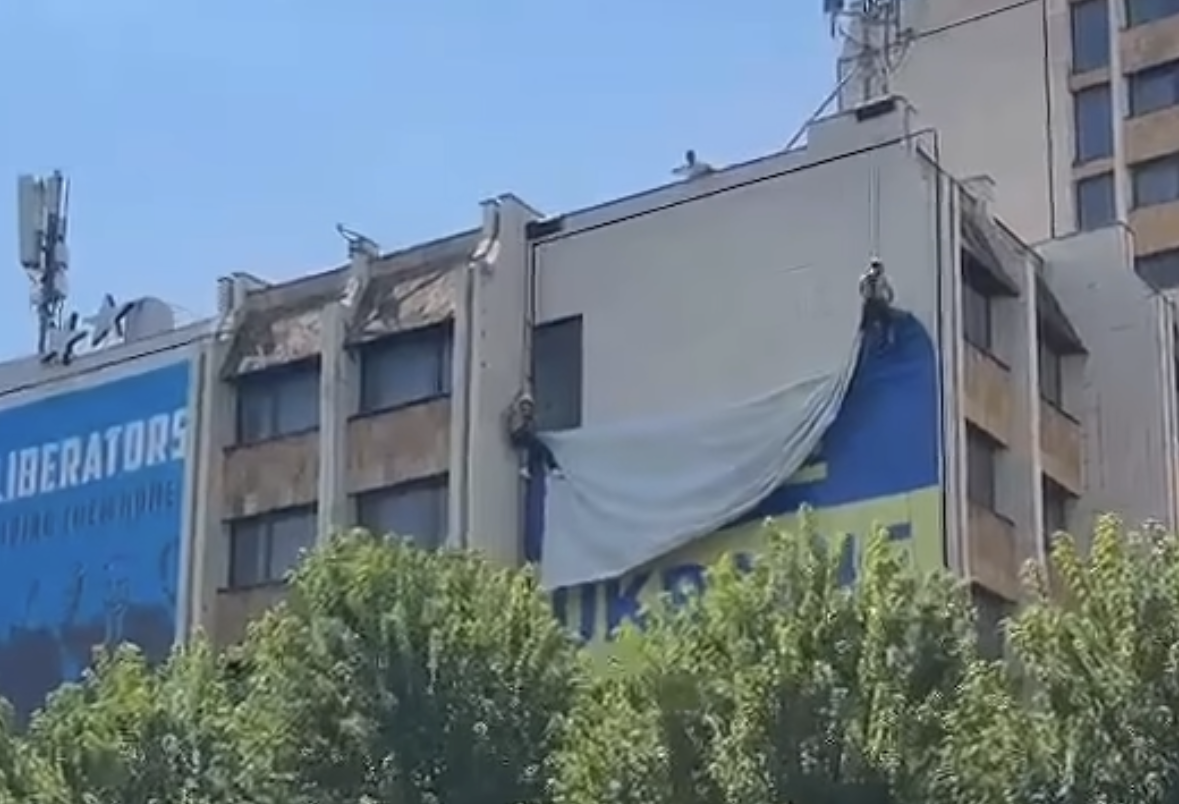
PRISTINA/TIRANA, Aug 9 (Balkan View) – Pristina authorities removed a Ukrainian flag displayed in Kosovo’s capital in solidarity with Kyiv after Ukrainian President Volodymyr Zelenskyy reaffirmed that his country would not recognise Kosovo’s independence, while Albania said comparisons between Kosovo and other territorial disputes were “wrong” and “opportunistic”.
The flag, bearing the words “Free Ukraine”, had been displayed in central Pristina following Russia’s full-scale invasion of Ukraine as a symbol of Kosovo’s support for the Ukrainian people.
Pristina Mayor Përparim Rama said the flag was removed after Zelenskyy’s comments in Belgrade on Saturday.
“The state of Kosovo must be respected. When Kosovo is not respected, the capital, Pristina, always responds in the same way,” Rama said in a social media post.
Rama said Kosovo’s people would continue to sympathise with populations facing war, violence and persecution because they understood what it meant to fight for “freedom, dignity and the right to exist as a state”.
“But no cause and no policy can be built by belittling Kosovo’s statehood and the sacrifice of its people,” he added.
Zelenskyy backs Serbia’s territorial integrity
During his first official visit to Serbia, Zelenskyy said on Saturday that Kyiv had not changed its policy of non-recognition of Kosovo.
“We respect the territorial integrity of our partners and international law. Regarding Kosovo, our position remains unchanged,” Zelenskyy said at a news conference in Belgrade alongside Serbian President Aleksandar Vučić.
He also thanked Serbia for respecting Ukraine’s territorial integrity, including Crimea, which Russia annexed in 2014.
Ukraine does not recognise Kosovo, which declared independence from Serbia in 2008.
Kosovo, however, has aligned itself with European Union and U.S. sanctions against Russia following Moscow’s invasion of Ukraine and has hosted Ukrainian journalists displaced by the war.
Albania: Kosovo cannot be equated with other cases
Albania’s Foreign Ministry responded on Sunday, saying attempts to draw parallels between Kosovo and other international territorial disputes were fundamentally flawed.
“There should be no misunderstanding on this point: any attempt to draw parallels or equate Kosovo with any other international situation is wrong, opportunistic and entirely inaccurate,” the ministry said.
Tirana pointed to the International Court of Justice’s 2010 advisory opinion on Kosovo’s declaration of independence.
At the request of the U.N. General Assembly, the court concluded that Kosovo’s declaration of independence did not violate international law, the ministry said.
Albania argued that Russia’s invasion of Ukraine represented a fundamentally different case, describing it as a serious violation of the U.N. Charter and international law.
According to Tirana, peace in the Western Balkans and the region’s European future require acceptance of what it called the “irreversible reality of Kosovo’s independence”.
“Kosovo’s independence has contributed to regional stability and is part of a future in which borders are not changed through force and peoples and communities can determine their future in peace and security,” the ministry said.
Tirana still backs Ukraine
Despite its criticism of Zelenskyy’s position, Albania reaffirmed its support for Ukraine’s sovereignty and territorial integrity.
Tirana also acknowledged that Zelenskyy’s visit to Serbia was primarily intended to advance Ukraine’s national interests and said efforts that help move Serbia away from Russian influence and closer to Europe should be viewed positively.
The dispute highlights a diplomatic contradiction created by the Ukraine war in the Western Balkans.
Kosovo has been among Ukraine’s firm regional supporters despite Kyiv refusing to recognise its statehood. Serbia, meanwhile, supports Ukraine’s territorial integrity but has maintained close relations with Moscow and refused to join Western sanctions against Russia.
Serbia also continues to reject Kosovo’s independence. Belgrade and Pristina have been engaged in EU-mediated talks aimed at normalising relations since 2011.