


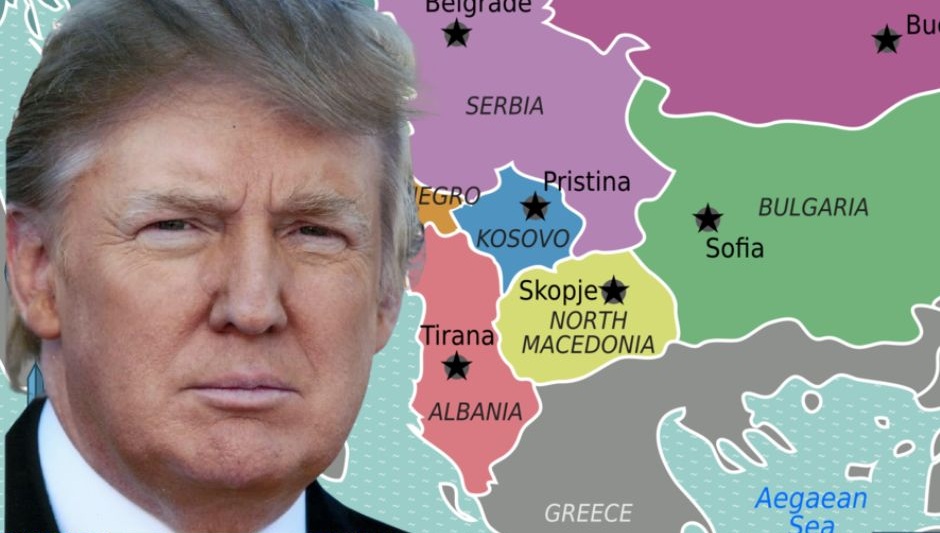
Donald Trump’s nominees for U.S. ambassador to Bosnia and Serbia have outlined a Western Balkans strategy built around four priorities: defending Bosnia’s territorial integrity, drawing Serbia away from Russia and China, pushing Belgrade and Pristina towards normalisation and opening more space for American energy, defence and commercial interests.
WASHINGTON, Sept 17 (BalkanView) – The United States will seek to curb Russian and Chinese influence in the Western Balkans while strengthening economic and security ties with Bosnia and Serbia, President Donald Trump’s nominees for ambassador to the two countries told senators on Thursday.
Ronald Johnson, nominated to become U.S. ambassador to Bosnia and Herzegovina, and Michael Young, Trump’s choice for Serbia, appeared before the Senate Foreign Relations Committee as Washington reassesses its engagement in a region still marked by unresolved disputes from the wars of the 1990s and increasingly exposed to geopolitical competition.
Both candidates stressed stability and economic cooperation, but their testimony also provided a clearer picture of how Washington views the two countries.
For Bosnia, the message was continued support for sovereignty, territorial integrity and the Dayton peace settlement, coupled with greater responsibility for the country’s own political leaders.
For Serbia, Washington wants deeper security and commercial cooperation while reducing Belgrade’s dependence on Russia, particularly in energy, and limiting China’s growing influence.
Young also pledged to encourage progress towards normalisation between Serbia and Kosovo.
Johnson: Bosnia must increasingly stand on its own
Johnson, a retired U.S. Marine Corps brigadier general, said Washington remained committed to a stable, secure and prosperous Bosnia and Herzegovina.
That commitment includes the country’s sovereignty and territorial integrity and the peace established by the Dayton agreement, which ended the 1992-95 Bosnian war.
But Johnson also signalled that, more than three decades after Dayton, Washington expects Bosnian institutions and political leaders to assume greater responsibility.
“The future of Bosnia and Herzegovina should increasingly depend on its own leaders and institutions,” he told senators.
The United States could continue acting as a partner and facilitator, he said, while helping create conditions for lasting peace and prosperity.
The message echoes a broader shift recently outlined by U.S. officials towards greater local ownership in the Western Balkans rather than indefinite externally driven state-building.
Johnson said responsible governance was particularly important ahead of Bosnia’s Oct. 4 general election.
Srebrenica: an unequivocal answer
One of the most politically significant exchanges came when Democratic Senator Jeanne Shaheen asked Johnson directly whether the 1995 Srebrenica massacre constituted genocide.
Johnson was unequivocal.
Srebrenica “was a genocide,” he said, referring to the findings of international courts.
Young gave the same answer when questioned about the issue, describing the genocide designation as a historical and legal fact.
Their responses are significant because Srebrenica and the glorification of convicted war criminals remain highly contentious issues in the region.
More than 8,000 Bosniak men and boys were killed after Bosnian Serb forces captured the United Nations-declared safe area of Srebrenica in July 1995. International courts have established that the killings constituted genocide.
Shaheen told the hearing that genocide denial and the glorification of convicted war criminals continued to deepen ethnic divisions in Bosnia, while Russia sought to exploit those divisions.
Dodik remains on Washington’s radar
Johnson was also pressed about Milorad Dodik, the leader of the dominant Bosnian Serb political party and former president of Republika Srpska.
Shaheen raised concerns over Dodik’s separatist rhetoric and asked how Johnson would respond to actions threatening Bosnia’s stability.
Johnson said he would closely follow developments and be prepared to recommend action to Washington in response to destabilising activities.
The exchange comes amid a debate in Washington over the Trump administration’s approach to Dodik.
Democrats have criticised the administration for lifting sanctions on him, arguing that the move weakened American leverage.
Shaheen used Thursday’s hearing to reiterate those concerns, saying political leaders continued to challenge Bosnia’s sovereignty, territorial integrity and state institutions.
Republican committee chairman Jim Risch also described support for a “strong, free, and united Bosnia” as a U.S. policy priority and called for efforts to counter Russian influence while strengthening the rule of law.
The bipartisan emphasis suggests that support for Bosnia’s territorial integrity remains a core point of U.S. policy even as Democrats and Republicans disagree over some of the tools Washington should use.
Serbia: Washington wants to compete with Moscow and Beijing
Young’s testimony offered an equally revealing picture of U.S. thinking about Serbia.
If confirmed, he said he would work to deepen defence and security cooperation while encouraging Belgrade to contribute to stability across the Western Balkans.
That includes normalisation with Kosovo.
But Young placed competition with Russia and China near the centre of his prospective mission.
He said he would encourage Serbia to pursue a political and economic future beneficial to its relationship with the United States rather than Washington’s strategic competitors.
Reducing Russian influence would include addressing Serbia’s energy dependence on Moscow.
The issue has become particularly sensitive because of the Petroleum Industry of Serbia, NIS, which has been majority Russian-owned.
U.S. sanctions against the company were announced in January 2025, with their implementation repeatedly delayed while changes in ownership were discussed.
The broader objective is clear: Washington wants to reduce one of Russia’s most important structural sources of influence in Serbia.
China presents a different challenge.
Beijing has developed an extensive economic presence in Serbia through infrastructure, mining, industrial investment and technology.
Risch said Russia and China had established footholds in Serbia, particularly in the energy and technology sectors, warning that closer Serbian relations with Washington would be difficult while Belgrade continued expanding cooperation with U.S. adversaries.
Kosovo remains part of the equation
Young also pledged to encourage Serbia to use its regional influence to promote stability, including through normalisation with Kosovo.
Washington has continued to support the EU-mediated dialogue between Belgrade and Pristina despite prolonged deadlock.
The emphasis during Young’s confirmation process suggests the Kosovo dispute will remain an important part of the next U.S. ambassador’s portfolio.
At the same time, Washington has recently signalled interest in expanding its relationship with Serbia beyond the Kosovo issue.
Security, defence, energy and investment are increasingly prominent elements of that relationship.
The result is a more multidimensional U.S. approach to Belgrade: pressure over Russia and regional disputes combined with incentives for closer defence, commercial and political cooperation.
American weapons and American investment
Young explicitly identified opportunities for U.S. companies.
He said he would seek to ensure American industry was well positioned as Serbia considered equipment and cooperation with the U.S. defence sector.
That reflects a wider theme running through Washington’s current Balkan diplomacy.
Security policy and commercial diplomacy are increasingly intertwined.
In Bosnia, Johnson said he would prioritise energy security, increased American exports and a business environment capable of attracting U.S. investment into important sectors.
In Serbia, Young sees opportunities in defence and other areas as Washington competes with Russian and Chinese influence.
The strategic proposition is that stronger commercial ties can simultaneously advance American business interests and reduce the region’s dependence on rival powers.
Trump family business interests trigger uncomfortable questions
The most awkward exchange of the hearing came when Democratic Senator Chris Murphy questioned both nominees about potential business interests involving Trump’s family.
Murphy referred to visits by Donald Trump Jr. to Serbia and Republika Srpska and asked whether the future ambassadors would use their embassies to support projects that could financially benefit the president or his relatives.
Johnson said he did not expect Trump to make such a request and that he would consult the State Department if one were made.
Young initially responded by referring to an ambassador’s responsibility to promote U.S. commercial opportunities.
Murphy interrupted, arguing that the appropriate answer should simply be that an embassy should not assist projects designed to enrich the president’s family.
The exchange did not establish wrongdoing by Trump or his family. It reflected congressional scrutiny over how potential private commercial interests would be handled by U.S. diplomatic missions.
A clearer Balkan strategy emerges
The hearing came only days after senior State Department official Daniel Lawton outlined Washington’s broader Western Balkans policy before the House of Representatives.
Taken together, the testimony points towards several recurring themes in the administration’s regional approach.
Washington continues to support Bosnia’s territorial integrity and the Dayton settlement while expecting greater responsibility from domestic political leaders.
It wants Serbia more closely connected to the United States economically and militarily and less dependent on Russia and China.
It continues to regard Serbia-Kosovo normalisation as essential for regional stability.
And it is placing greater emphasis on energy, trade, defence and American investment as instruments of foreign policy.
This does not amount to U.S. withdrawal from the Western Balkans.
Rather, Washington is signalling a model of engagement in which local governments are expected to solve more of their own political problems while the United States concentrates heavily on strategic competition, security and economic interests.
Johnson and Young still require Senate confirmation before they can take up their posts.
But their confirmation hearing already delivered a message about Washington’s priorities: keep Bosnia intact, pull Serbia closer, reduce Russian and Chinese leverage, and make American economic and security interests a larger part of Balkan diplomacy.