


The Western Balkans are emerging as increasingly important exporters of services, but the region’s dependence on tourism and traditional industries contrasts with the European Union’s technology-driven export economy.
SKOPJE, Nov. 13, 2026 (BalkanView) – The European Union exported nearly 1.6 trillion euros worth of services to countries outside the bloc in 2024, with large enterprises and technology-related businesses leading the expansion, according to Eurostat data that highlight a different economic model from that of much of the Western Balkans.
EU services exports reached 1.579 trillion euros, up 9.7% from 2023, with enterprises employing at least 250 people accounting for 41.7% of the total.
Small enterprises contributed 11.8%, while medium-sized companies accounted for 9%. The size of businesses responsible for the remaining 37.4% was not identified.
The figures underline the importance of corporate scale and advanced services in Europe’s international competitiveness.
In the Western Balkans, however, tourism, travel, transport and an expanding information technology sector are driving a different pattern of economic integration.
Serbia dominates regional services exports
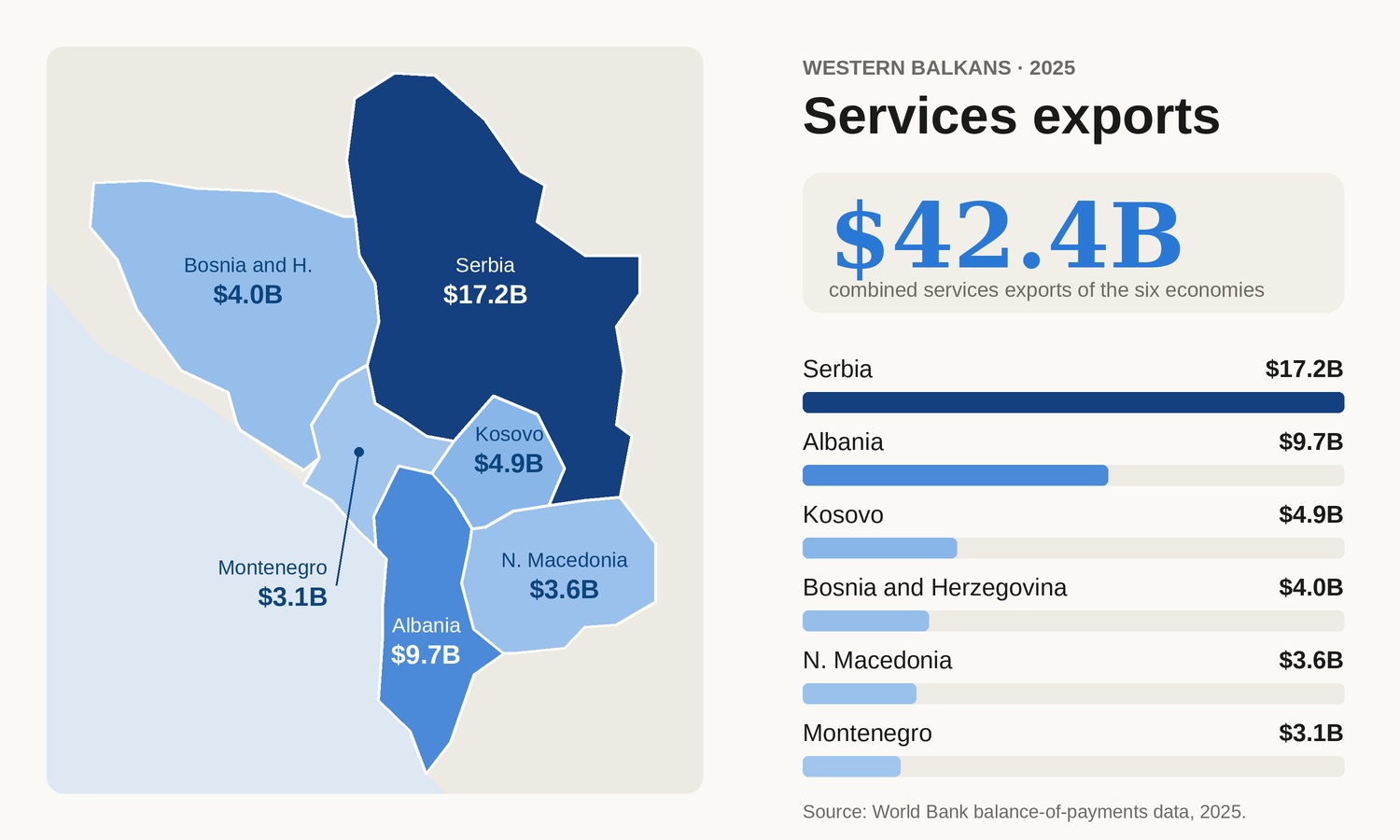
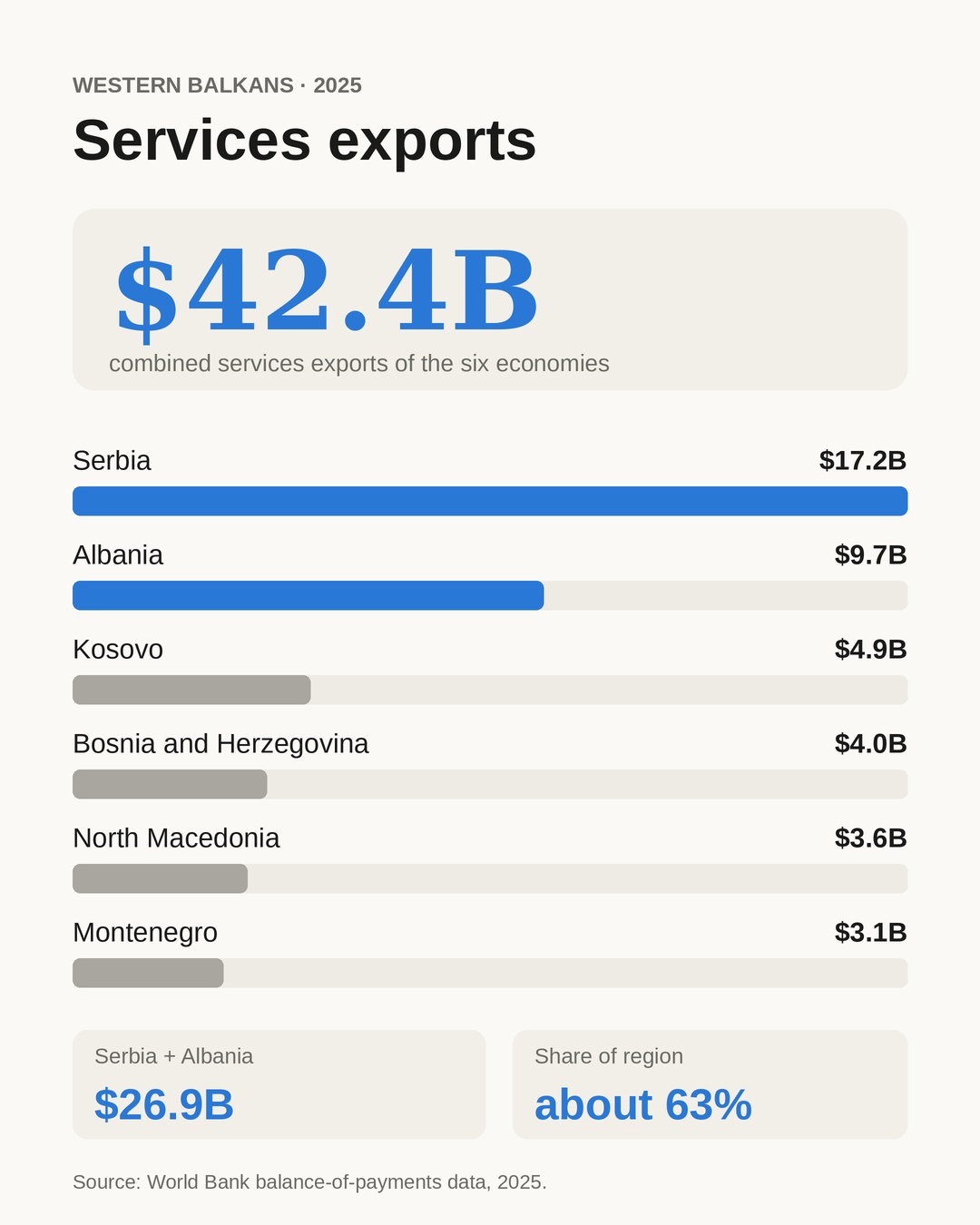
The six Western Balkan economies exported approximately $42.4 billion worth of services in 2025, according to World Bank balance-of-payments data.
Serbia was the region’s largest exporter, generating $17.2 billion, followed by Albania with $9.7 billion.
Kosovo recorded $4.9 billion in services exports, Bosnia and Herzegovina $4 billion, North Macedonia $3.6 billion and Montenegro $3.1 billion.
Serbia and Albania together accounted for nearly two-thirds of the regional total, although their export models differ considerably.
Serbia has developed a substantial information technology and business services sector, while Albania’s international services earnings are driven heavily by tourism and travel.
Montenegro is also highly dependent on tourism, while Kosovo benefits from travel spending associated with its large diaspora and an emerging digital services industry.
North Macedonia and Bosnia and Herzegovina have more diversified services sectors, including transport, business services and information technology.
The EU’s technology advantage
Enterprises operating primarily in information and communication accounted for 22.9% of EU services exports to non-EU markets in 2024, generating 362 billion euros.
Manufacturing enterprises contributed 249.3 billion euros in services exports, while transportation and storage businesses generated 236.2 billion euros.
The figures reflect the increasingly important role of services even in industries traditionally associated with physical goods.
The Western Balkans are also expanding their digital capabilities, although significant differences remain between individual economies.
According to the OECD’s 2026 Economic Convergence Scoreboard, ICT services exports in the Western Balkans reached 2.9% of gross domestic product in 2023-2024, compared with 5.1% in the EU.
Serbia led the region at 4.8% of GDP, approaching the EU average.
Albania recorded the lowest share, at 0.9%, highlighting the contrast between its strong tourism industry and its comparatively smaller digital export sector.
The OECD found that the region’s ICT services export intensity had increased from about 42% of the EU level in 2020-2022 to 56% in 2023-2024.
A rare trade advantage for the Western Balkans
Services are one area where the Western Balkans enjoy a trade surplus with the European Union. According to the Council of the EU, bilateral services trade exceeded 20 billion euros in 2024.
The EU imported approximately 10.9 billion euros worth of services from the Western Balkans and exported 9.2 billion euros to the region, giving the six economies a combined surplus of around 1.7 billion euros.
Trade in services between the two sides has more than doubled over the past decade.
The figures contrast with the region’s persistent deficit in goods trade with the EU and demonstrate the potential of services to strengthen the Western Balkans’ external economic position.
Beyond tourism and low-cost outsourcing
Tourism has become an important source of export revenue for several Western Balkan economies, particularly Albania and Montenegro.
However, dependence on travel-related earnings can leave economies vulnerable to seasonal fluctuations, international economic downturns and disruptions in travel demand.
The expansion of software development, digital services and business outsourcing offers opportunities to diversify export revenues and create higher-skilled employment.
For Serbia and North Macedonia, the development of technology-related services could provide a route towards greater integration into European value chains.
For Albania, Montenegro and Kosovo, diversification could reduce dependence on travel-related revenues while creating additional sources of economic growth.
The EU’s experience also demonstrates that large companies are not the only route to international competitiveness.
In Malta, small enterprises accounted for 78.6% of services exports to non-EU markets in 2024. In Estonia, the figure was 61.4%, and in Luxembourg 56.8%.
These examples suggest that smaller economies can develop internationally competitive services industries without relying exclusively on large corporations.
Comparable statistics on services exports by enterprise size are not available for all six Western Balkan economies in the data examined, making it difficult to establish whether the region’s small businesses are achieving similar export performance.
A test of economic convergence
The growing services trade between the Western Balkans and the EU offers an opportunity for the region to strengthen its economic integration ahead of eventual membership.
But the challenge extends beyond increasing export revenues.
Moving towards higher-value services requires investment in education, digital infrastructure, innovation and workforce skills, alongside an environment that allows businesses to expand into international markets.
The Western Balkans’ services surplus with the EU and the rapid growth of ICT exports indicate progress.
The next test will be whether the region can translate these gains into more productive businesses, better-paid jobs and sustainable economic convergence with the European Union.