


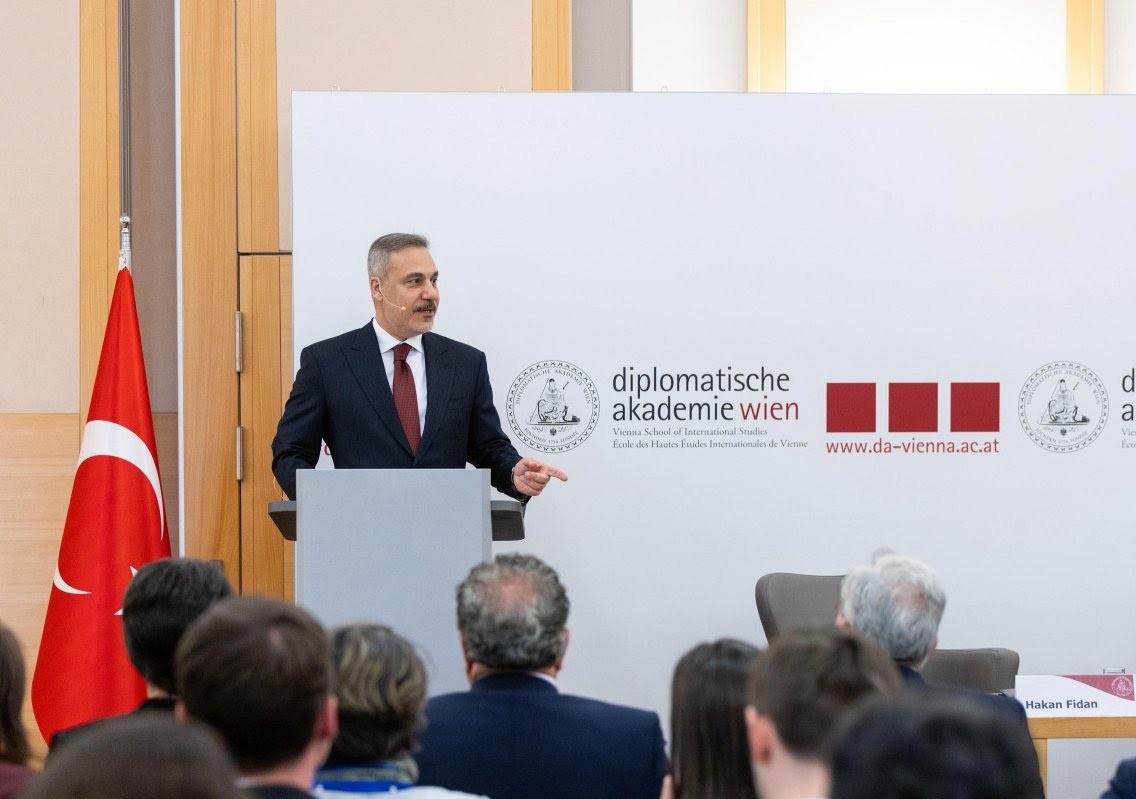
Turkish Foreign Minister Hakan Fidan said an upcoming NATO summit in Ankara represents a “historic opportunity” to reaffirm the alliance’s role, amid growing debate over its future and trans-Atlantic ties.
Speaking at a conference in Vienna, Fidan said the July summit in the Turkish capital would focus on strengthening NATO’s capabilities and addressing evolving security challenges.
“A more capable and more European NATO will be at the center of the debate at the summit,” he said, stressing that maintaining trans-Atlantic ties remains a strategic necessity for Turkey.
Uncertainty over U.S. role
Fidan’s remarks come at a time of uncertainty over the United States’ commitment to NATO, following statements by U.S. President Donald Trump questioning the alliance’s mutual defense obligations and suggesting Washington could reconsider its role.
The debate has intensified after disagreements among allies over international security issues, including conflicts in the Middle East and Europe.
European countries are increasingly exploring ways to strengthen their own defense capabilities, both within NATO structures and through additional multilateral partnerships.
Europe’s security architecture under pressure
Fidan said the outcome of the Russia-Ukraine conflict would play a decisive role in shaping a new European security architecture, adding that the current system, built after World War II, is under significant strain.
He emphasized that Europe’s security framework should extend beyond the European Union and include coordination with NATO and non-EU partners.
“Europe is bigger than the EU,” Fidan said, warning against what he described as the “weaponization” of the bloc’s foreign and security policy.
Turkey’s role in NATO
Turkey, a NATO member for more than 70 years, is set to host the alliance’s leaders for the second time in over two decades. The summit is scheduled for July 7–8 in Ankara and is expected to bring together around 6,000 participants, including heads of state and senior officials.
Ankara plays a key role within NATO due to its geographic position and military capabilities, particularly on the alliance’s southern flank and in the Black Sea region, where security concerns have intensified amid the war in Ukraine.
Officials say the summit will aim to address strategic priorities, reinforce unity among allies and adapt NATO to emerging global challenges, including shifting geopolitical dynamics and technological change.