


From twisting towers in Tirana to luxury resorts on the Adriatic and Ionian coasts, Albania is becoming an unlikely playground for some of the world’s best-known architects. But a building boom championed by Prime Minister Edi Rama is also provoking protests and questions over who benefits from the country’s dramatic transformation.
TIRANA, October 3— Albania’s rapid architectural transformation under Prime Minister Edi Rama has attracted around 60 international architecture firms and generated proposals for hundreds of projects, turning the small Balkan country into an increasingly prominent testing ground for global designers.
An investigation and feature published by The Guardian describes a pipeline of about 500 proposed projects across Albania, ranging from skyscrapers and public spaces to coastal developments, as international architects compete for a place in a construction boom that has accelerated during Rama’s long tenure.
The scale of the phenomenon has even acquired an informal nickname among architects: the “Albanian Architecture Army.”
The phrase emerged in a private architects’ group chat described by The Guardian, where new Albanian commissions have become frequent enough to be treated almost as a category of their own.
At the centre of the transformation is Rama, an artist-turned-politician who has served as prime minister since 2013 and has made architecture, urban redevelopment and tourism central elements of Albania’s international rebranding.
Tirana becomes a laboratory for global architects
The results are increasingly difficult to miss.
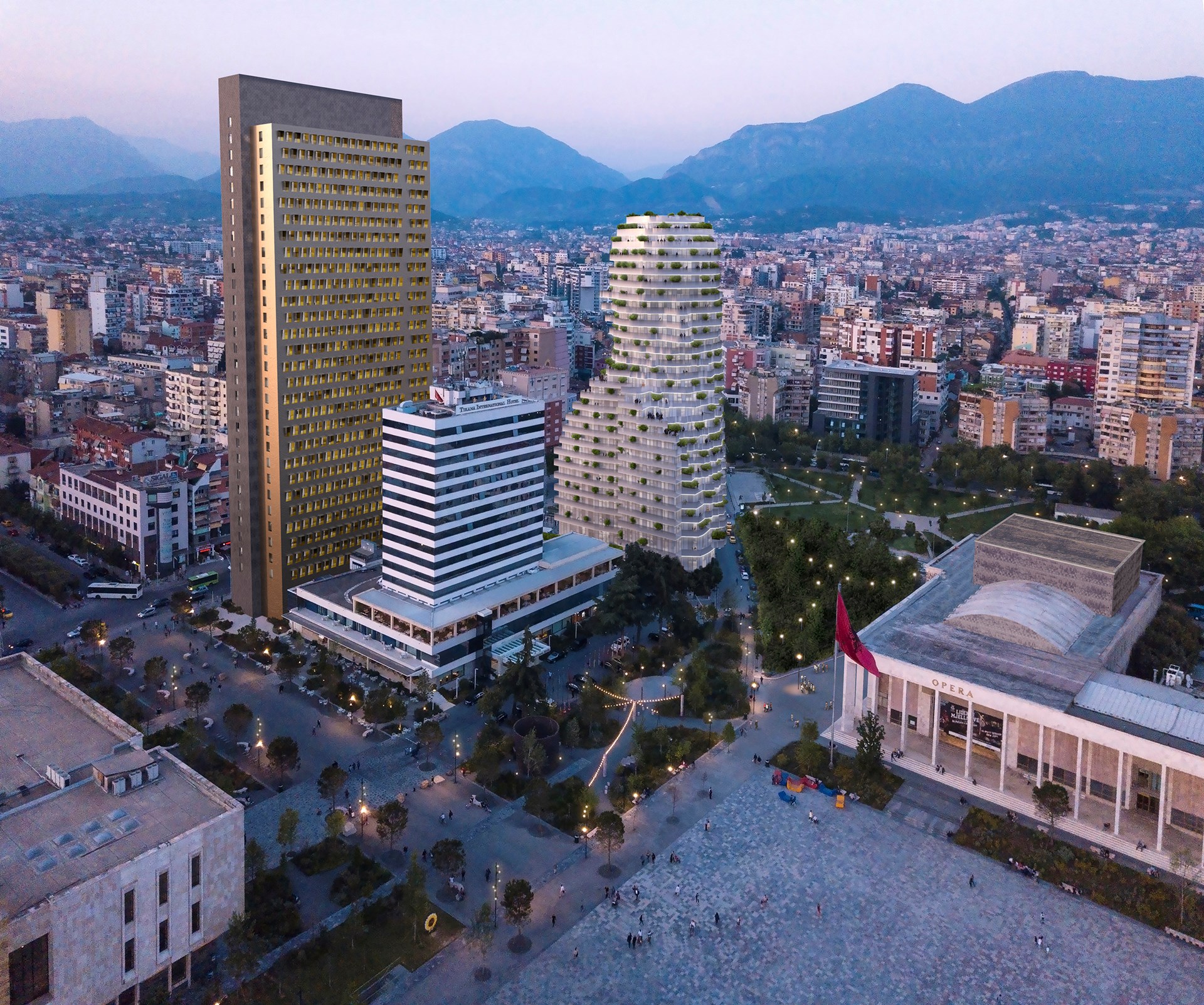
Tirana’s skyline has been transformed by an expanding collection of towers, many designed with unusually expressive forms and façades.
Among the most recognisable is the Skanderbeg Tower, conceived to evoke the profile of Albania’s 15th-century national hero.
Beyond the capital, international architects have produced plans for resorts, public spaces and developments along Albania’s increasingly valuable coastline.
The projects are now being documented in an approximately 800-page publication, The Albanian Files, according to The Guardian.
But what supporters may see as evidence of Albania’s extraordinary architectural emergence, critics view very differently.
The newspaper reports that the sheer concentration of projects has triggered anger and protests, with some critics treating the book less as a celebration than as what they describe as a potential “smoking gun” documenting the extraordinary scale of the development drive.
From isolation to construction frenzy
The transformation is particularly striking given Albania’s recent history.
For decades under communist dictator Enver Hoxha, Albania was among Europe’s most isolated countries, characterised by rigid central planning, limited private construction and an urban landscape largely disconnected from international architectural trends.
Three decades later, the contrast could hardly be greater.
Tirana has become a construction site where towers designed by international studios compete to reshape a skyline that barely existed in its current form a generation ago.
The building boom also coincides with Albania’s emergence as one of Europe’s rapidly growing tourism destinations.
That has increased demand for hotels, apartments, resorts and coastal infrastructure — and made land in Tirana and along the Adriatic and Ionian coasts increasingly attractive to investors.
Rama at the centre of the transformation
Rama occupies an unusual position in this story.
Before entering national politics, he was an artist and served as mayor of Tirana, where his administration became internationally known for painting drab communist-era apartment blocks in bright colours.
Architecture and urban design have remained prominent features of his political identity.
Under his premiership, internationally recognised architects have increasingly been invited to imagine a radically different Albania.
That has helped give the country a visibility in international architecture that would have seemed improbable two decades ago.
But it has also concentrated attention on how projects are selected, how land is developed and the relationship between architecture, political power and private investment.
The uncomfortable question behind the spectacular skyline
The controversy therefore extends beyond whether individual buildings are attractive.
It raises a more fundamental question: what kind of Albania is being built, and for whom?
Supporters of rapid development can point to tourism growth, investment, infrastructure improvements and Albania’s dramatically enhanced international profile.
Critics have raised concerns about the pace and transparency of development, the transformation of public and coastal spaces and the wider political economy surrounding the construction industry.
The debate has become especially sensitive because spectacular architecture can serve two purposes simultaneously: functioning as genuine urban investment while also providing powerful imagery for a government eager to present Albania as a modern European success story.
The approximately 500 projects documented by The Guardian illustrate just how ambitious that transformation has become.
From a once-isolated communist state to an architectural playground for internationally prominent designers, Albania has undergone an extraordinary visual reinvention.
Whether the resulting skyline will ultimately be remembered as a symbol of modernisation or as evidence of an era of uncontrolled development is the argument now unfolding beneath Tirana’s cranes.