


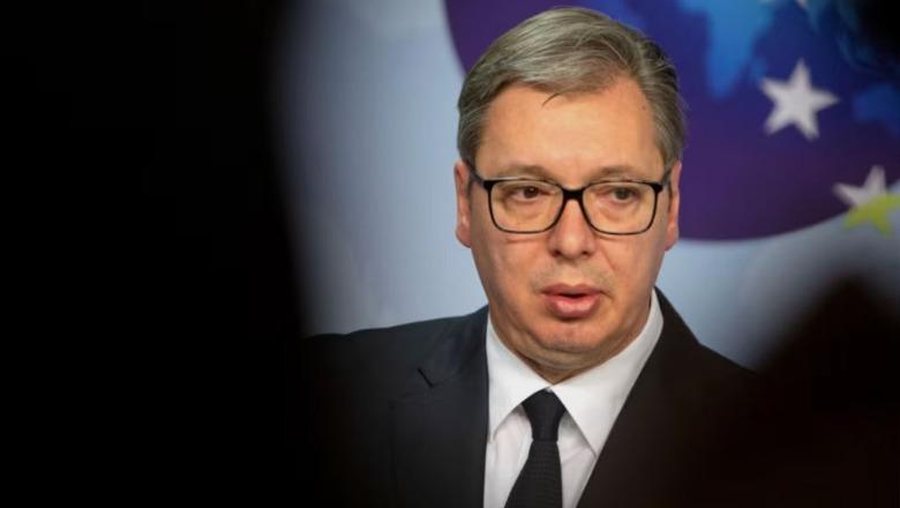
BELGRADE, Aug. 19 (Balkan View) – Serbian President Aleksandar Vučić has revived a decades-old idea of diverting the Ibar River in response to moves by authorities in Kosovo, triggering warnings from engineers and regional analysts that the proposal is technically extreme, legally fraught and more likely to be political messaging than a viable infrastructure project.
The Ibar-Lepenac water system is strategically important for Kosovo’s drinking-water supply, agriculture and energy production. The Ibar rises in Montenegro, flows through Serbia and Kosovo, feeds the Gazivode reservoir and later returns to central Serbia, where it joins the Zapadna Morava.
Any major intervention upstream of Gazivode could therefore affect not only the reservoir but the wider water system that depends on it.
Vučić said Serbia had begun consulting engineers and construction experts about the possibility of changing the river’s course, presenting the issue as a matter of sovereign decision-making on Serbian territory.
He also framed the idea as a response to what Belgrade describes as pressure on the Serb community in Kosovo, saying that if Serbia changed the Ibar’s course, “we will see what the Albanians will do and how they will behave.”
That language immediately raised concern in Kosovo and among international observers because water infrastructure in the region is both politically sensitive and heavily regulated by international rules governing transboundary rivers.
Engineers: technically possible only at enormous cost
Serbian experts have poured cold water on the idea.
Retired professor of hydrotechnics and hydrology Jovan Despotović told FoNet that Vučić’s statements were “like sleepwalking” and that a project of this kind could not be carried out quickly.
Diverting the natural course of the Ibar through mountainous and rocky terrain would require massive earthworks, tunnels, dams and long-term engineering works.
Despotović said such a project would not only be extraordinarily difficult but would also collide with European water regulations.
The environmental impact could also be severe, potentially affecting the entire river basin.
A plan with roots in the 1980s
The idea is not new.
According to DW, changing the flow of the Ibar was discussed as far back as 1985, during a politically charged period in Yugoslavia when the question of Kosovo was becoming increasingly central to Serbian nationalist discourse.
Dušan Janjić, chairman of the Forum for Ethnic Relations, told DW that he was surprised Vučić had returned to what he described as the “fantasies of Serbian nationalists” from the early 1980s.
Janjić said the old concept reflected an approach in which Kosovo was treated more through slogans and political symbolism than through workable policy.
For him, Vučić’s revival of the idea is less about solving a real problem and more about political messaging.
“This is not a project that solves anything,” Janjić said. He described it as an ideological and propaganda device designed to create noise in the region and strengthen the impression that only Vučić can protect Serbian interests.
Water as a political weapon
Kosovo officials have warned that transboundary waters cannot lawfully be used as a tool of pressure.
The Ibar is an international watercourse, and both the technical and legal questions surrounding any diversion would extend beyond Serbia’s domestic jurisdiction if downstream consequences affected Kosovo.
That is the central weakness in Vučić’s argument that Serbia can simply decide the issue internally.
International water law requires states to avoid causing significant cross-border harm and to cooperate on rivers that flow across or affect more than one jurisdiction.
Any serious attempt to divert the Ibar would therefore almost certainly trigger legal, diplomatic and environmental challenges.
Serbs in Kosovo would also be affected
Another problem with the threat is that reduced water flows would not affect only Kosovo Albanians.
The Gazivode reservoir and Ibar-Lepenac system also serve Serb communities in northern Kosovo.
Janjić said the idea that diversion could be used to punish Albanians was therefore misleading because any disruption would affect the broader population.
He also argued that, even if such a project were launched, it would take decades.
As a comparison, he noted that the Danube-Tisa-Danube canal system took around 20 years to build in a much more organised and wealthier state.
For the Ibar, he said, the timeline could be closer to 50 years.
That means Vučić would be unlikely ever to witness the political consequences he is threatening.
More weakness than strength?
The broader question is whether the rhetoric reflects strength or the opposite.
Janjić sees it as a sign of political pressure at home.
He argues that Serbian foreign policy is increasingly being used to absorb domestic tensions and preserve political control.
That interpretation is echoed by opposition figures.
Zdravko Ponoš, leader of the Serbia Centre party, mocked Vučić by saying that before trying to become “Moses,” he should first solve sewage problems in the Belgrade suburb of Borča.
Janjić offered another metaphor.
He said Vučić’s position resembles the myth of Sisyphus more than Moses: pushing a political stone uphill while trying to prevent it from rolling back over him.
Why the rhetoric matters even if the project never happens
The most immediate consequence may not be hydrological at all.
Janjić warned that statements like these damage Serbia’s credibility as a regional partner because they reinforce the perception that Belgrade is willing to use infrastructure and resource threats as political leverage.
That matters at a time when Serbia is still formally pursuing EU membership and when the normalisation of relations with Kosovo remains central to its European path.
The technical feasibility of diverting the Ibar may therefore be almost beside the point.
The political message has already been sent.
And for now, the message looks far more like pressure politics than a serious engineering plan.