


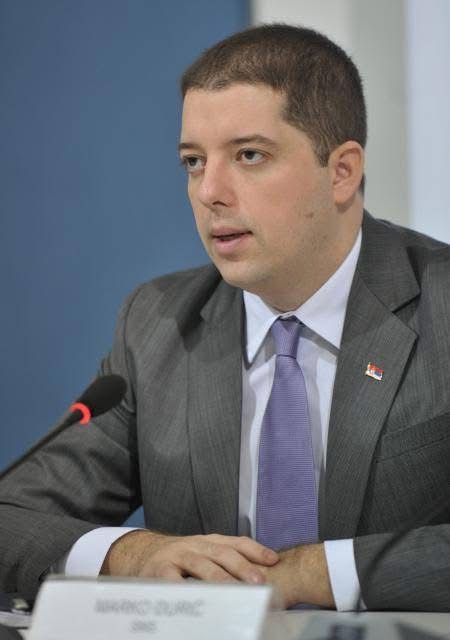
BELGRADE, Aug 11 (Balkan View) – Serbian Foreign Minister Marko Djuric accused Albania of interfering in an issue outside its jurisdiction in an escalating diplomatic dispute over the Ibar River, while also invoking concerns over what he described as ethnic expansionism and the concept of a “Greater Albania”.
In a post on X, Djuric said he had “carefully noted” a statement by Albanian Foreign Minister Ferit Hoxha, who had expressed concern over Serbian President Aleksandar Vučić’s comments that Belgrade was examining the possibility of changing the Ibar’s course.
Djuric said Albania was attempting to divert attention from what he described as continuing violations of the rights of Serbs in Kosovo.
“What we are witnessing is a clear attempt to change the subject and divert attention from the continuing violations of the fundamental rights of the Serbian people in Kosovo and Metohija,” Djuric said.
He accused Albania’s foreign ministry of remaining silent over alleged pressure on Kosovo Serbs, saying Tirana’s approach raised questions over whether its position was politically or ethnically neutral.
Djuric: Albania has no hydrological role
Djuric argued that Albania had no direct standing in the dispute because the Ibar does not flow through Albanian territory.
“The Ibar River does not flow through Albania, nor is Albania a riparian state within its basin,” he said.
“Albania therefore has no territorial or hydrological basis for claiming a role in determining how Serbia manages water resources within its own territory.”
He said Serbia would manage its resources in accordance with its constitution, domestic legislation and international obligations.
The Ibar originates in Montenegro, flows through Kosovo and then enters Serbia. Its waters feed the Gazivode/Ujman reservoir and the Ibar-Lepenac system, which are important for Kosovo’s water supply, agriculture, industry and energy infrastructure.
‘No place for a Greater Albania’
Djuric linked Tirana’s intervention to broader regional concerns, saying it revived questions about political concepts that, in his words, sought to treat Serbian territory and resources as part of a wider Albanian political sphere.
“There is no place for a Greater Albania — or for any other project founded upon ethnic expansionism and the redrawing of borders — in the European future of our region,” he said.
Instead, Djuric called for a region in which borders become progressively less divisive while states continue to respect each other’s sovereignty and territorial integrity.
“Serbia is a sovereign state and will decide for itself how to manage its natural resources. Albania will not make those decisions, nor will anyone else outside Serbia,” he said.
Foreign policy dispute widens
Djuric also criticised what he described as Albania’s growing interest in Serbia’s foreign policy, including Belgrade’s diplomatic meetings.
“The attention is touching, but loudspeaker diplomacy serves neither of our countries,” he said.
He called for lower rhetoric and a return to relations based on “mutual respect, sovereign equality and genuine cooperation”.
The statement marks the latest escalation in a dispute triggered by Vučić’s comments that Serbia had engaged engineers and other experts to examine options regarding the Ibar’s course.
Albania has argued that because the Ibar is a transboundary water system, any measure capable of affecting downstream water quantity, quality or security cannot be treated solely as Serbia’s internal affair.
The dispute has also become entangled with the wider disagreement over Kosovo’s status. Serbia does not recognise Kosovo’s 2008 declaration of independence, while Albania strongly supports Kosovo’s statehood.