


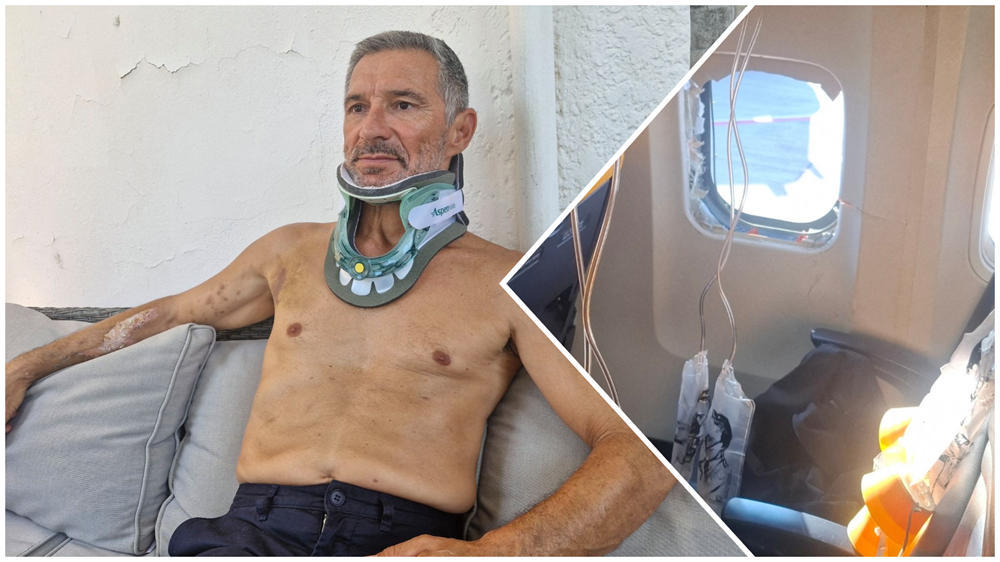
Ljubiša Karović remembers the explosion. It was the thunderous crack of a plane window breaking beside seat 11F, where the 61-year-old Serbian businessman had been sleeping on an early-morning Ryanair flight from Greece to Germany. Eleven days and 11 nights later, the sound still follows him into sleep.
“The explosion is what I remember,” Karović said in an interview with The Guardian, his head supported by a neck brace and his eyes fixed into the distance. “It is the noise before the chaos, the noise that is always there when I close my eyes to sleep.”
The injuries remain visible. Burns and bruises stretch along his right arm, towards his armpit and chest. They are the physical evidence of an incident few people could imagine surviving.
After the aircraft window shattered and the cabin suddenly lost pressure, Karović was pulled through the opening from the chest upwards. His head and right arm were outside the aircraft as it travelled at more than 600 kilometres per hour, around 15,000 feet above the ground.
He lost consciousness almost immediately. Inside the cabin, panic erupted. Oxygen masks dropped. Bottles and loose objects flew through the air. Passengers screamed as they tried to understand whether the aircraft was breaking apart.
Karović’s wife, Svetlana Grković, was seated three rows behind him. She ran towards her husband and saw him hanging partly outside the aircraft.
For between 90 seconds and two minutes, passengers fought against the force of the escaping air to stop him from being pulled completely through the broken window.
Among them was a man the couple believe was Albanian. “One man, I think he was Albanian, was incredible,” Grković said.
“He tried to block the window, first with a bag, which was immediately sucked out, and then with a suitcase, which worked. We will be grateful to him forever.”
At a time when relations between Belgrade and Pristina remain defined by political hostility, accusations and competing historical narratives, the scene inside the aircraft told a different story.
There were no Serbs and Albanians in that moment. There was only a man being pulled towards death and another man trying to save him.
The Albanian passenger reportedly attempted first to seal the opening with a bag. The pressure tore it away immediately. He then used a suitcase to cover the shattered window, helping reduce the force of the airflow while other passengers pulled Karović back inside.
It was a spontaneous act, carried out in seconds and without regard for nationality.
The Serbian businessman survived.
“I am lucky,” Karović said from the terrace of a modest rented villa in Katerini, near Thessaloniki, shortly after leaving hospital.
“I do not remember much, and my head and neck still hurt, but I am still alive. Maybe it was the seat belt, the fact that I was still strapped in. But maybe it was fate. I believe in God and thank him every day.”
Karović had been travelling to Germany to celebrate his brother’s birthday. Instead, he found himself drifting in and out of consciousness, his face temporarily distorted by the pressure and violent airflow.
His Greek lawyer, Vassilis Tsiaras, described him as “alive by mistake”. “Ljubiša was moving in and out of death,” Tsiaras said. “He looked at death, at that other world, and came back.”
Karović was reportedly unconscious once while partly outside the plane and twice after being pulled back into the cabin. His wife said fellow passengers, rather than members of the cabin crew, were the first to respond.
“I ran too. None of the cabin crew helped. It was the passengers,” she said.
Ryanair disputed that account and said its cabin crew had done a “phenomenal job”. The airline said that during a decompression and emergency descent, passengers and cabin crew were required to remain secured with seat belts and oxygen masks. Once the aircraft reached a safe altitude, the crew assisted Karović, moved him next to his wife and arranged for a doctor on board to remain with them until landing.
The company also said medical assistance was waiting when the plane returned safely to Thessaloniki. Tsiaras, however, said passenger accounts suggested the cabin crew had initially been paralysed by fear. “We have no complaint against the pilot, who followed safety protocols and handled the situation very well,” he said.
But regardless of the dispute over the crew’s response, one fact is not contested: passengers acted together to save Karović. And one of them, believed to be Albanian, used whatever he could find to stop the deadly rush of air. That detail gives the story a meaning beyond aviation safety.
For decades, relations between Serbs and Albanians have been shaped by war, displacement, disputed sovereignty and political rhetoric. The dialogue between Belgrade and Pristina remains stalled, while public discourse on both sides is often dominated by suspicion and hostility.
Yet emergencies strip away the identities imposed by politics. At 15,000 feet, an Albanian man did not ask whether the person in danger recognised Kosovo, supported Serbia or belonged to the other side of a national dispute. He saw a human being in mortal danger. He acted.
Karović, the owner of an aluminium factory in Serbia and a frequent traveller, now recoils at the thought of flying again. Doctors have warned that his recovery will be slow. He must wear a neck brace for at least six weeks before specialists determine whether he will need surgery.
The memories return in fragments: the explosion, the wind, the chaos and the images that follow him at night. But his survival also carries another memory — that of strangers who refused to let him die.
Karović believes his fastened seat belt helped save him. His wife believes the passengers did too. And among them was an Albanian whose name they may not know, but whose actions they say they will never forget. The political distance between Belgrade and Pristina may still appear vast. Inside that aircraft, however, it was erased in seconds. Humanity crossed it without hesitation.
Karović now has one message for every passenger who boards a plane. “Always wear your seat belt,” he said, allowing himself a slight smile. “I do not want anyone to suffer what happened to me.”