


North Macedonia’s economy is expected to grow faster than the Western Balkan average in 2026, but the World Bank warns that emigration, labour shortages, inflation and weak productivity could prevent the country from translating growth into lasting prosperity.
SKOPJE, Oct. 28, 2026 (BalkanView) — North Macedonia is on course for economic growth of 3.2% this year, slightly above the Western Balkan average, but deep-rooted structural weaknesses threaten to keep the country trapped at middle-income levels, according to the World Bank’s latest regional economic report.
The bank’s autumn forecast, released on Tuesday, paints a mixed picture of an economy that has demonstrated resilience despite geopolitical uncertainty but continues to struggle with labour shortages, weak productivity, rising prices and mounting pressure on public finances.
After a slowdown in the first quarter of 2026, North Macedonia’s economy rebounded more strongly than expected, recording real gross domestic product growth of 4.3% in the second quarter.
Yet the recovery has not eliminated the structural barriers that have constrained the country’s economic development for years.
Growth is returning, but prosperity remains uncertain
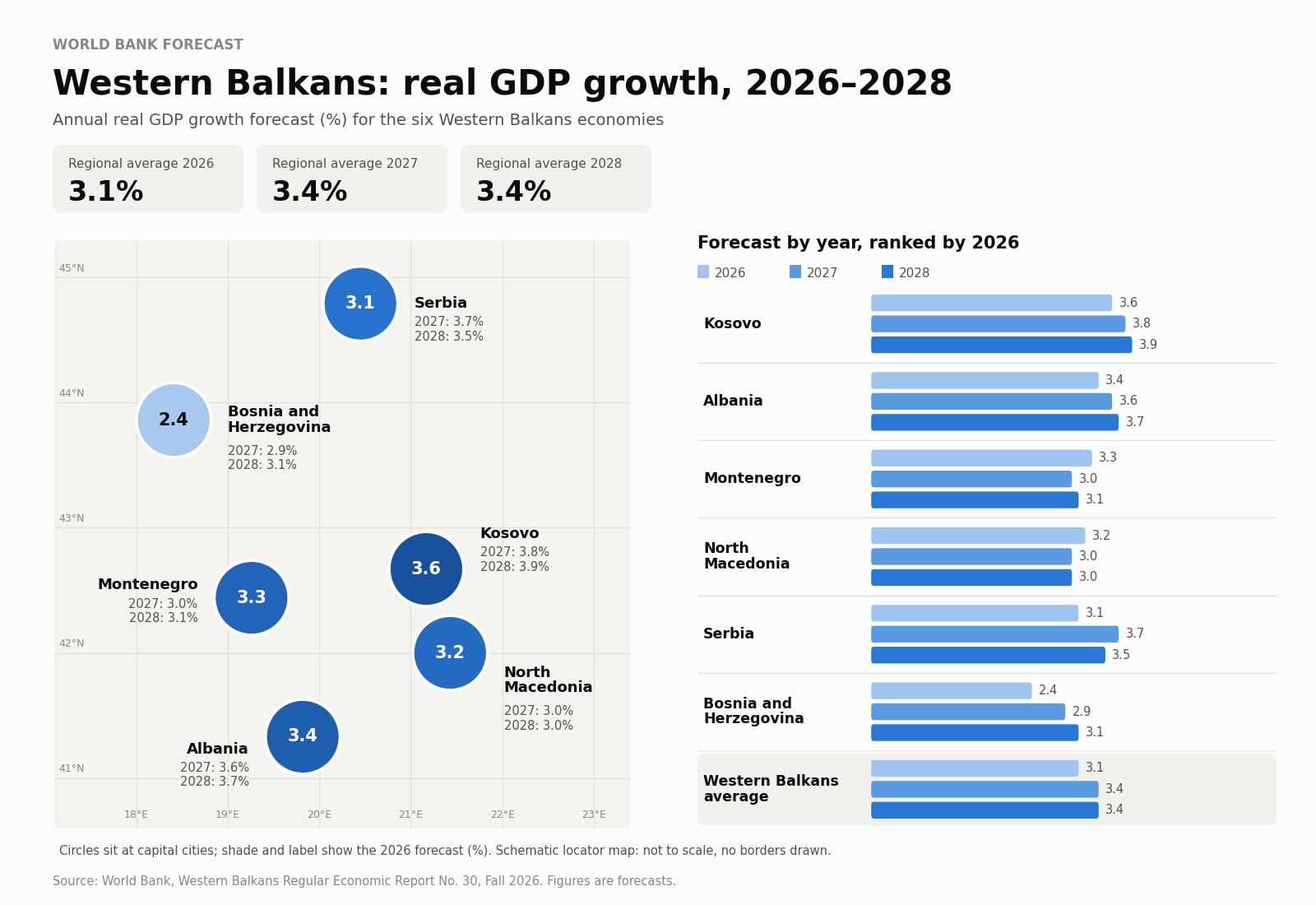
The World Bank expects North Macedonia’s economy to expand by 3.2% in 2026, compared with 3.5% estimated for 2025.
Growth is projected to remain close to current levels through 2028, supported primarily by household consumption and public investment, including major infrastructure projects along Corridors 8 and 10d.
The bank’s regional forecast provides a more precise projection of 3.0% growth for North Macedonia in both 2027 and 2028.
The outlook suggests that while the country has avoided a sharp economic slowdown, it has yet to establish the foundations for substantially faster, productivity-driven growth.
The bank also warns that weaker economic prospects in major European Union export markets could undermine external demand.
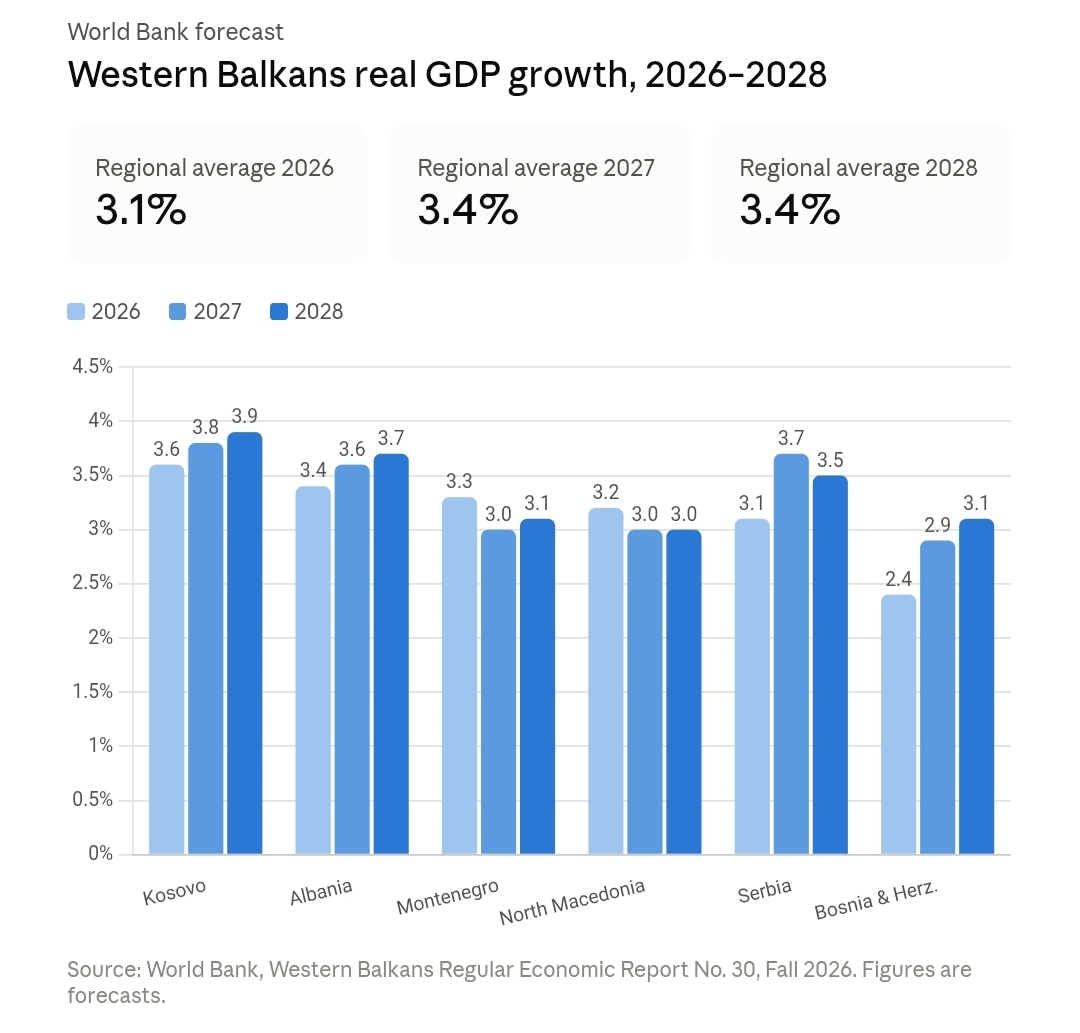
The World Bank forecasts average economic growth of 3.1% across the six Western Balkan economies in 2026, up from 2.6% in 2025. Regional growth is expected to accelerate to 3.4% in 2027 and remain at that level in 2028.
World Bank real GDP growth forecasts (%)
| Economy | 2026 | 2027 | 2028 |
|---|---|---|---|
| Kosovo | 3.6 | 3.8 | 3.9 |
| Albania | 3.4 | 3.6 | 3.7 |
| Montenegro | 3.3 | 3.0 | 3.1 |
| North Macedonia | 3.2 | 3.0 | 3.0 |
| Serbia | 3.1 | 3.7 | 3.5 |
| Bosnia and Herzegovina | 2.4 | 2.9 | 3.1 |
| Western Balkans average | 3.1 | 3.4 | 3.4 |
Source: World Bank, Western Balkans Regular Economic Report No. 30, Fall 2026. Figures are forecasts.
North Macedonia ranks fourth among the six economies in projected growth for 2026, behind Kosovo, Albania and Montenegro.
Its expected expansion is modestly above the regional average this year, but the forecasts suggest it could fall behind the region’s overall growth pace in 2027 and 2028.
Emigration and skills shortages threaten the economy
One of the report’s strongest warnings concerns North Macedonia’s labour market.
The World Bank identifies sustained emigration, low female labour-force participation, a high proportion of young people outside employment, education or training, and a widening mismatch between workers’ skills and employers’ needs as major constraints on economic development.
These problems reduce the country’s productive potential and complicate efforts to attract investment into higher-value industries.
The bank also highlights a growing imbalance between wages and productivity.
Although higher wages can support household spending, wage increases that consistently exceed productivity gains can gradually undermine the competitiveness of domestic companies, particularly those competing in international markets.
The result is a difficult economic equation: stronger domestic consumption may sustain short-term growth while leaving the underlying weaknesses of the economy unresolved.
Inflation and public finances under pressure
Inflation is another concern.
The World Bank says price pressures have resurfaced, eroding household purchasing power. Although inflation is expected to moderate gradually, the decline could be uneven.
Higher commodity prices, supply-chain disruptions and wage growth exceeding productivity improvements could keep inflation elevated for longer than expected.
Public finances also face increasing strain.
Revenue shortfalls and rising expenditure commitments underline the need for a credible fiscal strategy, the bank says.
This creates a challenge for policymakers seeking to finance infrastructure and public services while preserving fiscal stability.
The World Bank expects poverty to continue declining, although it does not provide a specific poverty-rate forecast in the North Macedonia country factsheet.
Trade barriers could be costing the Balkans billions
Beyond individual country forecasts, the report identifies trade costs as a major obstacle to stronger economic growth across the Western Balkans.
Despite substantial trade liberalisation, businesses continue to face administrative and regulatory barriers that make importing, exporting and delivering services more expensive.
Trade in goods and services reached 107% of regional GDP in 2025, compared with an EU average of 90%, demonstrating the region’s high level of international economic integration.
However, the World Bank estimates that while average import tariffs stand at around 6%, non-tariff measures add another 10% to import costs.
In some agricultural and food sectors, these additional costs exceed 20%.
Restrictions on cross-border services are even more expensive, with estimated costs of 29%.
The bank’s simulations suggest that removing half of the remaining import barriers — including licensing requirements, repeated inspections, certification procedures and local-presence rules — could increase regional GDP by as much as 12.5% over the medium term.
That figure represents a modelled potential gain under a reform scenario, not a forecast of additional annual growth.
Exporters struggle to survive
The report also reveals the difficulties Western Balkan businesses face in maintaining access to foreign markets.
Only around one-third of new export relationships established by regional firms survive their first year, while just 1% to 4% remain active into a fifth year.
This matters for employment because trading firms account for the vast majority of manufacturing jobs in the region and generally pay higher wages than comparable businesses focused on domestic markets.
Reducing unnecessary trade costs could therefore help businesses expand, increase productivity and create better-paid employment.
The World Bank recommends simplifying and digitalising procedures, introducing risk-based inspections, recognising compatible standards and qualifications, and maintaining safeguards that protect legitimate public interests.
World Bank calls for bold reforms
Carole Megevand, the World Bank’s country manager for Kosovo and North Macedonia, said the country needed structural reforms to turn economic openness into higher productivity and better employment opportunities.
“Creating more and better-quality jobs and expanding prosperity in North Macedonia require bold reforms in energy, human capital, business competitiveness, and connectivity,” Megevand said.
She added that the country needed to transform its high level of trade openness into more durable exports, higher productivity and better jobs.
Xiaoqing Yu, the World Bank’s director for the Western Balkans, said the region had demonstrated resilience despite geopolitical uncertainty and weak growth among major trading partners.
But she warned that resilience alone would not be enough to narrow the income gap with the European Union.
“The next phase of growth requires efficient, predictable regulation and removing trade barriers, not only at the border but also behind it,” Yu said.
The real test: From economic growth to economic transformation
For North Macedonia, the findings underline a distinction between maintaining economic growth and achieving economic transformation.
Public investment and household spending can support economic activity, but the World Bank’s assessment suggests that longer-term prosperity will depend on improving productivity, expanding labour-force participation, retaining skilled workers and helping businesses compete internationally.
The country also faces the challenge of maintaining fiscal discipline while financing infrastructure and responding to rising public expectations.
With economic growth forecast at around 3% through 2028, the central question is no longer simply whether North Macedonia’s economy will continue expanding.
It is whether that expansion will generate enough productive investment, competitive businesses and better-paid jobs to prevent the country from remaining stuck in the middle-income trap.