


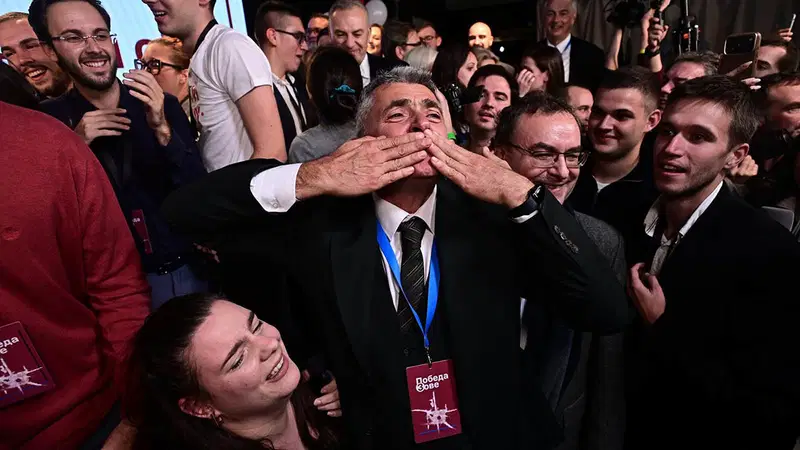
Serbia’s student-led movement has broken 14 years of political dominance by Aleksandar Vučić’s party. Montenegro hopes for better relations, North Macedonia expects greater regional cooperation, and Kosovo sees an opportunity to restart dialogue. But the incoming government has already signalled that some of Serbia’s most controversial foreign policy positions may remain unchanged.
BELGRADE, Oct. 27 (BalkanView) – Serbia’s student-backed electoral victory has raised expectations of a political reset across the Western Balkans, although analysts and officials in neighbouring countries caution that a change of government in Belgrade may not produce fundamental shifts on Kosovo, Russia or other longstanding regional disputes.
The Student List secured 52.65% of the vote in Sunday’s snap parliamentary election, according to preliminary results reported by regional media, defeating the United Serbia alliance of former President Aleksandar Vučić, which received 39.22%.
The movement is projected to control around 140 seats in Serbia’s 250-member parliament, giving it a majority after 14 years of dominance by Vučić’s Serbian Progressive Party (SNS).
The victory has generated optimism in Montenegro and North Macedonia, where analysts expect improved regional cooperation and a more constructive approach to European integration.
In Kosovo, however, officials expect continuity on Serbia’s refusal to recognise Kosovo’s independence, even as they express hope that EU-mediated negotiations could resume.
The contrast highlights a central question facing the incoming government: whether Serbia’s democratic transformation at home will lead to meaningful changes in its regional and foreign policy.
Montenegro expects a thaw in relations
Montenegrin political analysts say the election could reduce tensions between Podgorica and Belgrade.
Stefan Đukić told Montenegro’s public broadcaster RTCG that he expected closer cooperation and less confrontational political rhetoric.
He argued that Vučić had frequently portrayed Montenegro negatively while presenting himself as a defender of the Serbian population there.
Đukić said he doubted that such rhetoric would continue under the new government.
He also noted that several Montenegrin politicians, including figures from the Europe Now Movement and the Democrats, had expressed support for the Student List before the election.
Political analyst Aleksandar Ćuković similarly predicted more stable and predictable relations.
He said Montenegro’s NATO membership and advanced EU accession process provided some protection from political uncertainty in neighbouring countries.
Ćuković also argued that the Serbian election demonstrated that long-established political structures could be defeated democratically.
He expected the result to encourage stronger regional cooperation and a shared focus on European integration.
North Macedonia expects continuity, with a stronger European dimension
In North Macedonia, political analysts expect bilateral relations with Serbia to remain broadly stable.
Political analyst Petar Arsovski told the Macedonian news outlet Kolegium.mk that he did not anticipate a dramatic change in relations between Skopje and Belgrade.
He suggested that the student movement might adopt a more critical approach towards established political elites, including those in North Macedonia.
Arsovski pointed to an exchange in which representatives of the Serbian student movement reportedly criticised the leadership of North Macedonia’s opposition Social Democratic Union (SDSM), despite the party’s public support for the students.
Political scientist and regional analyst Xhelal Neziri also predicted continuity in bilateral relations, arguing that relations between North Macedonia and Serbia had not been seriously problematic under Vučić.
Neziri said Serbia’s democratisation could nevertheless accelerate the Western Balkans’ integration into the European Union.
He argued that a more democratic Serbia could become a more credible partner for Brussels and contribute to regional progress.
As the largest economy in the Western Balkans and a central political actor, Serbia’s closer alignment with European democratic standards could benefit neighbouring countries, including North Macedonia, Neziri said.
North Macedonian President Gordana Siljanovska-Davkova, Foreign Minister Timčo Mucunski and opposition SDSM leader Venko Filipče congratulated the Student List on its victory.
Mucunski expressed hope for stronger friendship and good-neighbourly relations.
Could Serbia’s student movement inspire others?
The Serbian election has also revived debate about whether student-led movements can challenge entrenched political systems elsewhere in the Balkans.
Arsovski said the Serbian experience would be difficult to reproduce without sustained organisation and public mobilisation.
He identified Albania as one country where ongoing protests could potentially develop into a broader political movement.
However, he said it remained uncertain whether those protests could produce a significant alternative to the country’s established political parties.
Neziri drew parallels between the Serbian student movement and protests in Albania, arguing that forms of civic mobilisation often spread across neighbouring countries.
He said similar movements could emerge elsewhere if political dissatisfaction combined with economic pressures and poor government performance.
The Serbian experience, he suggested, demonstrated how sustained civic mobilisation could eventually produce electoral change.
Nevertheless, analysts cautioned that each country has different political institutions, social conditions and opposition structures.
Kosovo hopes for renewed dialogue but expects no recognition
Kosovo’s Minister for Communities and Returns, Nenad Rašić, said he expected the new Serbian government to restart the stalled EU-mediated dialogue between Belgrade and Pristina.
Speaking to Radio Free Europe, Rašić said normalisation of relations with Kosovo was part of Serbia’s European integration agenda.
He predicted that the issue would become an early priority once a new government was formed.
However, he did not expect the Student List to abandon Serbia’s constitutional position that Kosovo remains part of its territory.
Rašić said it would be unrealistic to expect Serbian political representatives to publicly reject their country’s constitution.
The Student List has maintained that any lasting settlement should be pursued through peaceful dialogue, in accordance with Serbia’s constitution, United Nations Security Council Resolution 1244 and international law.
The movement has not committed itself to recognising Kosovo’s independence.
Some of its candidates have also suggested reviewing agreements reached during previous rounds of EU-mediated negotiations.
The implications for existing commitments, including arrangements concerning vehicle registration, identity documents and other practical issues, remain unclear.
Kosovo Serbs could face a different political environment
Rašić also expressed hope that a change of government in Serbia would reduce political pressure on Kosovo’s Serbian community.
He accused the outgoing SNS government of exercising influence through the Serb List, the dominant political party representing Kosovo Serbs.
Rašić said he hoped the new Serbian authorities would prevent the misuse of financial resources intended for Kosovo’s Serbian population.
The Serb List won nine of the 10 parliamentary seats reserved for Kosovo Serbs in the most recent Kosovo elections.
Rašić’s party, For Freedom, Justice and Survival, secured the remaining seat.
The Serb List had not publicly commented on the Student List’s victory at the time of the Radio Free Europe report.
A change in Belgrade’s approach could alter political competition within Kosovo’s Serbian community, although the new government’s intentions remain uncertain.
Russia: More continuity than expected?
Despite speculation that Vučić’s defeat could weaken Moscow’s influence in Serbia, the Student List has indicated that it does not intend to introduce sanctions against Russia.
The movement has previously said Serbia should maintain its position against restrictive measures targeting Moscow.
It has argued that sanctions do not necessarily resolve political or security disputes and can have negative economic consequences.
Ilija Srdanović, who headed the Student List, has also highlighted Serbia’s dependence on Russian energy supplies.
At the same time, the movement supports the territorial integrity of internationally recognised states, including Ukraine, and advocates a peaceful resolution to armed conflicts.
The position suggests that Serbia may continue balancing relations with Russia and the European Union rather than immediately adopting Brussels’ sanctions policy.
Kremlin spokesman Dmitry Peskov said Moscow hoped to maintain cooperation with Serbia despite the electoral defeat of its longstanding political partner.
He expressed hope that Serbia’s incoming leadership would recognise the benefits of continued relations with Russia.
Serbia’s refusal to align with EU sanctions against Moscow has been one of the issues complicating its accession process.
EU membership remains subject to a referendum
Although the Student List has emphasised the rule of law, judicial independence and media freedom, EU membership is not among the 11 central points of its political programme.
Srdanović has said that the final decision on Serbia’s accession should be made by citizens in a referendum following the completion of negotiations and a public debate.
This suggests that the new government could pursue EU-related institutional reforms without committing to rapid membership.
The movement has also not outlined a detailed position on NATO membership or a comprehensive policy towards China.
Its foreign policy priorities will become clearer during government formation and the preparation of a governing programme.
Anti-corruption reforms will be the first major test
The Student List’s political programme, known as the Student Plan, contains 11 points organised around institutional reform, education and economic development.
Its central promises include creating a specialised prosecutorial police unit to investigate corruption and introducing legislation to examine the origins of public officials’ wealth.
The movement also proposes reviewing the conduct of police officers, prosecutors and judges, particularly in cases involving alleged abuses of power.
It has pledged to publish state contracts and tenders, review major public investment projects and reduce political influence over appointments in state-owned enterprises.
In the media sector, it proposes reforming regulatory bodies and strengthening the independence of public broadcasters.
Its programme also includes reviewing national broadcasting licences, although the criteria and procedures for such reviews have not been fully specified.
Other proposals include free school textbooks, improved healthcare access, support for domestic businesses and measures to improve housing affordability.
Many of these commitments have yet to be accompanied by detailed implementation schedules or financial estimates.
Regional reconciliation will depend on political choices
The incoming government has promised to improve relations with neighbouring countries, but its approach to several sensitive regional questions remains undefined.
Srdanović criticised the outgoing government’s confrontational rhetoric towards Croatia during the election campaign.
He rejected claims that Croatia had been involved in supporting the student movement.
However, the Student List has not presented a comprehensive regional strategy covering Croatia, Bosnia and Herzegovina, Montenegro, North Macedonia and Kosovo.
Analysts say that the political transition could create opportunities for improved dialogue, but longstanding disputes will require more than a change in leadership.
The election result also does not automatically resolve differences over Kosovo’s status, the legacy of the Yugoslav wars or Serbia’s relations with Russia.
A regional opportunity, but no guaranteed transformation
Serbia’s election has altered the political balance in the Western Balkans.
The defeat of a party that dominated the country’s institutions for 14 years demonstrates the potential of sustained civic mobilisation to produce electoral change.
For Montenegro, the immediate opportunity lies in reducing political tensions and improving bilateral cooperation.
For North Macedonia, the potential benefit is a more democratic and European-oriented Serbia that could contribute to regional integration.
For Kosovo, the priority remains restarting dialogue and addressing unresolved agreements, even without a fundamental change in Belgrade’s position on independence.
The incoming Serbian government will also face pressure to deliver anti-corruption reforms, improve public institutions and maintain economic stability.
The Student List has won the opportunity to govern, but its capacity to deliver change remains untested.
Whether Serbia’s political transition becomes a turning point for the wider Balkans will depend less on the election result itself than on the policies the new government ultimately adopts.