


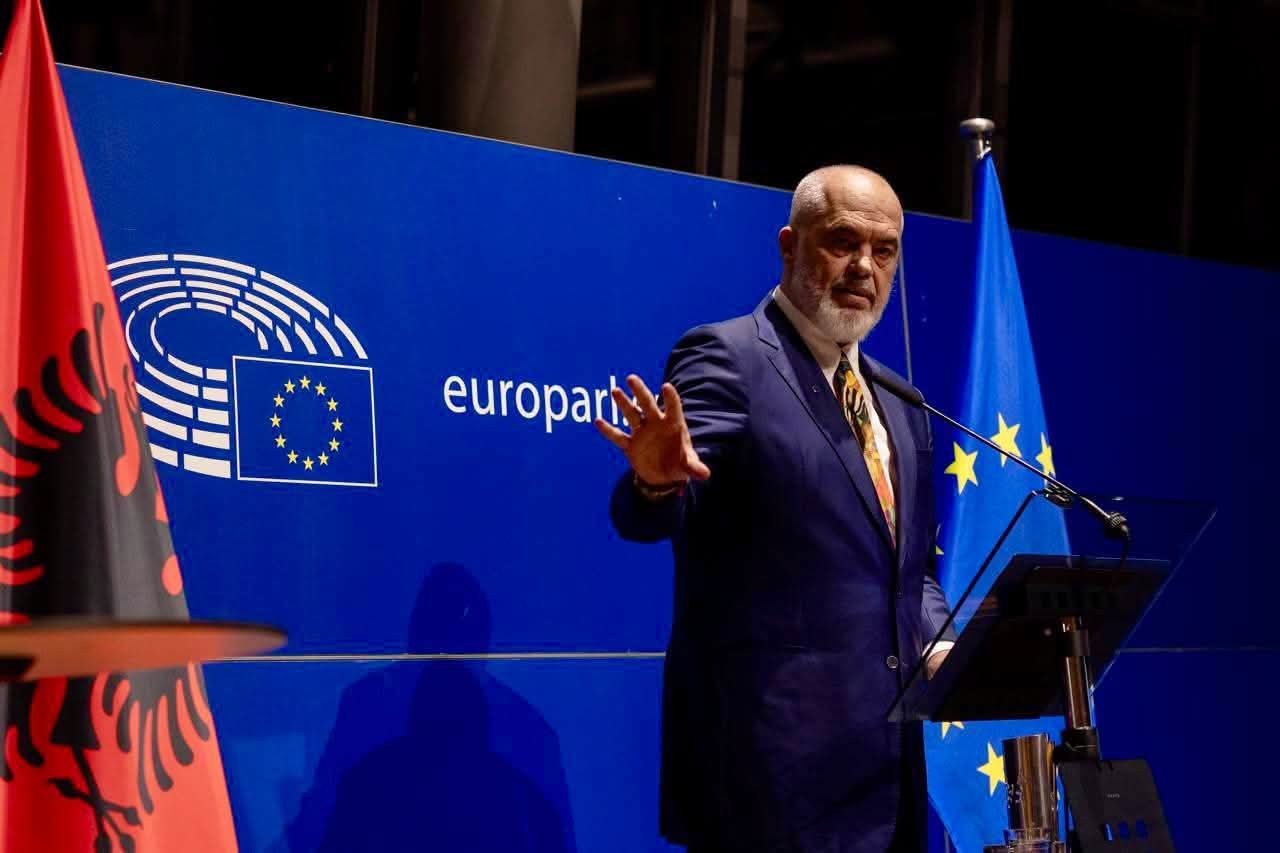
A performance intended to celebrate European unity triggered a diplomatic controversy in Brussels, with Albania’s prime minister, Kosovo officials and European lawmakers accusing the European Commission of insensitivity. Enlargement Commissioner Marta Kos expressed regret and distanced herself from the song’s political message.
BRUSSELS, Nov. 17, 2026 (BalkanView) – A Serbian nationalist song performed at a European Commission event celebrating EU enlargement has triggered a backlash from Kosovo and Albania, overshadowing discussions about regional reconciliation and forcing Enlargement Commissioner Marta Kos to explain how the controversial music became part of the official programme.
The instrumental rendition of “Oj Kosovo, Kosovo”, a song associated with Serbian nationalist claims over Kosovo, was performed by Slovenian ensemble Marko Hatlak & Kapobanda on Sunday, Nov. 15, during an invitation-only concert titled “Melodies of Unity”.
The performance took place ahead of the European Commission’s Enlargement Forum in Brussels, an event intended to promote European integration, reconciliation and cooperation among candidate countries and their neighbours.
Instead, the choice of music reignited tensions over Kosovo’s status, drawing criticism from Albanian Prime Minister Edi Rama, Kosovo diplomats, European Parliament members and civil society representatives.
Rama: Was it deliberate or ignorance?
Speaking at the forum on Monday, Rama criticised the Commission-hosted event for featuring music carrying a political message at odds with the principles of reconciliation.
“I don’t know if it was deliberate or because of ignorance. But a Serbian nationalistic song was performed here on the eve of this event,” Rama said.
“To add insult to injury, it was performed under the beautiful title Melodies of Unity.”
Rama said the controversy was not simply about offending Albanians or Kosovo citizens, but about the need to move beyond the historical disputes that have divided the Western Balkans.
He argued that European integration required countries to abandon narratives that revived past conflicts.
“We all need to engage for transforming our neighbourhoods,” Rama said, stressing that the objective was to bring European values into the region rather than merely secure formal EU membership.
His remarks brought the controversy directly into the forum’s political discussions, transforming what had initially appeared to be a cultural programming dispute into a wider debate about the EU’s approach to reconciliation.
Marta Kos apologises for song choice
Kos expressed regret over the performance and sought to distance both herself and the European Commission from its political implications.
“I regret the choice of the song by the musicians. It touches sensitive feelings,” she told reporters on Monday.
She acknowledged the painful history and differing experiences of Kosovo’s communities.
“I want to stress that this song in no way reflects the position of the European Commission or myself with respect to Kosovo and its history,” Kos said.
“What is clear is that we cannot change our shared past, but we can choose our shared future.”
The Commissioner’s response did not immediately settle questions about how the song had been selected.
It remains unclear who approved the concert’s repertoire, whether Commission officials reviewed the programme beforehand and what role the event organisers played in choosing the music.
Kos attributed the controversial selection to the musicians, but the available reporting does not establish who had final responsibility for approving the performance.
Kosovo demands an explanation
Kosovo’s chief negotiator Jeton Zulfaj and Ambassador to Belgium Agron Bajrami condemned the performance, arguing that a song associated with Serbian territorial claims had no place at an official EU enlargement event.
“This is not cultural exchange. The song advances explicit political claims over the territory of the Republic of Kosova,” Bajrami wrote on X.
He described its inclusion in a Commission event dedicated to enlargement, unity and good-neighbourly relations as unacceptable.
Estonian European Parliament member Riho Terras, the legislature’s rapporteur for Kosovo and a member of the European People’s Party, also demanded an explanation.
Terras questioned whether the performance resulted from deliberate provocation or a failure to recognise the song’s political significance.
The controversy was particularly sensitive because Kosovo was not represented by its state institutions at the main forum, according to Kosovo participants.
Kosovo declared independence from Serbia in 2008 and is recognised by most EU member states, although five — Spain, Greece, Romania, Slovakia and Cyprus — do not recognise its statehood.
Serbia continues to reject Kosovo’s independence, making questions of identity, sovereignty and historical symbolism especially contentious in regional diplomacy.
Kosovo analyst challenges Commission’s representation claim
Donika Emini, a Kosovo expert on European integration who participated in a panel on regional reconciliation, said she was shocked by the song’s inclusion.
Speaking at the forum, Emini read a passage from the song that presents Kosovo as Serbian territory.
She said she would have expected such music at a Serbian nationalist gathering rather than at an event organised by the European Union.
“I would not be surprised if I heard this song in Gazimestan or at Milosevic’s rally. But I was very surprised to hear it here in Brussels, in the EU, which is a peace project,” Emini said, according to Kosovo newspaper Koha Ditore.
Emini emphasised that her objection was not to the Serbian language or Serbian cultural expression.
“The Serbian language is also an official language in the Republic of Kosovo. I would be happy to hear songs in Serbian, as well as in Albanian, at such an event. But not a song like the one we heard last night,” she said.
She also challenged suggestions that her participation meant Kosovo had been officially represented at the event.
“I am proud to be from Kosovo, but I do not want to be used as a tool. I do not represent Kosovo,” Emini said.
She added that her invitation had arrived at the last moment.
Her remarks highlighted a distinction between the participation of an independent expert from Kosovo and the formal representation of Kosovo’s institutions at an EU event.
A song carrying the weight of history
The controversy centres on the historical and political associations of “Oj Kosovo, Kosovo”.
The song emerged in the period following Slobodan Milošević’s 1989 Gazimestan speech, when Kosovo became a central symbol of Serbian nationalist mobilisation.
Milošević’s political rise and the nationalist movements of the late 1980s preceded the violent disintegration of Yugoslavia.
For many Kosovo Albanians, music celebrating Serbian claims over Kosovo is associated with a period of political repression and the conflict of 1998–1999.
The performance in Brussels was instrumental, meaning the controversial lyrics were not sung.
Nevertheless, critics argued that the melody’s association with the song’s political message made its selection inappropriate for an event promoting reconciliation.
The distinction is important: the controversy concerns the historical and political meaning attached to the composition, rather than any objection to Serbian music as such.
Questions over Kos and the event’s organisation
The incident has also revived scrutiny of Kos among political figures who have previously questioned her past in Yugoslavia.
Slovenian historian Igor Omerza has published archival material that he interprets as evidence of Kos’s alleged cooperation with Yugoslav state security services during the late 1980s.
Slovenian politician Janez Janša and European Parliament member Romana Tomc have repeatedly raised the allegations.
Kos has consistently denied collaborating with or informing for Yugoslav intelligence services and has said she passed the European Commission’s vetting process.
There is no evidence in the reporting reviewed that these allegations are connected to the selection of the song at the enlargement event.
Nor does the fact that Kos and the performing musicians are Slovenian establish any involvement by the Commissioner in choosing the repertoire.
The immediate question remains who selected and approved the music for a politically sensitive event hosted by the European Commission.
A setback for the EU’s reconciliation message
The controversy comes as the European Union seeks to accelerate enlargement in the Western Balkans while encouraging countries in the region to resolve longstanding disputes.
Normalisation of relations between Kosovo and Serbia remains an important element of the EU’s regional policy.
Brussels has repeatedly emphasised reconciliation, good-neighbourly relations and respect for diversity as essential components of the accession process.
The incident exposed the difficulties of translating those principles into practice, particularly when cultural symbols carry sharply different meanings for communities shaped by conflict.
For Kosovo representatives, the performance raised questions about whether EU institutions sufficiently understand the region’s historical sensitivities.
For the Commission, the challenge is to explain how the music was selected and demonstrate that its cultural programming is consistent with the political principles promoted through enlargement policy.
Kos has rejected any suggestion that the song reflects the Commission’s position on Kosovo.
But the backlash illustrates how a single cultural performance can undermine the intended message of an international political event.
A concert designed to celebrate unity instead became one of the most contentious issues at the enlargement forum.
And for a region still struggling to overcome the legacy of Yugoslavia’s breakup, the controversy delivered an uncomfortable reminder: reconciliation requires not only diplomatic declarations, but also an understanding of the symbols and historical narratives that continue to divide its societies.