


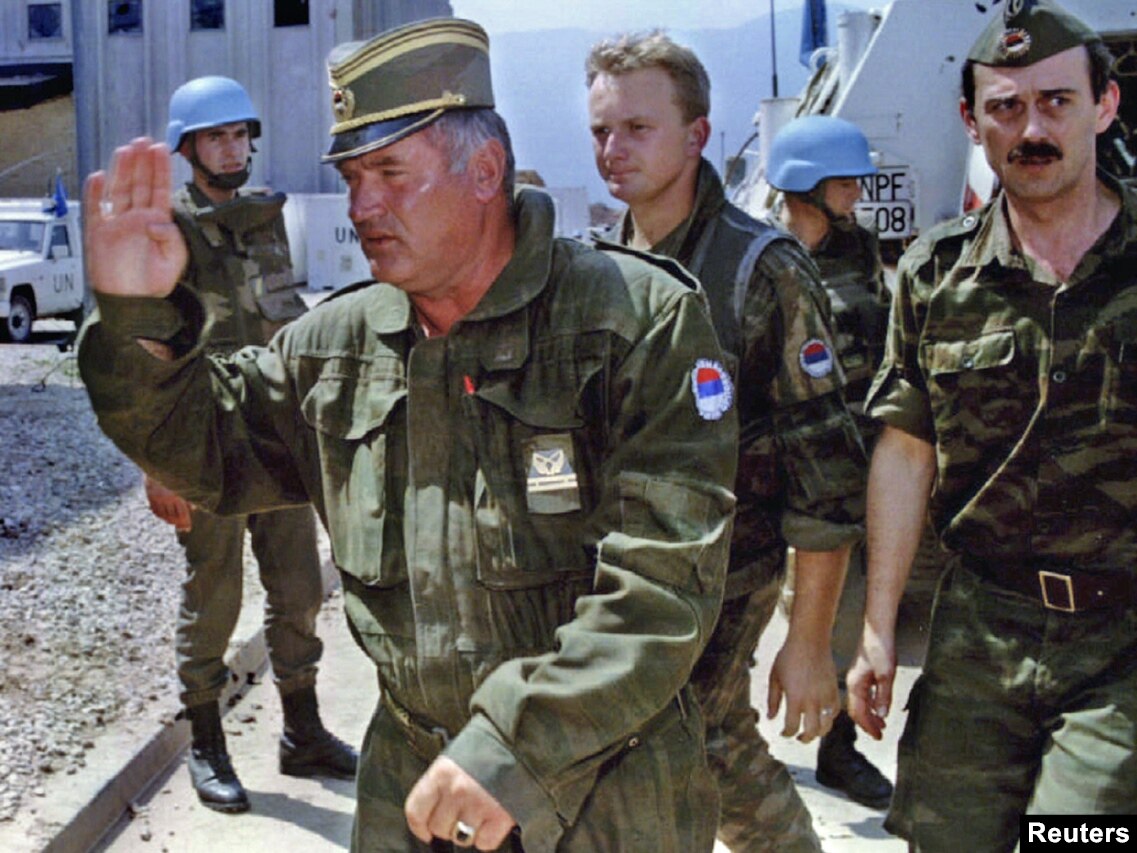
SKOPJE / PODGORICA, August 29 (BalkanView) — Ratko Mladić’s death was always likely to reopen the deepest wounds left by the wars that destroyed Yugoslavia.
What was less predictable was how quickly those wounds would cut into the politics of North Macedonia, a country that was spared the scale of bloodshed seen in Bosnia but whose multiethnic political system remains acutely sensitive to the competing historical narratives of the region.
Within hours of Mladić’s death in The Hague, where he was serving a life sentence for genocide, crimes against humanity and war crimes, political reactions spread from Belgrade and Sarajevo to Skopje.
At the centre of the controversy were two posts.
The Democratic Party of Serbs in Macedonia, led by Local Self-Government Minister Ivan Stoilkovic, published a text portraying Mladić as a soldier and general who had devoted his life to the army and the people to whom he belonged.
It said many Serbs would remember him as “their general”, rather than through the trials in The Hague, and ended with the message: “General, rest in peace. Time will judge. History will remember. And we will remember.”
Then Dalibor Kitanovic, director of North Macedonia’s Agency for the Realization of Community Rights, posted a montage on Instagram showing Mladić alongside other figures from Serbian history, including Chetnik leader Draža Mihailović, under the caption “Generals of the Heavenly Army”.
The symbolism was politically explosive.
The agency headed by Kitanovic exists to protect the rights of ethnic communities in one of the Balkans’ most diverse states. The suggestion that its director could publicly celebrate a man finally convicted of genocide immediately transformed an online post into a debate over the standards expected from state officials.
A domestic controversy becomes a test for the government
The reaction came first from opposition parties, but it soon spread inside the governing coalition itself.
The ethnic Albanian VLEN coalition, a government partner, condemned what it described as the glorification of the Chetnik movement and of Mladić.
“This is not a matter of personal taste or conviction,” VLEN said. “This is a matter of the standards of a public official and the message that institutions send to citizens.”
The coalition demanded immediate accountability, saying that a person who does not respect victims and the values of coexistence cannot be a guarantor of community rights.
That statement was particularly significant because VLEN governs alongside political actors associated with the Serbian community.
The Democratic Union for Integration, or DUI, which spent two decades as the dominant ethnic Albanian party in government before moving into opposition, had already accused VLEN of remaining silent and demanded Kitanovic’s dismissal.
The Social Democrats, or SDSM, pushed the question directly towards Prime Minister Hristijan Mickoski.
They asked whether the statements coming from Stoilkovic’s party reflected the position of the government or merely that of one coalition partner.
The Liberal Democratic Party went further.
It called on the government to distance itself clearly from the statements and asked the Interior Ministry and prosecutors to examine whether some of the posts could fall under provisions of the Criminal Code dealing with the public denial, gross minimisation, approval or justification of genocide, crimes against humanity and war crimes.
Whether the posts meet the legal threshold is a matter for prosecutors and courts.
Politically, however, the dispute has already gone much further.
Why Mladić remains different from other wartime figures
Mladić was not merely a controversial commander whose historical reputation depends on political interpretation.
He was convicted by an international tribunal.
The former commander of the Army of Republika Srpska was sentenced to life imprisonment for genocide in Srebrenica and for crimes committed during the 1992-1995 war in Bosnia and Herzegovina.
More than 8,000 Bosniak men and boys were killed after Bosnian Serb forces captured Srebrenica in July 1995.
Mladić was also convicted of persecution, murder, terrorising Sarajevo’s civilian population and taking United Nations personnel hostage.
His appeal was rejected and the life sentence became final in 2021.
That distinction matters because the controversy is not primarily about whether governments should impose one interpretation of Balkan history.
It is about how public officials treat judicially established facts.
For political parties demanding sanctions, praising Mladić is therefore not simply an expression of Serbian nationalism. They argue that it crosses a line between commemoration and the rehabilitation of a convicted perpetrator.
Europe enters the argument
The dispute also carries an EU dimension.
After Mladić’s death, the European Commission reiterated that the glorification of war criminals runs contrary to fundamental European values and has no place either inside the European Union or among candidate countries.
That message matters for North Macedonia and Serbia alike.
Both aspire to EU membership, while questions of reconciliation, good-neighbourly relations, the rule of law and acceptance of international court judgments remain deeply embedded in the region’s European integration process.
For North Macedonia, the political sensitivity is even greater.
Its constitutional order is based on power-sharing and protection of different ethnic communities, particularly since the 2001 conflict and the Ohrid Framework Agreement.
A government can therefore treat a controversy over Mladić as a foreign historical dispute only up to a point.
Once ministers, directors and coalition parties become involved, it becomes a domestic question about coexistence.
Serbia faces its own reckoning
In Serbia, Mladić’s death has revived a much older divide.
Justice Minister Nenad Vujic said Mladić could potentially receive the highest state honours at his funeral, while stressing that his family would decide where he would be buried.
President Aleksandar Vučić struck a more cautious tone, saying the state would help organise a dignified funeral if requested by the family.
Vučić also criticised the international judicial mechanism for refusing to allow Mladić to spend his final days in Serbia.
The European Commission said Serbian authorities should clarify what role the state might play in the funeral.
The very discussion of state honours illustrates how differently Mladić continues to be viewed.
For survivors of Srebrenica and Sarajevo, he is inseparable from mass graves, executions and the longest siege of a European capital in modern history.
Among parts of the Serbian nationalist public, however, he has long been presented as a commander who defended Serbs during the Bosnian war.
His death has not reconciled those narratives.
It has amplified them.
Montenegro shows the same fault line
The controversy has also spread beyond Serbia and North Macedonia.
In Montenegro, reactions surrounding parliamentary Speaker Andrija Mandić’s condolences for Mladić triggered criticism and forced governing parties to distance themselves from his position.
The episode again demonstrated that attitudes towards the wars of the 1990s continue to divide political elites even in countries that have formally committed themselves to European integration and regional reconciliation.
What happens after the death of a wartime commander can therefore say as much about the present as about the past.
North Macedonia’s uncomfortable question
For Mickoski’s government, the immediate challenge is political.
Opposition parties want dismissals. VLEN wants accountability. The LDP wants institutions to determine whether there is a criminal-law dimension. Other parties are demanding that the government define its position clearly.
The wider issue is harder.
North Macedonia has spent more than two decades building a political system around coexistence between Macedonians, Albanians, Turks, Serbs, Roma, Bosniaks and other communities.
That system cannot eliminate historical disagreements.
But it depends on agreement over certain boundaries.
One of those boundaries is increasingly being tested by the question of whether convicted war criminals can be celebrated by public officials without political consequences.
Mladić’s death has exposed that dilemma with unusual clarity.
The war in Bosnia ended more than three decades ago. The Hague trials are largely finished. Many of the principal political and military figures of the period are dead or have left public life.
Yet the battle over memory has not ended.
It survives in commemorations, murals, political speeches, football terraces and social media posts.
And, as the reaction in Skopje has shown, it can quickly move from history into the heart of contemporary government.
Mladić died serving his sentence.
What the Balkans still have not settled is what to do with the political ideas, symbols and loyalties that survived him.