


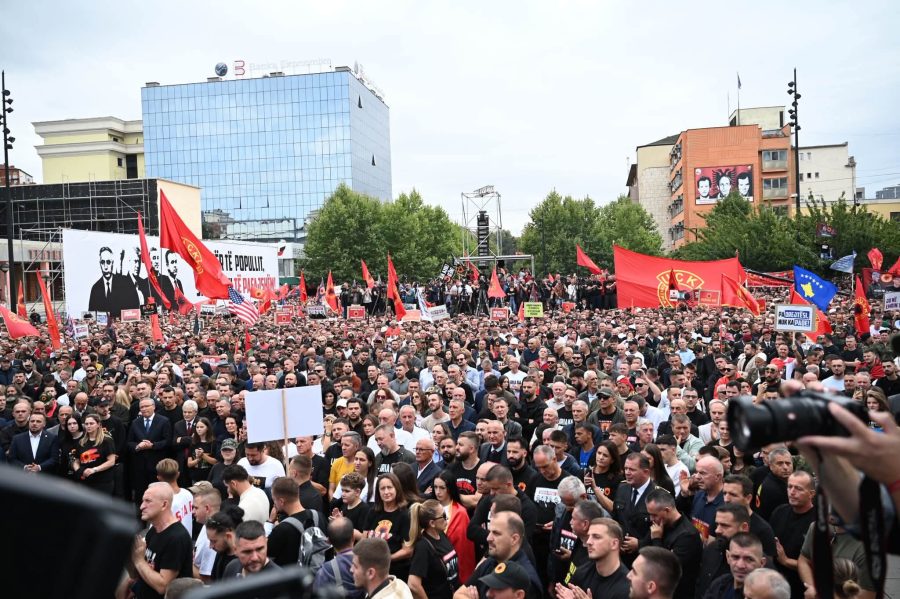
Kosovo’s former president Hashim Thaçi and three other former leaders of the Kosovo Liberation Army were handed lengthy prison sentences for war crimes on Wednesday, triggering anger in Kosovo, protests in Pristina and The Hague, and a new battle over how the 1998-99 war will be remembered.
THE HAGUE/PRISTINA, Sept. 16 (BalkanView) – Former Kosovo President Hashim Thaçi was sentenced to 25 years in prison on Wednesday after judges in The Hague found him criminally responsible for war crimes committed during the 1998-99 Kosovo conflict, in a landmark ruling that immediately reverberated across Kosovo and the wider Balkans.
The Kosovo Specialist Chambers also sentenced Jakup Krasniqi to 25 years, Kadri Veseli to 18 years and Rexhep Selimi to 13 years.
All four were senior figures in the Kosovo Liberation Army, or KLA, which fought Serbian forces during the war that ended after NATO’s 78-day bombing campaign in 1999.
The judges found the four criminally responsible for war crimes involving the arbitrary detention of at least 385 people, cruel treatment of 49 people, torture of 303 people and the unlawful killing of 96 people.
But the court acquitted them of crimes against humanity, finding that prosecutors had failed to prove beyond reasonable doubt that there had been a widespread or systematic attack against a civilian population. They were also acquitted in relation to several alleged war-crime incidents.
The distinction is significant in Kosovo, where the trial has become inseparable from a wider argument over whether individual prosecutions of former KLA leaders risk being interpreted as a judgment on the guerrilla movement and its war against Serbian rule.
Presiding Judge Charles Smith sought to draw a sharp line between the two.
The case, he said, was not about the legitimacy of the KLA, its objective of an independent Kosovo or crimes committed by Serbian forces and paramilitaries against Kosovo Albanians. It concerned whether the specific crimes alleged by prosecutors had occurred and whether the four defendants were responsible for them.
Court finds a common criminal purpose
The most consequential element of the judgment was the panel’s finding that the defendants made substantial contributions to a common criminal purpose targeting people regarded as obstacles to the KLA’s political and military objectives.
Those targeted included Kosovo Albanians associated with rival political or military groups, including the Democratic League of Kosovo, or LDK, and the Armed Forces of the Republic of Kosovo, known as FARK, as well as people suspected of links to Yugoslav or Serbian authorities and some members of minority communities, including Serbs and Roma.
The judges found that Thaçi, Veseli, Selimi and Krasniqi played different roles in implementing that purpose.
Thaçi, who later became Kosovo’s prime minister and president, was found to have made a substantial contribution through his position in the KLA General Staff and Political Directorate.
Veseli, who later headed Kosovo’s parliament, was found to have played a key role through intelligence structures used to identify and target perceived opponents.
The court said Selimi encouraged and participated in crimes and was aware that KLA units were targeting certain people, while Krasniqi was found to have contributed through political statements, communiqués and orders.
The ruling does not declare the KLA itself a criminal organisation. The court explicitly framed the case around the individual criminal responsibility of the four defendants.
Almost six years in detention
Thaçi, Veseli, Selimi and Krasniqi have been in detention in The Hague since November 2020.
Their trial opened in April 2023 and became the largest case heard so far by the Specialist Chambers.
The proceedings involved evidence from hundreds of witnesses, thousands of exhibits and tens of thousands of pages of transcripts. Prosecutors closed their case in April 2025, while evidentiary proceedings ended in December. Closing arguments were heard in February.
Prosecutors had sought 45-year prison terms for each defendant.
The time already spent in detention will count toward their sentences.
The verdicts are first-instance judgments and can be appealed.
Thaçi’s lawyer, Pierre-Richard Prosper, said the defence would do exactly that, calling the ruling a failure of justice and arguing that the judges had misunderstood the structure of the KLA and Thaçi’s authority within it.
Anger erupts in Kosovo
The sentences triggered an immediate political and public backlash.
Citizens who had gathered in central Pristina to watch the judgment reacted with disbelief and anger. Some later marched towards the EULEX offices in Fushë Kosovë, where additional police forces were deployed.
In The Hague, tensions briefly flared outside the court as police used water to move protesters away from the premises after some demonstrators climbed onto and struck police vehicles.
Kosovo political leaders across party lines challenged the implications they said could be drawn from the judgment while several also appealed for calm.
The Democratic Party of Kosovo, which was founded by former KLA figures and led for years by Thaçi and later Veseli, described the judgment as unjust and said Kosovo’s history could not be rewritten by a court ruling.
The Democratic League of Kosovo expressed deep concern over the sentences but called for restraint and stressed its commitment to the rule of law and the defendants’ right to exhaust the appeals process.
Alliance for the Future of Kosovo leader Ramush Haradinaj also rejected the ruling but urged supporters not to damage Kosovo or its institutions.
Albanian Prime Minister Edi Rama responded with a single word on social media: “Shame.”
Albanian President Bajram Begaj said the decision caused “deep sadness” and argued that the KLA’s historical role could not be tarnished.
The reactions underscored the political sensitivity surrounding a court that was established under Kosovo law but is seated in The Hague and staffed by international judges and prosecutors.
EU calls for restraint
The European Union called on political actors and citizens in Kosovo and across the region to show restraint.
It stressed that the Specialist Chambers must be allowed to complete their mandate without interference and pointed to the defendants’ right to appeal before an independent appeals panel.
The EU also emphasised that the court operates on the principle of individual criminal responsibility — an important distinction as political leaders and veterans’ organisations argued that the judgment risked being interpreted as a condemnation of the KLA as a whole.
That dispute is likely to dominate Kosovo’s political debate in the coming weeks.
For many Kosovo Albanians, the KLA remains inseparable from the struggle that ended Serbian rule and eventually led to Kosovo’s 2008 declaration of independence.
Around 13,000 people were killed during the Kosovo war, most of them ethnic Albanians, and hundreds of thousands were displaced as Serbian and Yugoslav forces conducted operations across the territory.
The Specialist Chambers, however, have a narrower legal mandate focusing on individual responsibility for crimes within their jurisdiction rather than assigning collective responsibility for the conflict.
A battle over history — and the appeals court
The ruling therefore creates two parallel debates.
The first is legal: whether prosecutors proved that Thaçi, Veseli, Selimi and Krasniqi were individually responsible for the war crimes established by the Trial Panel. That fight will now move to the appeals process.
The second is political and historical. Kosovo’s leaders and veterans’ organisations have already signalled that they will resist attempts to use the convictions to portray the KLA’s broader struggle as criminal. The judgment itself explicitly stopped short of doing that.
But the sentences — 25 years for two of the most prominent figures of Kosovo’s independence struggle and lengthy terms for two others — ensure that the verdict will resonate far beyond the courtroom.
Nearly 27 years after the war ended, Kosovo now faces a difficult distinction: defending the historical narrative of its struggle for independence while confronting a judicial finding that some of the men at the top of that struggle were individually responsible for serious crimes.
For Thaçi, Veseli, Krasniqi and Selimi, meanwhile, Wednesday’s judgment is not the final legal word. Their next battle will be before the appeals judges.