


Western Balkans urged to move faster than criminals as organised crime tops Berlin Process agenda
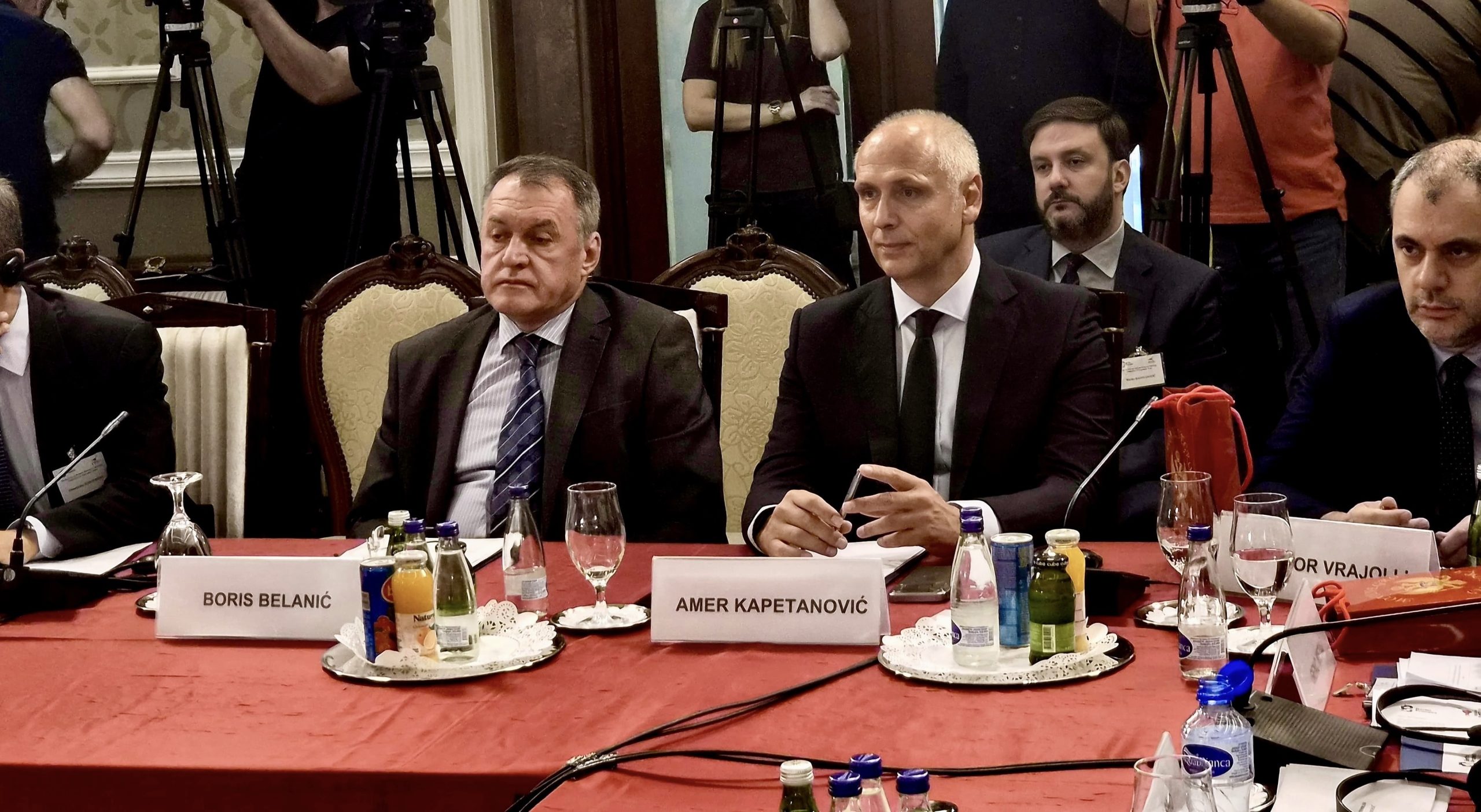
PODGORICA, Sept 16 (BalkanView) – Western Balkan countries need faster and more coordinated action against organised crime as expanding trade and transport links create opportunities for criminal networks to operate across borders, Regional Cooperation Council Secretary General Amer Kapetanović said on Wednesday.
Speaking at the Berlin Process Interior Ministers’ Meeting in Podgorica, Kapetanović said security cooperation in the Western Balkans had consequences well beyond the region.
“Every shipment stopped in our region is a shipment that never has to be stopped in Vienna, Berlin, Paris or London,” Kapetanović said. “This is not only helpful for the region, but security for all of us.”
“Criminals cooperate across our boundaries without joint statements. Let us cooperate at least as fast,” he added.
The meeting, held on Sept. 15-16 at Vila Gorica under Montenegro’s 2026 chairmanship of the Berlin Process, brought together representatives of the Western Balkans Six, the European Commission and international partners.
Kapetanović addressed a session titled “Strengthening Resilience against Organised Crime”, chaired by Montenegro’s Interior Minister Danilo Šaranović.
The discussions focused on improving regional coordination against serious and organised crime at a time when the Western Balkans is seeking closer economic integration with the European Union and easier movement of people and goods.
Corruption concerns remain high
Kapetanović pointed to findings from the RCC’s latest SecuriMeter survey showing that 81% of respondents believe corruption is widespread, while 72% expressed concern about organised crime.
The figures highlight a continuing gap between regional integration ambitions and citizens’ perceptions of the institutions responsible for enforcing the law.
Kapetanović called for greater use of regional evidence and data to identify security weaknesses and determine where governments and law-enforcement agencies should concentrate resources.
He also urged authorities to pay greater attention to ports and the risk posed by insiders who can facilitate criminal operations from within legitimate transport, logistics or public institutions.
Personnel security, information protection and digital systems should increasingly be treated as interconnected rather than separate challenges, he said.
Ports and transport corridors under scrutiny
Transport and logistics networks emerged as another key concern.
Western Balkan governments are investing in faster borders, new roads, railways and regional corridors designed to increase trade and connect their economies more closely with the European single market.
But the same infrastructure can be exploited by organised crime.
Kapetanović said protecting those networks required closer cooperation between police, customs authorities and private logistics operators.
The challenge is particularly important as the region tries simultaneously to remove obstacles to legitimate trade while preventing criminal networks from exploiting easier movement across borders.
The message reflects a wider security dilemma facing the Western Balkans: how to make borders easier to cross for businesses and citizens without making them easier for organised crime.
Firearms remain a regional security challenge
Kapetanović also pointed to the Western Balkans Small Arms and Light Weapons Control Roadmap and cooperation with the South Eastern and Eastern Europe Clearinghouse for the Control of Small Arms and Light Weapons, or SEESAC.
The initiatives have created an existing regional framework that governments can use to address firearms-related security risks, he said.
Weapons trafficking has long been treated as a problem extending beyond the Western Balkans because illicit firearms originating or circulating in southeastern Europe can reach criminal networks elsewhere on the continent.
Kapetanović’s argument was that governments should build on mechanisms already operating in the region instead of continually creating new frameworks for cooperation.
Security of the Balkans increasingly tied to EU security
The participation of European Commission officials underscored the extent to which organised crime in the Western Balkans is regarded as a broader European security challenge.
Olivier Onidi, deputy director-general at the Commission’s Directorate-General for Migration and Home Affairs, and German State Secretary Bernd Krosser delivered introductory remarks ahead of the discussion.
Representatives from all six Western Balkan partners also participated.
The regional focus is particularly significant because criminal organisations rarely operate within the administrative boundaries that constrain national police forces.
Drug trafficking, weapons smuggling, money laundering and other forms of organised crime can involve routes stretching from ports and border crossings in the Balkans to major EU markets.
That gives Western Balkan law-enforcement cooperation a direct security dimension for EU member states.
Berlin Process puts security alongside integration
The Berlin Process was launched in 2014 as a framework to strengthen cooperation between the Western Balkans and participating European countries and to support the region’s European integration.
Much of its public profile has traditionally centred on economic integration, connectivity and reconciliation.
The Podgorica meeting highlighted another pillar: internal security.
Montenegro’s 2026 chairmanship is bringing together governments and European partners at a time when infrastructure connectivity, border management, migration and organised crime are increasingly interconnected.
The emphasis also reflects a shift from treating Western Balkan security primarily through the legacy of the conflicts of the 1990s towards addressing transnational challenges shared with the rest of Europe.
Next stop: Tirana
The RCC said it would continue the discussion at its JUMBO Regional Security Conference in Tirana in November.
The conference is expected to bring together practitioners and international partners to examine how security assistance is reaching institutions, where gaps remain and which areas require stronger regional coordination.
For Kapetanović, the central message from Podgorica was that existing mechanisms need to translate into faster operational cooperation.
Criminal networks already exchange information, move money and operate across national boundaries without waiting for formal political agreements.
The challenge for the Western Balkans and its European partners is to ensure that the institutions pursuing them can do the same.