


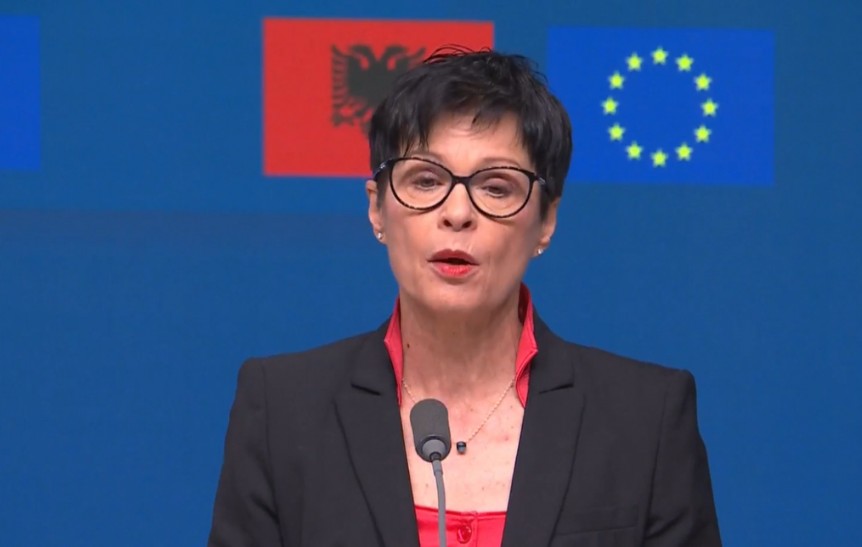
Montenegro, Albania, Ukraine and Moldova are preparing for new EU accession conferences, European Enlargement Commissioner Marta Kos said on Monday. But North Macedonia is missing from the list, highlighting the continuing obstacles to its European integration.
LUXEMBOURG, Oct. 12 (BalkanView) — European Enlargement Commissioner Marta Kos said on Monday that the European Union was preparing four accession conferences with Montenegro, Albania, Ukraine and Moldova, signalling renewed momentum in the bloc’s enlargement agenda.
Speaking ahead of a meeting of EU foreign ministers, Kos said candidate countries were making progress but stressed that accession must remain closely linked to European security, strategic alignment and the rule of law.
“Enlargement is on the move,” Kos said in remarks published ahead of the Foreign Affairs Council.
“Four accession conferences in sight with Montenegro, Albania, Ukraine and Moldova. Our frontrunners are delivering, and so are we.”
She added that progress must be accompanied by strategic alignment and respect for the rule of law, describing both as essential to European security.
Montenegro and Albania advance, North Macedonia remains blocked
The announcement places Montenegro and Albania among the countries expected to participate in the next round of accession conferences.
Both Western Balkan countries have continued their EU accession processes, although the pace and substance of negotiations differ.
North Macedonia was not included among the four countries mentioned by Kos.
The country has faced a prolonged obstacle to advancing its accession negotiations because of its dispute with Bulgaria over constitutional amendments and the recognition of the Bulgarian community.
Under the EU negotiating framework agreed in 2022, North Macedonia is expected to amend its constitution to include Bulgarians among the communities explicitly recognised in its constitutional preamble before moving to the next stage of negotiations.
The government in Skopje has sought guarantees that implementing the constitutional changes will not expose the country to additional bilateral demands.
Bulgaria, meanwhile, maintains that previously agreed commitments must be fulfilled.
Kos did not specifically address North Macedonia or its dispute with Bulgaria in the statement.
Ukraine and Moldova remain part of the enlargement agenda
The inclusion of Ukraine and Moldova reflects the EU’s continued focus on enlargement towards Eastern Europe.
Both countries have pursued accession reforms amid heightened regional security concerns following Russia’s full-scale invasion of Ukraine.
Kos linked the broader enlargement process to the EU’s strategic interests, suggesting that security considerations and democratic reforms must advance together.
Her remarks also reinforced the European Commission’s position that alignment with EU policies and respect for the rule of law remain central to the accession process.
Enlargement momentum faces an implementation test
The four conferences identified by Kos represent prospective steps in accession negotiations rather than guarantees of membership or completion of the process.
Their scheduling and outcomes remain subject to the relevant EU procedures and decisions by member states.
For the Western Balkans, the announcement underscores the increasingly different stages of European integration across the region.
Montenegro and Albania are preparing for further accession discussions, while North Macedonia continues to face an unresolved bilateral obstacle.
Kos’s message ahead of the Foreign Affairs Council was that enlargement remains an active EU priority, but progress must be accompanied by reforms, strategic alignment and adherence to European legal standards.
For Skopje, the immediate challenge remains finding a way to meet the conditions of its negotiating framework while addressing domestic concerns over further concessions in its dispute with Bulgaria.