


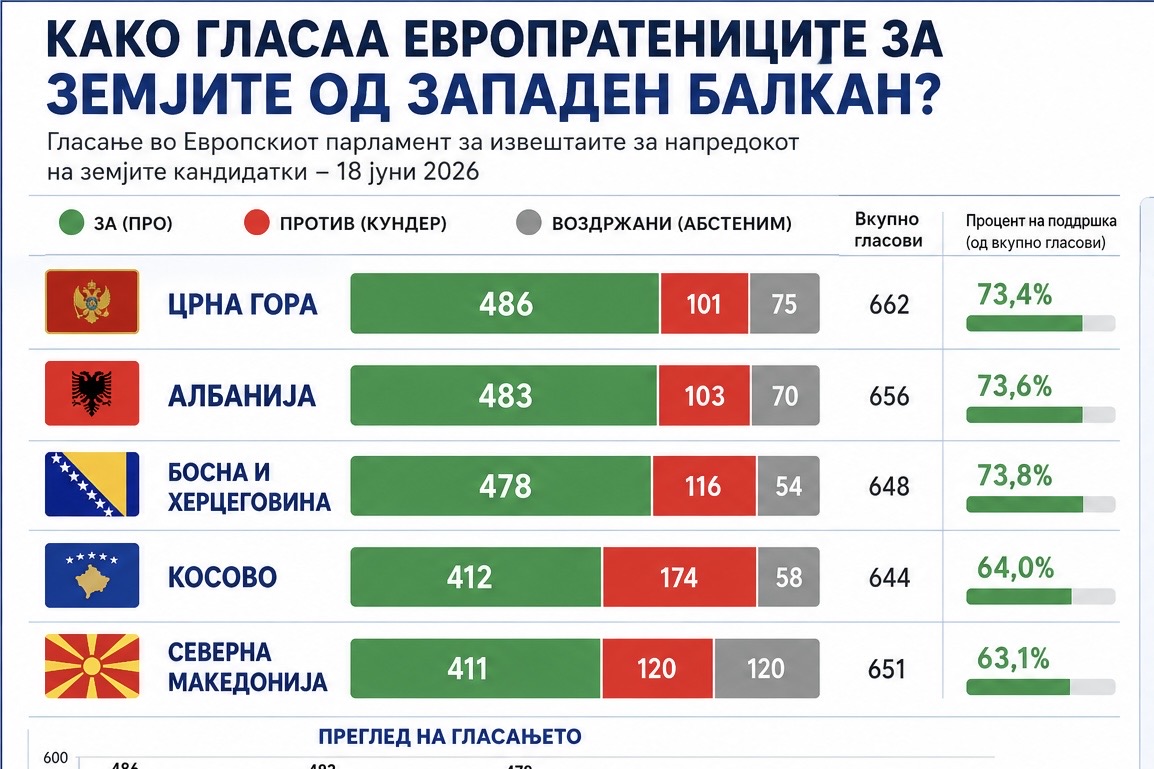
BRUSSELS, June 19 (BV) – The European Parliament approved annual progress reports on five Western Balkan countries on Wednesday, with Montenegro, Albania and Bosnia and Herzegovina receiving the strongest backing from lawmakers, while North Macedonia and Kosovo faced greater skepticism over their EU accession prospects.
Montenegro received the highest level of support among the five candidates, with 486 votes in favour, 101 against and 75 abstentions. Members of the European Parliament welcomed the country’s steady progress on reforms and its ambition to conclude accession negotiations by the end of 2026 and join the European Union by 2028.
Albania followed closely, securing 483 votes in favour, 103 against and 70 abstentions. Lawmakers praised the country’s rapid progress in recent years but stressed that political polarisation, rule-of-law reforms and anti-corruption efforts remain significant challenges.
Bosnia and Herzegovina’s report was approved with 478 votes in favour, 116 against and 54 abstentions. MEPs reaffirmed support for the country’s EU path while urging political leaders to end obstructionism, strengthen democratic institutions and accelerate long-delayed reforms.
Kosovo received 412 votes in favour, 174 against and 58 abstentions. Parliament welcomed Pristina’s continued commitment to European integration but expressed concern over the prolonged political deadlock and the inability to establish fully functioning institutions.
North Macedonia’s report was adopted with 411 votes in favour, 120 against and 120 abstentions, the highest number of abstentions among all five Western Balkan countries. MEPs reiterated their support for the country’s EU membership ambitions but expressed regret over the limited progress since the previous report, particularly regarding judicial reforms, the rule of law and the fight against corruption.
Lawmakers also stressed that the opening of the first negotiating cluster remains dependent on the adoption of constitutional amendments and renewed political consensus.
The voting results suggest that Montenegro, Albania and Bosnia and Herzegovina currently enjoy the broadest political consensus within the European Parliament, while Kosovo and North Macedonia face more divided views among lawmakers despite continued support for their European aspirations.