


As Europe moves steadily toward digital payments, criminals continue to rely on one of the oldest financial tools: cash.
A joint operation by the European Border and Coast Guard Agency (Frontex) and the World Customs Organization (WCO) has highlighted how undeclared cash remains a key facilitator of organized crime across Southeast Europe, exposing the region’s role as an important transit corridor for illicit financial flows.
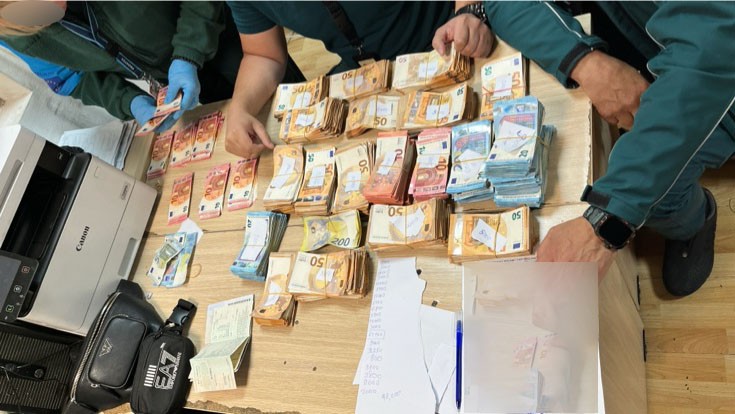
During the Balkans Action Days, conducted between 20 and 24 July, authorities from Bulgaria, Greece, North Macedonia, Montenegro and Serbia detected undeclared assets worth hundreds of thousands of euros while targeting cross-border cash smuggling.
The operation resulted in the seizure of €221,770, $20,000, 100,000 Turkish lira and 2.02 kilograms of silver jewellery.
Following the Money
Unlike drugs or weapons, undeclared cash often attracts less public attention. Yet investigators consider it one of the clearest indicators of organized criminal activity.
Cash remains difficult to trace, leaves no digital footprint and can move quickly across borders. It is frequently used to finance drug trafficking, migrant smuggling, human trafficking, illicit tobacco trade and money laundering.
By intercepting undeclared currency before it enters the financial system, authorities hope to disrupt criminal networks at their financial source.
Southeast Europe Under the Spotlight
The Balkans continue to rank among the regions with the highest number of undeclared cash detections entering or leaving the European Union.
The latest operation brought together border guards and customs authorities for one of the first coordinated actions focusing specifically on financial smuggling rather than narcotics or migration.
Frontex officers from the Standing Corps assisted national authorities by supporting passenger baggage inspections, combining border-control expertise with customs intelligence.
Criminal Networks Are Adapting
Recent cases demonstrate increasingly sophisticated concealment methods.
Only months earlier, Serbian Border Police, Serbian Customs and Frontex officers intercepted more than €374,000 hidden inside specially modified compartments sewn into a jacket at the Gradina border crossing with Bulgaria.
The case illustrates how criminal organizations continue to adapt their techniques despite tighter border controls.
Authorities say cash smuggling has remained remarkably stable over the past decade, even as electronic payments have become widespread across Europe.
Beyond Migration
Although Frontex is primarily associated with migration management and protecting the EU’s external borders, the agency has steadily expanded its role in combating cross-border crime.
Its operations now increasingly target financial crime, document fraud, weapons trafficking and other forms of organized criminal activity alongside migration-related offences.
Joint operations with customs authorities reflect a growing recognition that border security extends beyond controlling the movement of people.
A Growing Security Challenge
The Balkans Action Days also underline increasing cooperation between European agencies and Western Balkan partners.
As countries in the region move closer to the European Union, strengthening cooperation against financial crime has become a key part of the accession process, particularly in areas involving customs controls, anti-money laundering and the fight against organized crime.
For law enforcement agencies, every undeclared bundle of cash intercepted at a border crossing may represent more than hidden money—it may expose the financial lifeline of a much larger criminal network operating across Europe.