


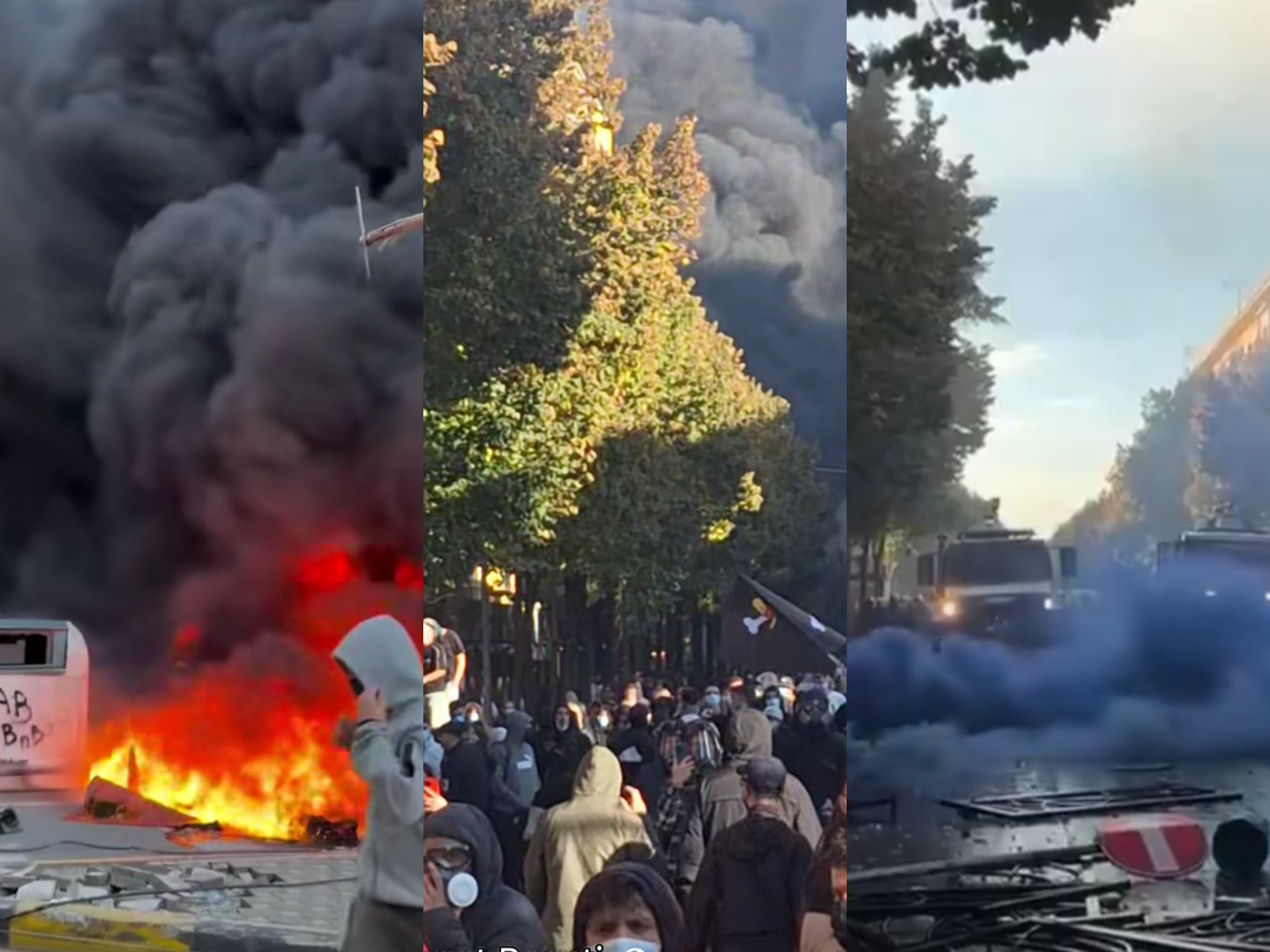
Albania’s capital has been rocked by a second day of violent protests, with demonstrators attacking government buildings, setting municipal vehicles ablaze and smashing commercial properties. As police deploy tear gas, the unrest is becoming a major challenge for Prime Minister Edi Rama’s government.
TIRANA, Oct. 14 (BalkanView) – Violent protests spread across Albania’s capital for a second consecutive day on Wednesday, with demonstrators attacking government institutions, setting vehicles on fire and damaging private businesses as police used tear gas to disperse crowds.
The unrest, which began on Tuesday as a student-led demonstration over education and employment grievances, escalated into confrontations near parliament, the prime minister’s office and several ministries.
According to local broadcaster Top Channel, protesters also attacked a shopping centre near Tirana Castle, smashing exterior windows before police intervened.
Other incidents included the burning of municipal vehicles, attacks on financial institutions and damage to police cars.
The latest violence followed Tuesday’s clashes, when protesters entered Tirana City Hall and confronted police during demonstrations that continued for more than eight hours.
Government institutions targeted
Wednesday’s demonstrations moved through several politically significant locations in central Tirana.
Protesters gathered outside Albania’s parliament and threw fireworks towards the building, while other groups confronted security forces near the prime minister’s office.
Local media reported that demonstrators also targeted the Ministry of Justice and other government buildings.
In one incident, protesters entered a parliamentary administrative building and started a fire, according to Top Channel.
Demonstrators also reportedly set fire to a tree near the prime minister’s office and threw fireworks as police attempted to disperse the crowds with tear gas.
The violence spread along major roads, including Dëshmorët e Kombit Boulevard, where groups of protesters blocked traffic and confronted police.
Municipal vehicles burned, shopping centre attacked
Several municipal utility vehicles were set ablaze during the unrest, according to local television reports.
In another incident, demonstrators blocked and damaged a police vehicle.
The disturbances also reached commercial areas near Tirana Castle, a popular location in the city centre.
Protesters smashed the windows of a shopping centre before police arrived.
Separately, Top Channel reported fires at the Chamber of Commerce and Industry and a bank, while other financial institutions and businesses were targeted during the demonstrations.
The extent of the damage was not immediately clear.
Injuries reported as police deploy tear gas
Wednesday’s confrontations left at least seven protesters injured, according to figures reported by Top Channel.
Three remained in hospital, while four police officers were also reported to have received emergency medical treatment.
Police used tear gas and water cannon as demonstrators threw fireworks and other objects towards security forces and government buildings.
The protests have also generated allegations of excessive police force.
A 19-year-old man who reportedly suffered a broken leg during Tuesday’s unrest told local media from hospital that he had not participated in the demonstration.
The circumstances of his injury and the allegations against police had not been independently established.
The reported injuries have intensified scrutiny of the authorities’ response to the demonstrations.
EU and foreign embassies call for restraint
The European Union expressed concern about the violent escalation and called on Albanian police to act proportionately and respect fundamental rights.
The British Embassy also stressed that the right to peaceful protest does not justify violence.
Albanian President Bajram Begaj called for greater responsibility and said his office remained open to dialogue.
He also urged police to respect the law and the principle of proportionality.
The statements came as the authorities faced pressure to restore public order while protecting the right to peaceful assembly.
Protesters reject both government and opposition figures
The unrest has also revealed hostility towards Albania’s established political leadership.
During Wednesday’s demonstrations, protesters reportedly confronted Democratic Party lawmaker Edi Paloka, throwing water towards him while chanting slogans demanding imprisonment for both Prime Minister Edi Rama and opposition leader Sali Berisha.
The incident suggested that at least some demonstrators were directing their anger at both the governing Socialist Party and the main opposition.
However, the extent to which such sentiments represent the wider protest movement remains unclear.
The demonstrations began with grievances over education and employment, but the violence and confrontations with political figures have broadened their public significance.
Government condemns violence
Albania’s ruling Socialist Party condemned the destruction of public and private property.
In a statement reported by local media, the party argued that those who love their country should not destroy it.
Parliament Speaker Niko Peleshi also called for restraint, saying that no individual’s political agenda should take precedence over Albania’s interests.
Government officials urged protesters not to undermine the country’s European future through violence.
Rama’s government has been pursuing EU membership negotiations, making the unrest particularly sensitive as Albania seeks to demonstrate institutional stability and progress towards European integration.
A growing political challenge
The second day of disturbances marks a significant escalation from the initial student protest outside the Ministry of Education on Tuesday.
The demonstrations have now spread across central Tirana, affecting government buildings, financial institutions, commercial properties and public infrastructure.
While the original mobilisation focused on education and employment, the confrontation has evolved into a broader challenge involving public order, police conduct and political accountability.
The protests also highlight frustration among sections of Albania’s younger population, although the movement’s leadership, demands and degree of political organisation remain unclear.
As Wednesday evening’s demonstrations continued, there was no indication of an agreement between protesters and the authorities.
The immediate challenge for Albania’s institutions is to prevent further violence while addressing the grievances that brought demonstrators onto the streets.