


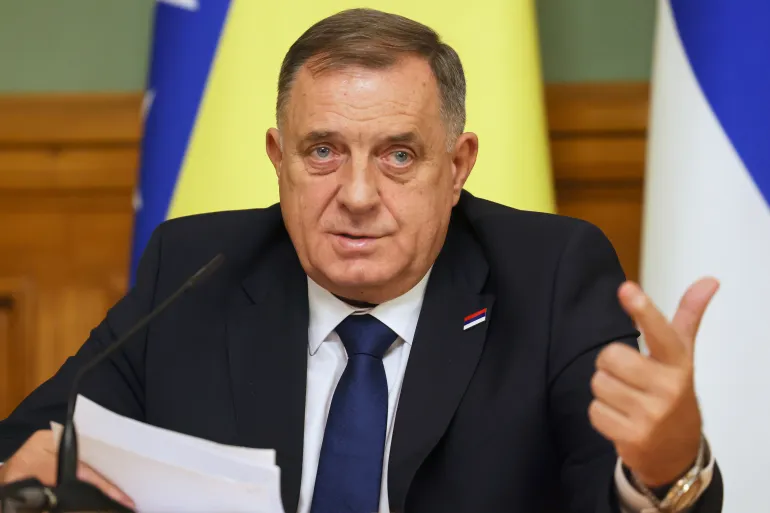
Bosnian Serb leader Milorad Dodik has intensified political tensions in Bosnia and Herzegovina after describing the country as a “failed state” and reiterating his long-standing position that Bosnian Serbs do not wish to live under what he called Sarajevo’s political dominance.
Speaking in a podcast interview with American journalist Lara Logan, Dodik argued that Bosnia and Herzegovina is dysfunctional and suggested that the United States should reconsider its engagement in the country. He said Bosnian Serbs want to focus on developing Republika Srpska, the Serb-majority entity within Bosnia, and govern it according to their own political vision.
Dodik claimed that Serbs in Bosnia and Herzegovina do not want to be subjected to what he described as political pressure from Sarajevo and questioned why Bosnian authorities insist on maintaining the current state framework.
He also stated that younger generations of Bosnian Serbs, including those who did not experience the 1990s war, reject what he characterized as political domination by Sarajevo. At the same time, he said he did not seek to rule over Bosniak Muslims, but did not want them to rule over Serbs either.
The remarks are widely seen as a continuation of Dodik’s long-standing political strategy of portraying Bosnia and Herzegovina as an unworkable state while promoting Republika Srpska as a distinct political entity with greater autonomy.
Analysts say the latest comments are more than domestic political rhetoric and reflect an effort to reinforce Dodik’s position internationally at a time when Bosnia is facing renewed institutional and political disputes.
The comments come against the backdrop of one of the most serious political crises in Bosnia and Herzegovina since the end of the 1992–1995 war. Ongoing disputes involve the authority of state institutions, judicial powers, constitutional arrangements and the role of the international community in overseeing the implementation of the Dayton Peace Agreement.
Tensions have also been fueled by repeated confrontations between Dodik and international officials, particularly High Representative Christian Schmidt, whose authority is not recognized by Bosnian Serb leaders.
For years, Dodik has advocated greater autonomy for Republika Srpska and has occasionally raised the prospect of separation from Bosnia and Herzegovina, moves that have drawn criticism from Western governments and international organizations concerned about regional stability.
Observers warn that statements questioning the legitimacy and functionality of Bosnia and Herzegovina risk deepening ethnic divisions and undermining efforts to strengthen state institutions.
More than three decades after the breakup of Yugoslavia and nearly 30 years after the Dayton Peace Agreement ended the Bosnian war, the country continues to struggle with political fragmentation, institutional deadlock and competing visions of its future.
Dodik’s latest remarks have once again placed those unresolved questions at the center of political debate, highlighting the persistent challenges facing one of the Balkans’ most fragile states.