


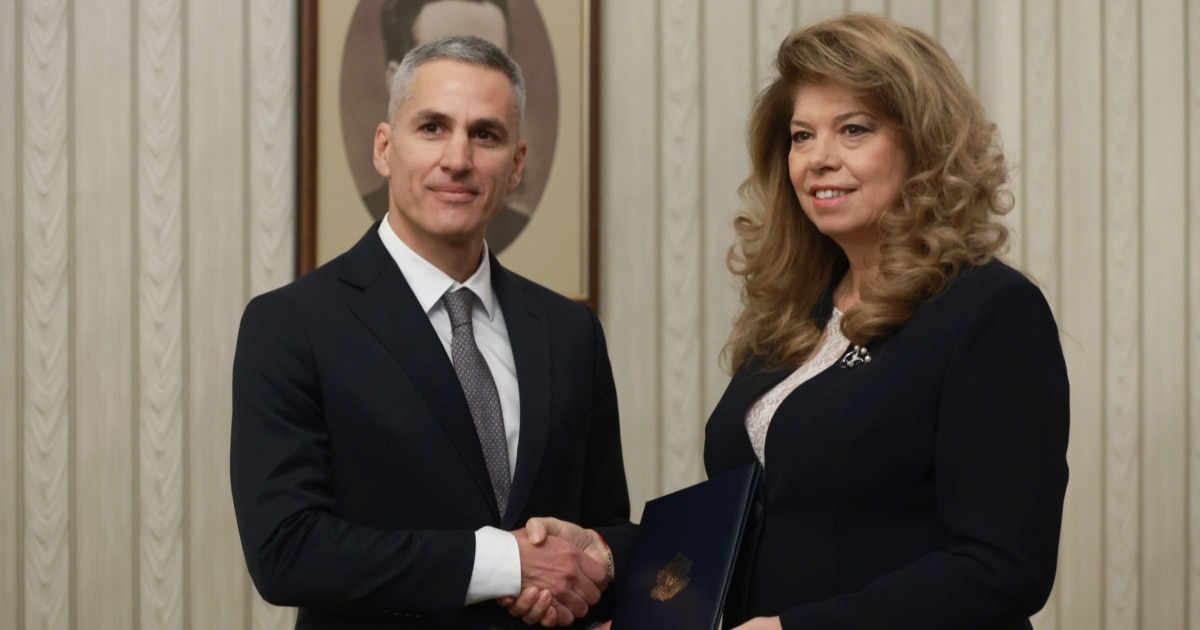
Bulgaria’s Oct. 25 presidential election is shaping up as more than a contest for a largely ceremonial office. With acting President Iliana Iotova backed by Prime Minister Rumen Radev and pro-European challenger Andrey Gyurov gathering support across the centre-right, the vote is becoming a test of Bulgaria’s geopolitical direction – and of how much political power Radev’s camp can consolidate.
SOFIA, Sept 15 (BalkanView) – Bulgaria’s presidential election is taking shape as a contest between competing visions of the country’s place in Europe, its relationship with Russia and the concentration of political power around Prime Minister Rumen Radev after years of instability.
Democrats for a Strong Bulgaria, or DSB, has thrown its support behind former caretaker prime minister Andrey Gyurov for president and Georgi Kandev for vice president, strengthening a pro-European ticket that is emerging as the main challenge to acting President Iliana Iotova.
Iotova, Radev’s former vice president, is seeking a full presidential term in the Oct. 25 election with the prime minister’s backing.
Her victory would put the presidency and government under the influence of closely aligned political forces, a prospect likely to become one of the defining issues of the campaign.
For Bulgaria, a NATO and European Union member strategically positioned on the Black Sea flank, the election also carries implications for policy towards Ukraine and Russia.
Gyurov builds a broad pro-European coalition
DSB said it viewed Gyurov and Kandev as capable of restoring the presidency to its constitutional role of uniting society, protecting democratic institutions and helping build a new national consensus.
The endorsement adds to support already announced by We Continue the Change and Democratic Bulgaria.
More than 200 artists, writers, academics, former ministers and other public figures have also joined a citizens’ initiative backing the ticket.
The committee was formally established in Sofia with opera singer Alexandrina Pendachanska and journalist Konstantin Valkov as co-chairs.
Its supporters include former ministers, academics, cultural figures, economists and civil society representatives.
Organisers have stressed that the committee itself is a citizens’ initiative rather than a party structure, even though Gyurov has secured clear political backing from parties opposed to Radev’s government.
That distinction reflects a broader trend in Bulgaria’s presidential campaign: candidates are presenting themselves as personalities standing above traditional party structures even as established parties line up behind them.
‘I will not let Bulgaria leave Europe’
Gyurov has placed Bulgaria’s European and Euro-Atlantic orientation at the centre of his campaign.
“As president, I will be a guarantor of Bulgaria’s development in Europe and the free world,” he said when presenting his candidacy.
He pledged not to allow what he described as narrow party, oligarchic or foreign interests to undermine the achievements of Bulgaria’s post-communist integration into Europe.
The message is clearly aimed at voters concerned that years of political instability, growing populism and disputes over Russia could weaken Sofia’s Western orientation.
Gyurov has also put judicial reform, anti-corruption measures, transparency and reducing oligarchic influence at the heart of his campaign.
He has portrayed the election as a chance to break with a political system that he says has dominated Bulgaria for almost two decades.
“Such a change requires new individuals with energy and the will to work differently, not a regrouping of the old players behind new masks,” he said.
Ukraine emerges as dividing line
The clearest geopolitical difference between the leading camps concerns Russia and the war in Ukraine.
Iotova has argued that the war cannot be resolved by military means and has criticised continued spending on weapons, saying it produces more casualties and deepens divisions between Orthodox nations.
Her position broadly echoes Radev’s more cautious approach towards military support for Ukraine and his repeated emphasis on diplomacy.
That contrasts with Gyurov’s explicit commitment to Bulgaria’s place within the EU and NATO and his warnings against foreign influence.
The divide gives the presidential race significance beyond Bulgaria.
Sofia sits on NATO’s southeastern flank, participates in European decisions on Ukraine and is part of a region where Russia retains political, historical, cultural and energy influence.
The presidency does not control day-to-day government policy, but the Bulgarian president is commander-in-chief, has a powerful public platform and can exercise significant influence during periods of parliamentary instability.
Recent Bulgarian history has demonstrated just how important that can become.
Radev’s extraordinary political transformation
The election follows a dramatic transformation in Bulgaria’s political system.
Radev moved from the presidency into party politics and, after winning the April 2026 parliamentary election, became prime minister.
His rise followed five years marked by repeated elections, unstable parliamentary majorities and short-lived governments.
A victory for Iotova would therefore create an unusual alignment.
Radev would control the government as prime minister while a long-time political ally occupied the presidency.
Opponents are likely to argue that such an outcome would concentrate too much political influence in one camp.
Supporters could counter that Bulgaria needs institutional stability after years of fragmented parliaments and repeated elections.
The contest is consequently becoming as much about checks and balances as about the personalities running for president.
GERB stays out – but its voters could decide the election
One of the biggest uncertainties is GERB.
The centre-right party that dominated Bulgarian politics for much of the period between 2008 and 2025 has decided not to nominate its own presidential candidate.
GERB leader Boyko Borissov has argued that fielding a candidate could divide the pro-European vote and benefit Iotova.
He had called for broader democratic forces on the right to unite around a common candidate, but such an agreement did not materialise.
The absence of a GERB candidate creates a potentially decisive pool of voters.
Gyurov’s supporters are already openly courting them.
Professor Kosta Kostov, a member of the initiative supporting Gyurov, appealed directly to GERB voters, arguing that Bulgaria needs a president capable of acting as a corrective to the government while protecting the country’s EU and NATO orientation.
The strategic question is whether GERB voters will follow that logic, abstain or move towards another candidate.
Their choice could determine whether Iotova can dominate the race or faces a competitive runoff.
Iotova starts as the candidate to beat
Iotova nevertheless enters the contest with significant advantages.
She is acting president, has high name recognition and benefits from Radev’s political machinery and electoral momentum.
Her initiative committee includes figures associated with the Bulgarian left, public personalities and some individuals connected with GERB.
Political observers therefore see her as an early favourite.
But the race remains fluid.
Ivan Hristanov, a former caretaker agriculture minister, is also running, while MECH leader Radostin Vassilev has entered the contest.
The nationalist Revival party has yet to nominate a candidate, while the Movement for Rights and Freedoms has not clarified its position.
Those decisions could significantly affect the distribution of votes in the first round.
Independent candidates, powerful parties behind them
The election also illustrates a peculiarity of Bulgarian politics.
Leading candidates are formally running through citizens’ initiative committees while enjoying varying degrees of support from established political parties.
The model allows candidates to present themselves as figures capable of transcending partisan divisions.
But the political alignments remain visible.
Iotova is closely associated with Radev’s political camp.
Gyurov is increasingly becoming the candidate around whom pro-European opposition forces are gathering.
Other candidates could appeal to voters disillusioned with both blocs.
The result may be a presidential campaign fought less through conventional party structures and more through personalities, social media and competing narratives about Bulgaria’s future.
Social media could become the real battlefield
That could make the campaign particularly volatile.
After years of repeated elections, Bulgarian voters have shown growing frustration with established parties and political elites.
Social media has increasingly become a central arena for mobilisation, especially among younger voters.
Campaign messages are likely to focus heavily on personalities, corruption, national sovereignty, Russia, Ukraine and the question of who genuinely represents political change.
That environment can favour outsider-style campaigns but can also intensify polarisation and disinformation.
The battle between Gyurov and Iotova is particularly suited to that dynamic.
One side can frame the election as a defence of Bulgaria’s European future and institutional checks on Radev.
The other can present itself as a force for stability, sovereignty and a less confrontational foreign policy.
A presidency with more influence than its formal powers suggest
Bulgaria’s presidency is sometimes described as largely ceremonial, but the country’s recent political crises have shown that description to be incomplete.
The president represents the state internationally, serves as commander-in-chief and has constitutional powers that become particularly important when parliament cannot produce stable governments.
Repeated political deadlock after 2021 dramatically increased the presidency’s practical influence.
That experience is likely to shape how Bulgarians vote.
Gyurov has promised to use the presidency as a constitutional counterweight rather than an alternative centre of executive power.
He said he would be guided by the constitution and resist attempts to replace Bulgaria’s established parliamentary system with other models of government.
That message directly targets concerns about excessive concentration of authority.
Russia, Ukraine – and Bulgaria’s place in the West
The deeper question behind the campaign is geopolitical.
Bulgaria joined NATO in 2004 and the European Union in 2007, but attitudes towards Russia remain more complicated than in many Central and Eastern European states.
Historical and cultural ties coexist with Bulgaria’s institutional integration into the West.
Russia’s invasion of Ukraine turned those ambiguities into a major political dividing line.
The presidential election could sharpen that divide further.
Gyurov is campaigning explicitly as a guarantor of Bulgaria’s Western orientation.
Iotova is emphasising diplomacy and questioning the logic of continued military solutions to the Ukraine war.
Neither position by itself would determine Bulgaria’s foreign policy, which remains primarily a government responsibility.
But a president can shape public debate, influence institutional conflicts and send powerful signals to allies.
The Oct. 25 vote becomes a test of Radev’s Bulgaria
For Radev, an Iotova victory would represent another major political achievement after his move from the presidency to the premiership.
For the opposition, defeating her could create an institutional counterweight to his government.
For GERB, the election presents a different challenge: whether it can remain politically relevant without fielding its own candidate.
And for Bulgaria’s Western partners, the campaign will provide an indication of how firmly public opinion remains anchored to the EU and NATO as the war in Ukraine continues to reshape European politics.
What initially looks like an election for a constitutional head of state is therefore developing into something much larger.
Bulgarians will formally choose a president on Oct. 25.
But the political choice increasingly looks like one between competing ideas of Europe, Russia, institutional power and the direction Bulgaria should take after five years of political upheaval.