


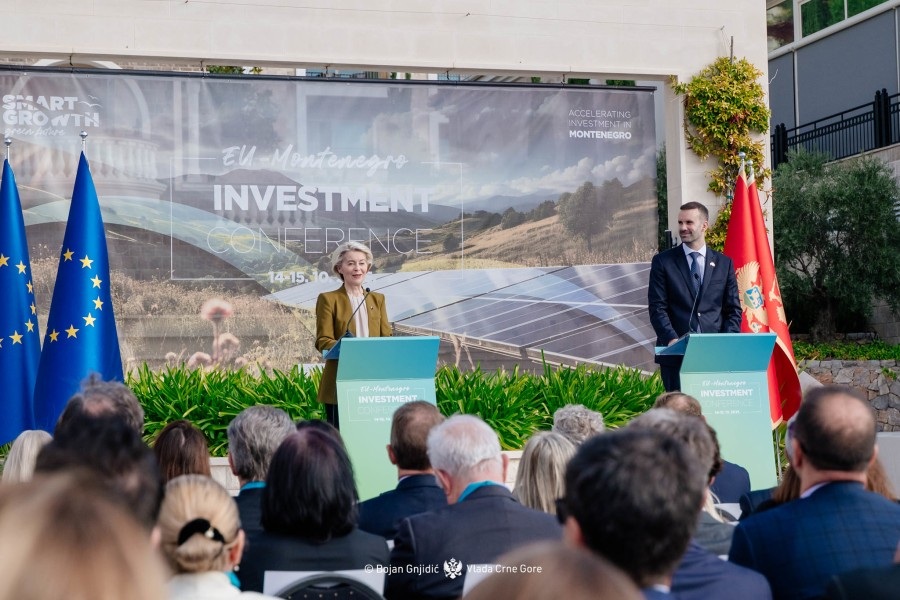
BRUSSELS, Aug. 25 (Balkan View) – The European Union is preparing an accelerated plan to complete accession negotiations with Montenegro, potentially closing all remaining negotiating chapters by the end of 2026 and producing a first draft of the country’s Accession Treaty by the end of September, European Western Balkans reported, citing the Montenegrin daily Pobjeda.
If implemented, the plan would move Montenegro significantly closer to the final stage before EU membership and further consolidate its position as the most advanced Western Balkan candidate.
According to Pobjeda, ambassadors representing five influential EU member states recently held urgent consultations in Brussels over political and social developments in Montenegro.
Sources within the European Commission cited by the newspaper expressed concern about what they described as increasing hybrid influence from the region, primarily from Serbia, which they said could potentially slow or jeopardise Montenegro’s European integration.
“Montenegro’s European path must be protected from hybrid influence,” a senior European Commission official was quoted as saying, while adding that Podgorica must also fulfil all remaining reform commitments.
The allegations regarding Serbian influence and details of the accelerated timetable are based on unnamed sources and have not been formally confirmed by the European Commission.
Von der Leyen’s office expected to take direct role
According to the report, the office of European Commission President Ursula von der Leyen, working in coordination with the Irish presidency of the Council of the EU, is expected to take a direct role in coordinating the next stages.
The process could gain additional momentum after Iceland’s Aug. 29 referendum on whether the country should reopen EU accession negotiations.
A positive result in Iceland could, according to sources cited by Pobjeda, strengthen political momentum behind enlargement and ease resistance among some member states to admitting new countries.
For Montenegro, that would come at a particularly important moment.
The country has been negotiating EU membership since 2012 and has opened all 33 negotiating chapters. Its government has said it wants to complete negotiations by the end of 2026 and become an EU member by 2028.
Work on Montenegro’s Accession Treaty already under way
Preparations for Montenegro’s eventual Accession Treaty have already begun at EU institutional level.
EU member-state ambassadors approved the creation of a specialised working group in April, while the Council of the EU formally established an ad hoc group in May tasked with preparing the treaty and accompanying legal acts.
Those documents will eventually define the precise conditions under which Montenegro would join the bloc, including possible transitional arrangements, financial obligations, institutional provisions and safeguard clauses.
Under the reported accelerated timetable, another four or five negotiating chapters could be provisionally closed at the next EU-Montenegro intergovernmental conference.
Brussels is also seeking greater European involvement in resolving outstanding bilateral disputes between Montenegro and Croatia, according to the report, in an effort to prevent them from becoming an obstacle during the final stage of accession.
If all remaining chapters are closed by the end of 2026, the centre of gravity would shift from negotiations to finalising, signing and ratifying the Accession Treaty.
Montenegro increasingly separates itself from the Western Balkan pack
Montenegro is already considerably ahead of most other Western Balkan candidates.
The European Parliament said in June that it welcomed Montenegro’s steady progress on EU-related reforms and noted Podgorica’s ambition to complete negotiations by the end of 2026 and become the bloc’s 28th member by 2028.
By contrast, North Macedonia remains unable to open the first negotiating cluster because constitutional amendments required under its negotiating framework have not been adopted, while Serbia’s accession process has slowed amid disputes over rule-of-law reforms, foreign-policy alignment and relations with Kosovo.
Albania has accelerated its negotiations and hopes to close them by the end of 2027.
That leaves Montenegro with an increasingly realistic opportunity to become the first Western Balkan country to join the EU since Croatia became a member in 2013.
But even an accelerated political timetable would not automatically guarantee membership.
Every negotiating chapter must be provisionally closed, the Accession Treaty must be agreed by EU governments and Montenegro, approved by the European Parliament and then ratified by all EU member states under their respective constitutional procedures.
The accelerated plan being discussed in Brussels would therefore not amount to immediate membership.
It would, however, signal that the EU is increasingly preparing for the possibility that enlargement in the Western Balkans could move from political promise to institutional reality.