


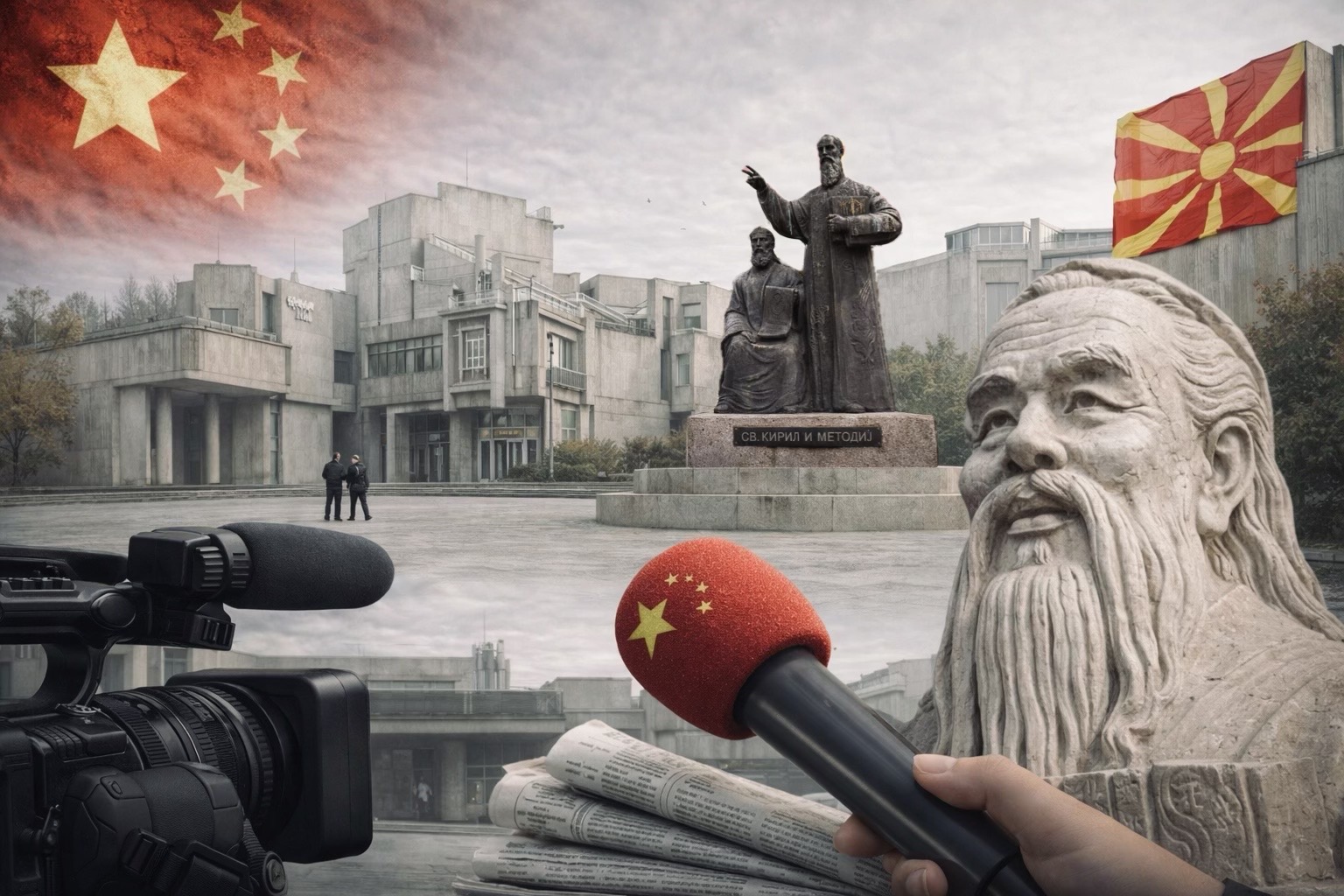
SKOPJE, August 18 (BalkanView) – In the last two decades, China has emerged as one of the most visible non-Western economic players in North Macedonia, expanding or maintaining a presence in transport, energy and major infrastructure projects.
The trend is particularly significant because North Macedonia is a NATO member and European Union candidate whose largest strategic and financial partners remain Western institutions and countries.
Chinese firms have secured important contracts and Chinese technology is entering critical infrastructure. Beijing has also demonstrated its willingness to exert diplomatic pressure over contacts with Taiwan.
Chinese companies move deeper into energy
One of the clearest examples of China’s expanding commercial presence is the energy sector.
State-owned electricity producer ESM signed contracts in June 2026 with POWERCHINA Jiangxi Electric Power Construction for the construction of two photovoltaic plants with a combined capacity of 30 megawatts — 10 MW at Oslomej and 20 MW at Bitola.
The projects give a major Chinese state-controlled engineering group a role in North Macedonia’s transition from coal towards renewable energy.
There is, however, an important distinction.
The solar projects are not evidence of Chinese financing of North Macedonia’s energy transition. The wider programme has been supported by the European Bank for Reconstruction and Development. The Chinese company won the construction work.
POWERCHINA is also the corporate group behind Sinohydro, the Chinese company already deeply associated with one of North Macedonia’s most controversial infrastructure projects — the Kicevo-Ohrid motorway.
China’s presence is also visible in wind energy.
Goldwind, one of China’s largest wind-turbine manufacturers, supplied nine 4.8-MW turbines for a 43.2-MW wind project in southern North Macedonia. The development demonstrates the penetration of Chinese technology into a sector regarded as increasingly strategic as Europe accelerates its energy transition.
Claims that another major Chinese turbine producer, Envision, has established a comparable concrete project in North Macedonia are harder to substantiate. Available evidence confirms growing activity by Chinese wind manufacturers in Europe and the Balkans, but is insufficient to establish a specific Envision project in North Macedonia.
The distinction matters.
A wind farm using Chinese turbines does not necessarily constitute a Chinese investment. Chinese equipment, Chinese contractors and Chinese ownership of energy assets are three different forms of economic involvement and should not be treated as interchangeable.
The electric-bus deal raises another China question
China’s footprint may also extend further into public transport.
North Macedonia has launched a procurement procedure for 150 electric buses and 75 charging stations. In the repeated tender, the lowest offer came from Ikarus Electric and EVN, worth about 3.12 billion denars, or slightly more than 50 million euros excluding VAT.
Although Ikarus is a Hungarian brand, its electric-bus business has extensive links with Chinese manufacturers and technology.
Taken together, these developments point to something broader than individual contracts: Chinese industrial technology is becoming increasingly embedded in sectors ranging from rail transport to electric mobility and renewable energy.
The motorway that became a symbol of Chinese involvement
No project illustrates North Macedonia’s complicated relationship with Chinese infrastructure investment better than the Kicevo-Ohrid motorway.
The highway has suffered years of delays, cost increases, construction difficulties and changes to the original project.
Sinohydro remains central to its construction.
In March 2026, an eighth annex to the construction contract provided an additional 186 million euros and extended the completion deadline to May 31, 2027.
Authorities have said the additional works include the rehabilitation of 14 landslides, slope stabilisation, safety infrastructure, a control centre and additional roads.
The project therefore remains one of the strongest examples of the durability of Chinese commercial involvement in North Macedonia.
The missing Chinese billions on Corridor X
A potentially even larger project requires greater caution.
Claims have circulated that construction of a high-speed railway along Corridor X is being rapidly implemented as part of China’s Belt and Road Initiative and that North Macedonia will repay billions of dollars in Chinese loans.
China has previously expressed interest in transport connectivity through the Balkans, and North Macedonia’s position on the north-south Corridor X makes the country strategically important for freight moving between the Greek ports and Central Europe.
But earlier proposals for Chinese involvement do not amount to proof that the current high-speed railway programme is being financed through billions of dollars in Chinese loans.
On the contrary, European institutions remain deeply involved in financing North Macedonia’s transport infrastructure through the EBRD, European Investment Bank, Western Balkans Investment Framework, IPA and the EU’s Global Gateway framework.
The geopolitical significance of Corridor X is real. Describing its current development as a multibillion-dollar Chinese Belt and Road project, however, goes beyond what the available evidence demonstrates.
Taiwan: where Beijing’s political influence becomes visible
China’s economic footprint becomes more politically sensitive when Taiwan enters the picture.
Taiwanese electronic-components giant Yageo announced in 2023 what was presented as one of the largest foreign investments in North Macedonia’s history.
An agreement envisaged investments of up to 205 million euros over 10 years, new production facilities in Skopje and Stip and thousands of jobs.
Yageo already has a presence in North Macedonia through KEMET, which the Taiwanese company acquired in 2020.
The more ambitious expansion announced in 2023, however, has raised questions over the pace of implementation.
That has produced claims that Chinese pressure prevented or obstructed the Taiwanese investment.
No publicly available statement from Yageo, the North Macedonian government or another directly involved party demonstrates that Beijing blocked the investment.
What is documented is China’s willingness to pressure North Macedonian politicians over Taiwan.
In 2024, Chinese diplomats contacted politicians from several countries in an effort to discourage their participation in a summit in Taiwan organised by the Inter-Parliamentary Alliance on China.
Among them was North Macedonian lawmaker Antonio Milososki, who said he received a direct message from a representative of the Chinese embassy asking whether he intended to attend the conference.
Similar pressure was reported by politicians in Bosnia and Herzegovina and several other countries.
That episode provides concrete evidence that Beijing regards North Macedonia’s political contacts with Taiwan as an issue on which it is prepared to intervene diplomatically.
North Macedonia formally follows the One China policy, as do most European countries.
But respecting that policy and allowing Beijing to determine contacts between elected lawmakers and Taiwan are not necessarily the same thing.
China advances, but Europe still pays much of the bill
The emerging picture is therefore more nuanced than a simple Chinese takeover.
Chinese companies have secured strategically important positions in North Macedonia.
POWERCHINA is building renewable-energy infrastructure. Sinohydro remains embedded in one of the country’s largest highway projects. Goldwind technology has entered the wind-power market. Chinese industrial partnerships are appearing around electric public transport, while CRRC already has a history in the country’s railway sector.
At the political level, Beijing has demonstrated that it is willing to pressure North Macedonian politicians when its core interests regarding Taiwan are involved.
Yet the other side of the equation is equally important.
Much of North Macedonia’s major infrastructure development continues to depend on European money.
The EU, EBRD, EIB and associated European financing mechanisms remain fundamental sources of capital for transport, energy and connectivity. In some cases, European money is effectively financing projects on which Chinese companies subsequently win contracts.
That creates a different geopolitical question.
The issue is not simply whether North Macedonia is “turning towards China”. It is whether Chinese state-linked companies are gradually establishing commercially and technologically important positions inside infrastructure financed partly by North Macedonia’s Western partners.
For a small NATO country negotiating EU membership, that distinction is crucial.
A footprint worth watching
China does not need to replace the European Union or the United States as North Macedonia’s principal strategic partner to increase its influence.
Infrastructure provides relationships that can last for decades.
A motorway requires maintenance. A railway fleet requires spare parts and technical support. Electric buses need software, batteries and charging systems. Wind turbines and solar plants require servicing and replacement components.
Winning the initial contract can therefore be only the beginning.
This makes the growing presence of Chinese companies in North Macedonia less dramatic than claims of a sudden geopolitical pivot — but potentially more consequential over the long term.
But the broader trend is difficult to ignore.
China is building a deeper commercial and technological footprint in North Macedonia’s infrastructure and energy sectors while fiercely defending its political red lines over Taiwan.