


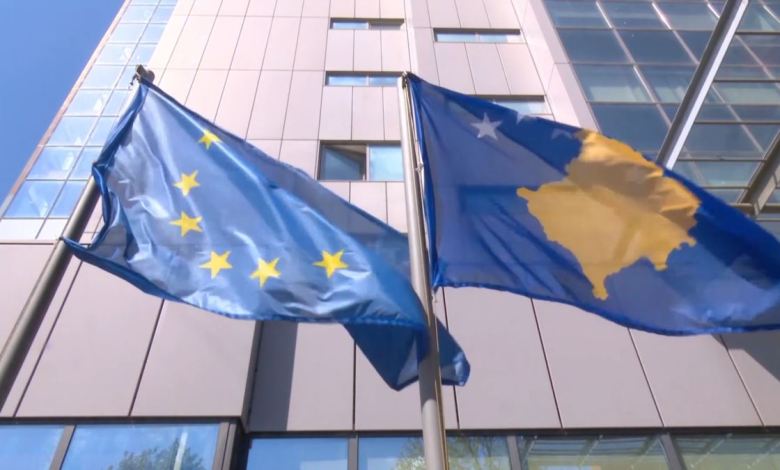
BRUSSELS, Oct 8 (BalkanView) — The European Union has warned Kosovo that newly adopted amendments to legislation governing its Hague-based war crimes court conflict with the country’s international obligations, as nine EU member states separately called for a clear rejection of war crimes glorification and genocide denial in countries seeking membership.
The two developments highlight the continuing importance of accountability for the wars of the 1990s in the Western Balkans, where disputes over wartime responsibility remain closely connected to relations with the European Union.
In a statement issued by the European External Action Service, EU spokesperson Christian Wiegand said the amendments adopted by Kosovo’s parliament were incompatible with commitments Pristina had made to the bloc.
“The law adopted by the Kosovo Assembly amending and supplementing the Law on the Specialist Chambers is contrary to Kosovo’s international obligations towards the EU,” the statement said.
Brussels called on Kosovo to preserve the independence of the Kosovo Specialist Chambers and Specialist Prosecutor’s Office, protect witnesses and ensure justice for victims and their families from all communities.
The institutions, based in The Hague but operating under Kosovo law, were established through decisions taken by Kosovo’s authorities in 2014 and 2015.
They investigate and prosecute crimes linked to the 1998-1999 Kosovo conflict and its aftermath.
Kosovo’s controversial legal changes
The EU’s response follows the Kosovo parliament’s adoption of amendments intended to change the legal framework governing the Specialist Chambers.
The proposed changes have been a central political issue in Pristina, particularly following the September convictions of former senior Kosovo Liberation Army figures.
Among the measures discussed are restrictions on the court’s jurisdiction, changes to sentencing provisions, including a proposed maximum prison term of 15 years, and arrangements that could allow sentences to be served in Kosovo.
Supporters of the changes have questioned aspects of the court’s mandate and treatment of defendants, while Brussels maintains that Kosovo must honour the commitments under which the institution was created.
The EU did not provide a detailed legal assessment of each amended provision in the statement cited by Kosovo media.
It nevertheless made clear that the independence of the court and the protection of witnesses must not be compromised.
“The Kosovo Specialist Chambers are delivering justice based on the principle of individual criminal responsibility,” Wiegand said.
That principle is particularly important in Kosovo, where the prosecution of former KLA commanders has generated political controversy and public debate over the relationship between individual criminal responsibility and the country’s struggle for independence from Serbia.
The EU statement did not announce specific punitive measures against Kosovo.
Nine EU countries issue a broader warning
Separately, nine Mediterranean EU member states, collectively known as MED9, adopted a declaration in Split, Croatia, reaffirming their support for the European future of the Western Balkans.
The group comprises Croatia, Cyprus, France, Greece, Italy, Malta, Portugal, Slovenia and Spain.
The declaration described enlargement as a geostrategic investment in peace, security and prosperity.
But it also stressed that candidate countries must demonstrate a genuine commitment to reconciliation and unequivocally reject the glorification of war crimes and genocide.
The statement did not identify Serbia or any other candidate country by name.
Its language nevertheless comes amid renewed controversy over how governments and political leaders in the former Yugoslavia commemorate individuals convicted of wartime atrocities.
The shadow of Ratko Mladić
The MED9 declaration follows international criticism of the September funeral in Belgrade of Ratko Mladić, the former Bosnian Serb military commander convicted of genocide at Srebrenica, crimes against humanity and war crimes.
Mladić died while serving a life sentence imposed by the United Nations war crimes tribunal and upheld on appeal.
His funeral, which included military honours and the participation of Serbian officials, prompted criticism from European leaders and renewed concerns over the public commemoration of convicted war criminals.
European Commission President Ursula von der Leyen and European Council President António Costa condemned the scenes associated with the funeral.
The Split declaration does not explicitly connect its position on reconciliation to that event.
However, the timing places the statement within a wider debate over whether candidate countries are confronting the legacy of the Balkan wars in a manner consistent with European principles.
Enlargement is more than adopting EU laws
For Western Balkan countries, EU accession has traditionally involved democratic reforms, judicial independence, economic development, fundamental rights and alignment with European legislation.
Good-neighbourly relations and regional cooperation have also been important components of the process.
The MED9 statement reinforces the political importance of reconciliation alongside those established requirements.
Its emphasis on rejecting the glorification of war crimes and genocide reflects concerns that unresolved historical disputes can continue to undermine relations between neighbouring countries.
It does not, however, establish a new formal accession criterion or automatically change the negotiating frameworks governing individual candidate countries.
The nine states have expressed a collective political position rather than announced a new EU-wide legal mechanism.
Two different messages, one common principle
The statements concerning Kosovo and the Western Balkans address different questions.
In Kosovo’s case, the EU is challenging legislation affecting a specific judicial institution and the international commitments supporting its work.
In the MED9 declaration, nine member states are setting out broader expectations concerning reconciliation, historical accountability and the political conduct of countries seeking EU membership.
Both developments reflect the continuing influence of the region’s wartime past on its relationship with Europe.
The EU has repeatedly argued that criminal responsibility must be determined individually through independent judicial proceedings, while political reconciliation requires respect for victims and established judicial findings.
For Kosovo, the immediate question is how its institutions will respond to Brussels’ objections to the Specialist Chambers legislation.
For Serbia and other Western Balkan countries, the Split declaration adds political weight to the expectation that a clear rejection of war crimes glorification must accompany closer European integration.
Neither statement sets out new sanctions or an automatic suspension of accession processes.
Together, however, they underscore that the European future of the Western Balkans remains closely linked to how the region addresses the legacy of its conflicts.