


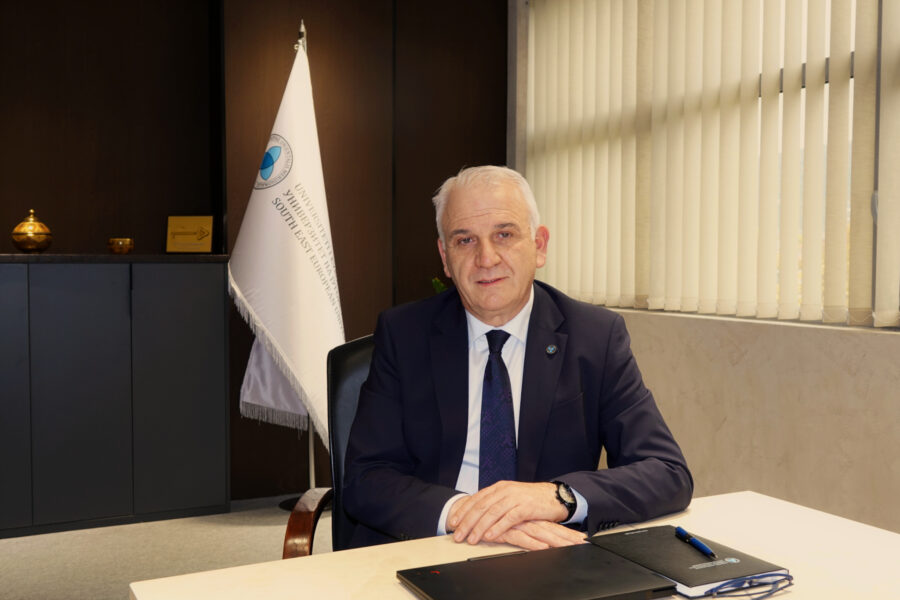
Professor Sadudin Ibraimi says North Macedonia must protect university autonomy, overhaul research funding and adapt higher education to artificial intelligence, warning that producing qualified graduates means little if the country cannot offer them a future.
TETOVO, North Macedonia – North Macedonia risks undermining university independence through proposed higher education reforms, while its failure to create attractive career opportunities continues to drive young graduates abroad, the rector of South East European University (SEEU) has warned.
In an interview with KDP, Professor Sadudin Ibraimi said universities faced mounting pressure from demographic decline, technological disruption and a labour market increasingly demanding skills that traditional academic programmes struggle to provide.
He welcomed tougher academic standards but warned that proposed changes to university governance could expose institutions to greater political influence.
“The fundamental difference lies in how members of the University Council are nominated,” Ibraimi said, referring to proposed legislation.
“In our assessment, this leaves considerable room for political influence and, within our political and institutional culture, could jeopardise academic autonomy.”
His comments come as North Macedonia debates changes to three laws governing higher education, quality assurance and scientific research.
University reform or political control?
Ibraimi said SEEU supported stricter accreditation procedures, independent evaluations and higher academic standards, but argued that reforms must account for differences between universities.
The Tetovo-based institution, established 25 years ago to expand equitable access to higher education, particularly in Albanian, operates as a private-public nonprofit university.
Ibraimi said its special institutional status should be preserved under the proposed legislation.
“A university with seven faculties should not be penalised simply because it does not have the scale of a much larger university,” he said.
“It should be assessed according to the quality and results of its work.”
He said SEEU’s governance model, which separates executive management from strategic oversight, already resembles elements of the proposed reforms.
The main concern, he argued, was whether political actors could gain influence over university decision-making through appointments to governing bodies.
More than 70% of graduates employed within six months
Despite demographic pressures and competition among universities, Ibraimi said SEEU had maintained institutional stability and recorded steady enrolment growth.
According to the university’s latest figures, more than 70% of its graduates secure employment within six months of completing their studies.
In computer science, he said, many students find jobs before graduating.
The rector attributed these results partly to cooperation with employers and the university’s Career Centre, established in 2005 with support from the United States Agency for International Development.
But he acknowledged that the wider education system continued to struggle with a mismatch between graduates’ qualifications and employers’ needs.
“There is particular interest today in technology, business and healthcare, but long-term success will not depend solely on the name of the profession,” he said.
“It will depend on our ability to prepare students for continuous change.”
Artificial intelligence is changing the classroom
Ibraimi said artificial intelligence was forcing universities to reconsider not only what they teach but also how they evaluate students.
SEEU has developed its own institutional AI platform, AI@SEEU, with contributions from students and university staff.
The rector described it as the first platform of its kind developed by a university in North Macedonia and the wider region, a claim that was not independently verified.
The system supports academic and administrative activities and forms part of the university’s broader digital transformation strategy.
Rather than prohibiting students from using AI tools, Ibraimi said universities should encourage responsible use while redesigning assessments to emphasise reasoning, practical knowledge and critical thinking.
“Artificial intelligence can help students learn more, but it should not think for them,” he said.
He called for greater emphasis on analysis, argumentation and source verification instead of assignments based primarily on reproducing information.
The university has also invested in facilities including a STEM laboratory, a virtual reality laboratory and a Future Skills Centre to help students acquire practical skills.
Brain drain: Universities cannot solve what governments fail to address
One of the interview’s central themes was the continuing departure of young professionals from North Macedonia.
Ibraimi said universities had a responsibility to prepare internationally competitive graduates but could not compensate for weaknesses in the country’s economic and institutional environment.
“Youth emigration is linked to employment opportunities, salaries, prospects for professional development and trust in institutions,” he said.
He argued that efforts to retain talent should move beyond appeals to patriotism and focus on creating meaningful opportunities.
“It is not enough to ask young people to stay. We must create reasons and opportunities for them to stay or to return.”
SEEU has sought to encourage what Ibraimi described as brain circulation, attracting academics with international experience and supporting students who want to establish businesses serving foreign markets while remaining in North Macedonia.
He cited researchers returning from British universities, including Cambridge and Birmingham, as examples of how international experience could strengthen domestic institutions.
Through its Technology Park, the university also supports startups and entrepreneurial initiatives.
Ibraimi said the ultimate goal was to transform brain drain into brain gain by connecting international expertise with local employment, research and innovation.
Research funding must reward results, not just enrolment
The rector also called for an overhaul of public funding for universities, arguing that the current system placed too much emphasis on institutional inputs rather than measurable outcomes.
He said funding should increasingly reflect teaching quality, graduate employment, innovation, scientific research and cooperation with industry.
“We should reward not only enrolments, but also the quality of learning, graduates’ employability, the creation of new businesses, innovation and applicable scientific research,” he said.
He advocated competitive, transparent and multi-year research grants, available to institutions based on academic performance rather than ownership status or size.
According to Ibraimi, SEEU ranks among North Macedonia’s top three universities in the QS Europe 2026 rankings and is placed third nationally for scientific impact.
He also highlighted its performance in the Times Higher Education Impact Rankings 2025, particularly in the category assessing contributions to quality education.
The rector said the university’s participation in European academic partnerships, including the ChallengeEU Alliance, helped strengthen research and international cooperation.
SEEU uses about 100 international mobility grants annually for students and staff, though the number of completed exchanges varies with available funding, he said.
Twenty-five years after its founding, SEEU defends its multiethnic mission
As SEEU marks its 25th anniversary, Ibraimi said the institution’s original mission of improving access to higher education and promoting cooperation between ethnic communities remained relevant.
Founded during a period of significant political and social change in North Macedonia, the university was designed to expand educational opportunities while encouraging multilingualism and intercultural understanding.
Ibraimi said the university had evolved into an internationally connected institution without abandoning those foundations.
“Multilingualism and diversity are not slogans for us. They require sustainable policies, staff, services and continuous investment,” he said.
He acknowledged that ethnic and linguistic divisions remained a challenge in the country’s education system.
“Whenever we see tendencies towards division along linguistic or ethnic lines, we become even more convinced that universities must be spaces for encounters and cooperation.”
Three reforms North Macedonia urgently needs
Asked to identify his three most urgent priorities for higher education, Ibraimi called for a comprehensive quality assurance system, a funding model based on measurable outcomes and stronger connections between universities, scientific research and the economy.
He argued that North Macedonia could narrow its productivity gap with the European Union only by investing more effectively in education, research and innovation.
For Ibraimi, the central challenge is not simply whether universities can produce graduates capable of competing internationally.
It is whether North Macedonia can build an economy and institutions that persuade those graduates to build their futures at home.