


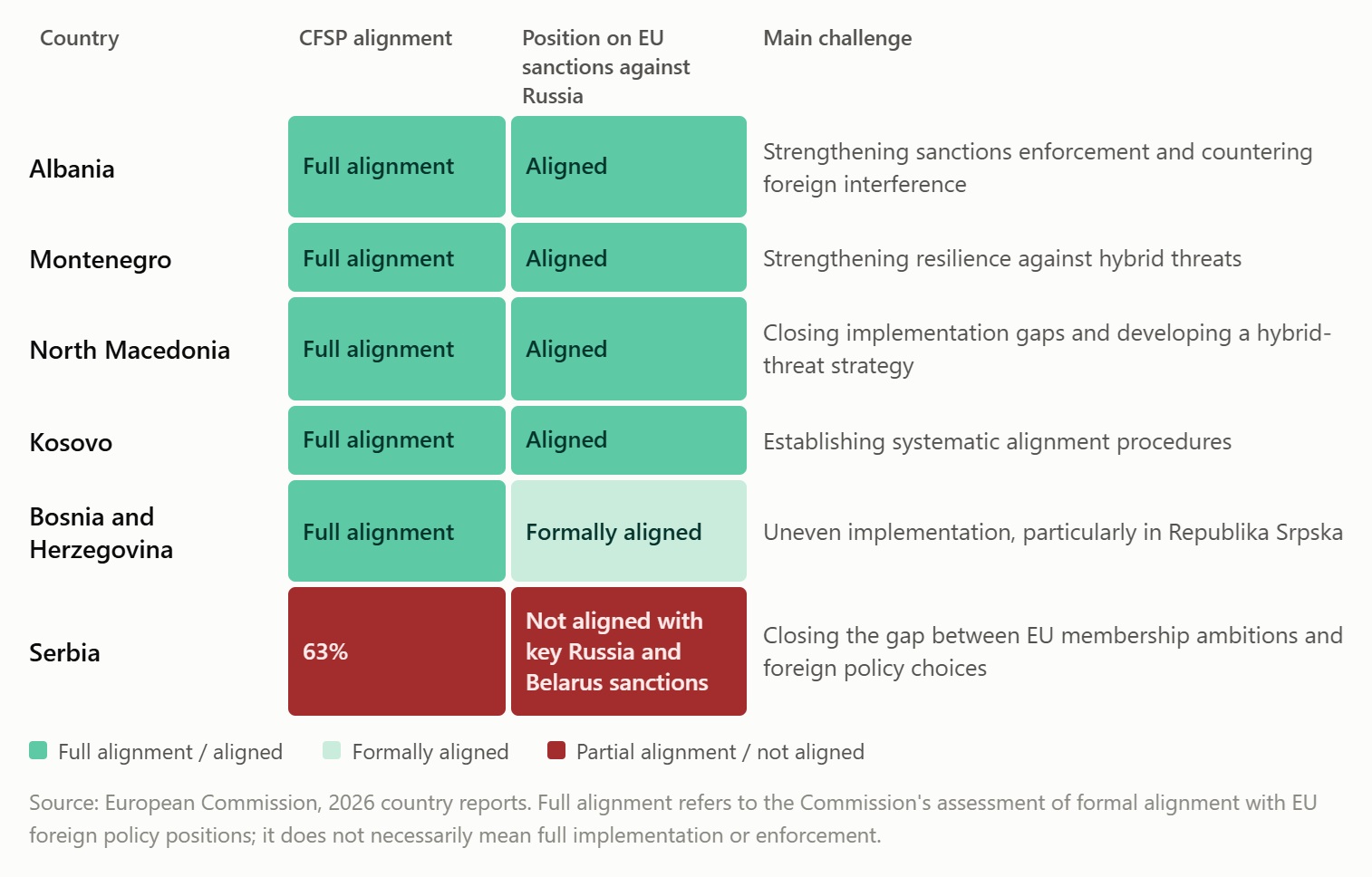
The European Commission’s 2026 enlargement reports reveal a sharp geopolitical divide in the Western Balkans. Albania, Montenegro, North Macedonia, Kosovo and Bosnia and Herzegovina maintain full alignment with EU foreign policy, while Serbia’s alignment has fallen from 67% to 63%, largely reflecting its refusal to join sanctions against Russia.
BRUSSELS, Nov. 5, 2026 (BalkanView) — Five of the six Western Balkan countries seeking European Union membership have maintained full alignment with the bloc’s foreign and security policy, leaving Serbia increasingly isolated in a region where Russia’s war against Ukraine has become a defining test of geopolitical loyalty.
The European Commission’s 2026 enlargement reports, published on Wednesday, show that Albania, Montenegro, North Macedonia, Kosovo and Bosnia and Herzegovina continued to align with EU foreign policy declarations and restrictive measures.
Serbia, however, recorded an alignment rate of just 63%, down from 67% in 2025, and continued to refuse EU sanctions against Russia and Belarus imposed over Moscow’s invasion of Ukraine.
The divergence is particularly significant because Serbia has been negotiating EU membership since 2014 but remains behind neighbours that have not yet opened accession negotiations.
For Brussels, foreign policy alignment is more than a diplomatic formality. Candidate countries are expected progressively to adopt the EU’s Common Foreign and Security Policy (CFSP), including sanctions, international positions and security commitments.
The latest reports reveal an important distinction: five countries have formally adopted the EU’s foreign policy positions, but their ability to implement those commitments varies.
Serbia: The Region’s Main Geopolitical Outlier
Serbia stands apart from its Western Balkan neighbours.
The Commission reports that Belgrade’s CFSP alignment rate fell by four percentage points, from 67% in 2025 to 63% in 2026.
The decline comes despite Serbia’s stated commitment to EU membership and its participation in political dialogue with Brussels.
The central disagreement remains Russia.
Serbia has not joined the EU’s restrictive measures against Russia and Belarus introduced in response to the invasion of Ukraine.
The Commission also notes that Serbia continues to operate flights to Russian cities, including Moscow, St Petersburg, Kazan and Nizhny Novgorod, and hosts pro-Kremlin news channels.
Brussels expresses concern about foreign information manipulation and interference, urging Serbia to prevent its territory or citizens from being used by third countries for hybrid operations.
The report acknowledges cooperation between Serbian and EU authorities on preventing sanctions circumvention, but calls for significantly stronger political alignment.
Serbia’s position reflects a longstanding attempt to maintain relations with the EU while preserving ties with Moscow.
That approach has become increasingly difficult to reconcile with the EU’s expectation that future members share its strategic priorities.
The October 25 parliamentary election, which gave the student-backed Student List an absolute majority according to preliminary results, introduces a new political variable.
The Commission’s assessment largely covers the period before the election and should therefore be read as a record of the outgoing political system, not a judgement on the incoming authorities.
Whether the new leadership changes Serbia’s policy towards Russia will be an important indicator of its commitment to accelerating EU integration.
North Macedonia: Fully Aligned, but Still Blocked on Accession
North Macedonia offers one of the region’s clearest contrasts between geopolitical alignment and accession progress.
The Commission confirms that Skopje maintained full alignment with the EU’s foreign and security policy throughout the reporting period, including sanctions related to Russia’s war against Ukraine.
The country also made good progress in foreign, security and defence policy, an area where it has achieved a good level of preparation.
North Macedonia continued participating in EU security operations, including EUFOR ALTHEA in Bosnia and Herzegovina and the HELBROC EU Battlegroup.
Its security partnership with Brussels has also expanded.
The EU–North Macedonia Security and Defence Partnership was signed in November 2024, followed by a security dialogue launched in Skopje in May 2025 and a further meeting in Brussels in 2026.
The EU has supported North Macedonia’s armed forces through three European Peace Facility assistance measures worth a combined 38 million euros by April 2025.
The Commission nevertheless identifies implementation challenges, particularly delays between alignment with EU restrictive measures and their formal entry into force under national law.
It also recommends a comprehensive national strategy to address hybrid threats.
Despite its foreign policy record, North Macedonia remains unable to advance to the next stage of accession negotiations because the constitutional amendments required under the 2022 Council conclusions have not been adopted.
This creates a central contradiction in the country’s European integration process.
Skopje has demonstrated geopolitical solidarity with Brussels but has not secured corresponding progress in accession negotiations.
The case illustrates that foreign policy alignment, although important, cannot replace other political and institutional conditions for membership.
Albania: Full Alignment Becomes Part of Its EU Strategy
Albania has positioned itself among the Western Balkans’ most consistently pro-European foreign policy actors.
The Commission confirms that Tirana remained fully aligned with the CFSP, including EU declarations and decisions on restrictive measures.
Albania also continued participating in EU security and defence discussions, with the second EU–Albania Security and Defence Dialogue held in Brussels in April 2026.
The country strengthened its institutional framework for implementing sanctions, adopting new procedures in March 2026 for its Committee on International Restrictive Measures.
However, the Commission says Albania still needs to improve its technical capacity to enforce complex sanctions regimes.
This distinction matters because adopting EU sanctions does not necessarily guarantee their effective enforcement.
Albania’s foreign policy alignment reinforces its broader accession momentum. The country has opened all six negotiating clusters and provisionally closed four chapters, making it one of the region’s most advanced candidates.
Its challenge is to turn diplomatic alignment into the administrative and enforcement capacity expected of an EU member state.
Montenegro: The Closest to Membership Also Stays Closest to Brussels
Montenegro combines advanced accession negotiations with full foreign policy alignment.
The Commission confirms that Podgorica maintained complete alignment with EU foreign policy declarations and restrictive measures throughout the reporting period.
Montenegro also participated in EU crisis-management missions and strengthened its cooperation with Brussels on security and defence.
The first EU–Montenegro Security and Defence Dialogue took place in December 2025.
During the reporting period, the country held seven regular and one extraordinary session of its Permanent Coordination Body for Restrictive Measures, while providing training to strengthen sanctions implementation.
Montenegro also aligned with EU positions at the United Nations General Assembly, including resolutions concerning Ukraine.
The Commission nevertheless calls for stronger sanctions enforcement and greater resilience against disinformation, foreign interference and hybrid threats.
With 21 negotiating chapters provisionally closed, Montenegro’s full foreign policy alignment strengthens its position as the region’s accession frontrunner.
But the Commission makes clear that formal alignment must be supported by the capacity to implement and enforce EU decisions.
Bosnia and Herzegovina: Aligned on Paper, Divided in Practice
Bosnia and Herzegovina presents one of the most complicated cases in the region.
The Commission confirms that Sarajevo maintained full formal alignment with the EU’s common foreign and security policy, including restrictive measures against Russia.
Yet implementation remains uneven because of political disagreements within the country.
The report specifically identifies resistance from the authorities of Republika Srpska, who have been unwilling to fully implement EU statements and measures concerning Russia.
It also highlights frequent high-level contacts between Republika Srpska officials and Russian representatives.
The country’s foreign policy strategy expired in 2023 and has not been renewed.
Divergent positions within Bosnia and Herzegovina’s tripartite Presidency have further complicated the implementation of a coherent foreign policy.
The Commission also criticises ethnic-quota practices in diplomatic appointments, saying they undermine the foreign ministry’s capacity.
Bosnia and Herzegovina therefore demonstrates the difference between adopting European foreign policy decisions and ensuring they are implemented consistently.
The state formally aligns with Brussels, but internal political divisions weaken the credibility and effectiveness of that alignment.
Kosovo: Full Alignment Despite Political Instability
Kosovo maintained full alignment with the EU’s foreign and security policy during the reporting period, according to the Commission.
Pristina has aligned with EU restrictive measures concerning Russia and Belarus and has provided military assistance to Ukraine.
The Commission nevertheless says Kosovo’s political instability and the absence of systematic procedures have sometimes delayed alignment with EU decisions.
It recommends establishing a more reliable institutional mechanism to ensure that future EU foreign policy decisions are adopted promptly.
Kosovo is also encouraged to strengthen its response to foreign information manipulation and interference and improve legislation governing sanctions violations.
Its position is distinctive because Kosovo remains at an earlier stage of European integration than several neighbours despite its full foreign policy alignment.
The country’s EU membership application has not yet led to accession negotiations, while the unresolved dispute with Serbia continues to complicate its European path.
For Kosovo, geopolitical alignment is a clear expression of its European orientation, but it has not removed the political obstacles to deeper integration.
Foreign Policy Alignment Is Not the Same as EU Membership Progress
The Commission’s findings reveal a fundamental contradiction in the Western Balkans’ European integration.
Five countries are fully aligned with the EU’s foreign policy, but only Montenegro and Albania have translated their broader reform efforts into substantial negotiating progress.
North Macedonia remains blocked by constitutional amendments linked to its dispute with Bulgaria.
Kosovo faces institutional instability and unresolved normalisation issues with Serbia.
Bosnia and Herzegovina continues to struggle with internal political divisions and unfinished institutional reforms.
Serbia, meanwhile, remains the region’s clearest foreign policy outlier despite having opened 22 negotiating chapters.
This means that geopolitical loyalty alone does not determine the pace of EU accession.
Judicial independence, democratic governance, anti-corruption reforms, regional relations and the implementation of EU legislation remain equally important.
Nevertheless, the growing geopolitical significance of EU foreign policy creates additional pressure on countries that seek membership while maintaining positions contrary to those of Brussels.
Russia’s invasion of Ukraine has made the issue particularly sensitive.
For candidate countries, joining EU sanctions has become a visible demonstration of their willingness to share the bloc’s strategic decisions, even when those decisions carry economic or political costs.
The Next Test: From Diplomatic Statements to Real Enforcement
The Commission’s assessments also show that full alignment should not be confused with flawless implementation.
Albania needs stronger sanctions enforcement capacity.
Montenegro must continue developing its ability to implement restrictive measures and respond to hybrid threats.
North Macedonia needs to address legal delays in applying EU sanctions.
Kosovo must establish systematic alignment procedures.
Bosnia and Herzegovina must overcome internal resistance to implementing agreed foreign policy positions.
Serbia faces the most fundamental political choice: whether to move closer to the EU’s position on Russia or continue its existing approach.
These differences will become increasingly consequential as the EU seeks to strengthen its security and defence role.
A Geopolitical Divide That Could Shape the Region’s Future
The 2026 enlargement reports demonstrate that the Western Balkans is no longer divided simply between countries that want EU membership and those that do not.
All six maintain a declared European perspective.
The deeper division concerns their willingness and ability to translate that ambition into common geopolitical decisions.
For five countries, formal alignment with Brussels has become an established part of foreign policy.
For Serbia, balancing relations with Russia and the EU remains a central unresolved question.
The Commission’s message is therefore twofold: adopting European foreign policy positions matters, but implementing them consistently matters just as much.
Five Western Balkan countries have made their formal geopolitical choice. Serbia remains the exception — and its next foreign policy decisions could determine whether the region’s political transition also becomes a turning point in its European integration.