


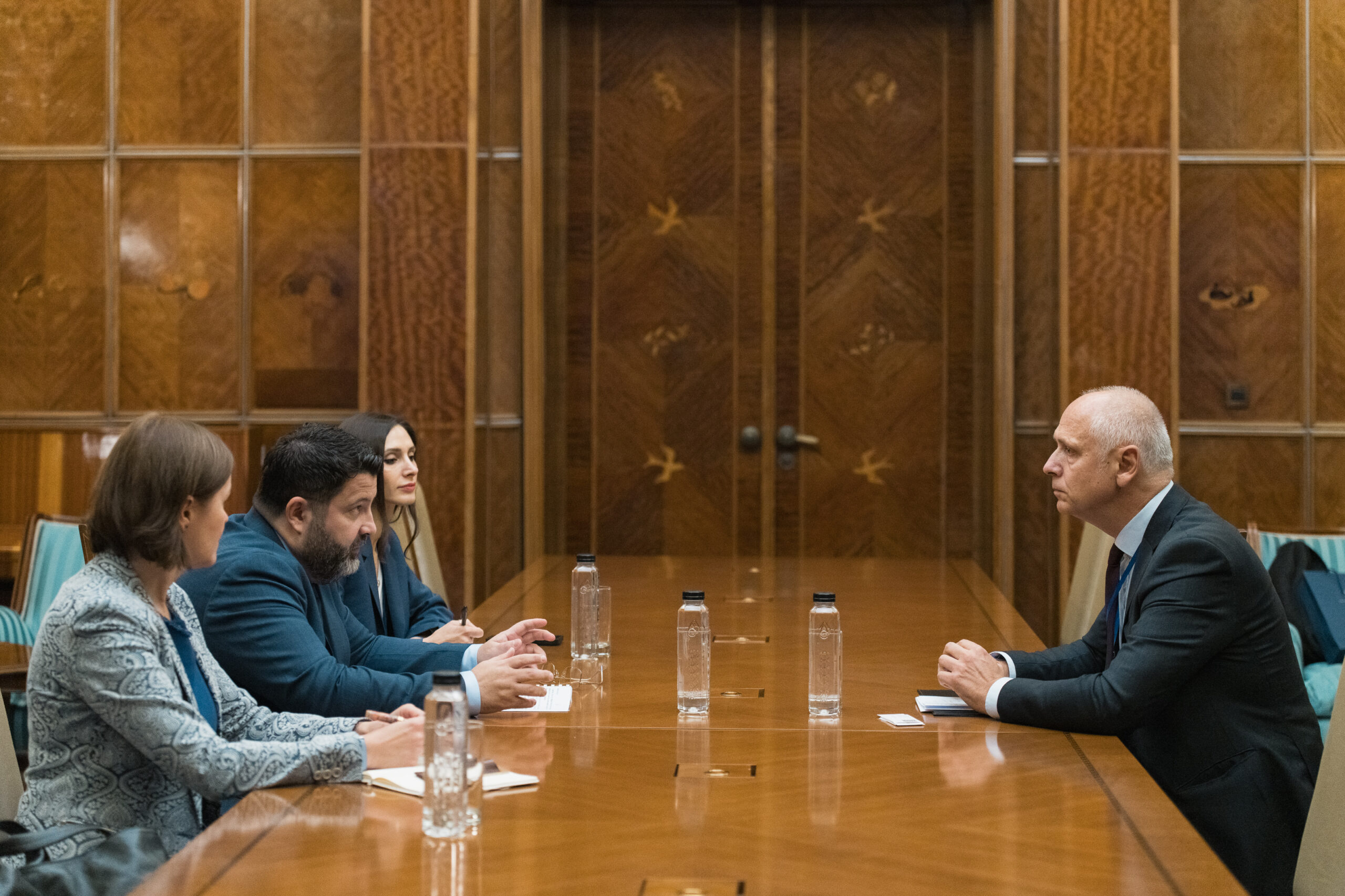
Romania’s new foreign minister and the Regional Cooperation Council’s chief have pledged closer cooperation on economic integration, sustainable development and regional resilience, with European integration at the centre of their agenda.
BUCHAREST, Nov. 6, 2026 (BalkanView) – Romania and the Regional Cooperation Council (RCC) have pledged to deepen cooperation on economic integration, regional connectivity and sustainable development, as Bucharest seeks to strengthen its leadership role in South East Europe.
RCC Secretary General Amer Kapetanović met Romania’s newly appointed Foreign Minister Dan Neculăescu in Bucharest to discuss priorities under Romania’s current chairmanship of the South-East European Cooperation Process (SEECP), a regional framework aimed at strengthening political and economic cooperation.
The meeting came as Romania hosted foreign ministers and representatives attending the Central European Initiative (CEI) meeting, bringing together regional partners to discuss European integration, economic cooperation and shared challenges.
Romania seeks concrete results from regional cooperation
Kapetanović welcomed Romania’s leadership of the SEECP and said regional cooperation needed to produce tangible benefits for citizens and economies.
“Romania has long been an important supporter of regional cooperation, and we welcome its active leadership of the SEECP at a time when our region needs both closer cooperation and concrete results,” Kapetanović said.
“The RCC stands ready to work closely with Minister Neculăescu and his team to translate the priorities of the Romanian Chairmanship into practical initiatives that bring South East Europe closer together and strengthen its European perspective.”
He added that the organisation’s focus must remain on delivering results.
The RCC serves as the operational secretariat of the SEECP, supporting regional governments in implementing joint priorities and coordinating initiatives across South East Europe.
Neculăescu reaffirmed Romania’s support for the RCC and its role in facilitating regional cooperation, stressing the importance of coordination during Bucharest’s SEECP chairmanship.
Beyond GDP: A broader vision for economic development
The talks also focused on the South East Europe 2030 Strategy, a regional framework for advancing sustainable development.
Kapetanović thanked Romania for its voluntary financial contribution to the strategy, which supports initiatives aimed at addressing long-term economic and social challenges.
Among the priorities discussed were the Beyond GDP agenda, which seeks to assess development through measures beyond traditional economic output, stronger private-sector engagement, development financing and regional cooperation on disaster risk insurance and risk sharing.
These initiatives are intended to help South East European economies strengthen resilience, attract investment and address shared development challenges.
European integration takes centre stage
Kapetanović also participated in the Central European Initiative foreign ministers’ meeting, hosted under Romania’s 2026 CEI presidency.
Held under the theme “Closer in the Region, Stronger in Europe”, the gathering focused on strengthening regional cooperation and advancing European integration.
Kapetanović stressed the importance of coordination between regional frameworks, including the CEI and SEECP, to avoid duplication and support common objectives.
He said closer cooperation between these initiatives could contribute to a more connected, resilient and economically integrated Europe.
The Bucharest discussions underscored Romania’s role in regional diplomacy and the RCC’s efforts to translate political commitments into practical cooperation, particularly as European integration remains a central strategic objective for the Western Balkans.