


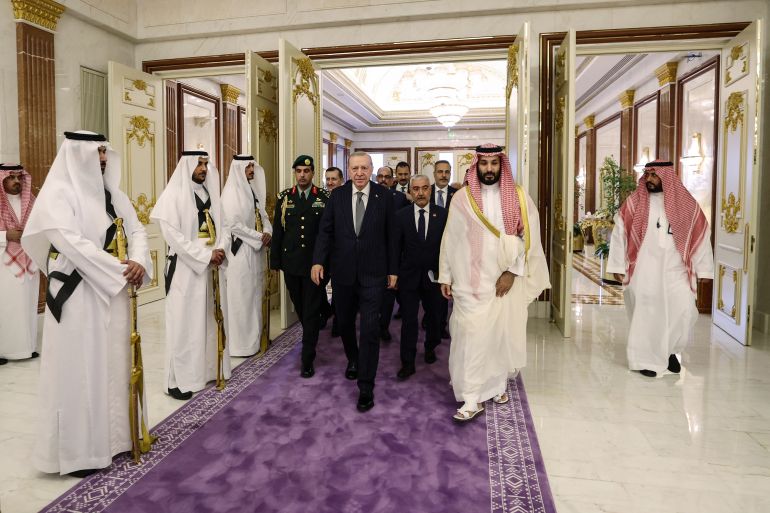
MECCA, Saudi Arabia, Aug 8 (Balkan View) – A new mutual defence agreement between Saudi Arabia, Türkiye and Pakistan is emerging as one of the clearest signs yet that Middle Eastern powers are seeking to diversify their security relationships as the war involving the United States, Israel and Iran strains Washington’s traditional role as the region’s principal security guarantor.
The Mecca Joint Defence Agreement, signed on Friday, commits the three countries to regard an armed attack against any one of them as an attack against all three, according to a statement issued after the meeting.
The agreement also calls for broader defence cooperation, although details on how the collective-defence commitment would operate in practice have yet to be disclosed.
The pact brings together three of the Muslim world’s most influential military powers: Saudi Arabia, a major Gulf energy producer and longstanding US partner; Türkiye, NATO’s second-largest military by personnel; and Pakistan, the only Muslim-majority country possessing nuclear weapons.
Its creation amid the Iran war gives the agreement significance well beyond conventional military cooperation.
A Middle Eastern Version of Collective Defence?
The most striking element of the agreement is its collective-defence clause.
Its language resembles the principle underlying NATO’s Article 5: aggression against one member is treated as aggression against all.
But unlike NATO, the Mecca agreement has not yet been accompanied by a publicly detailed integrated command structure, joint operational planning mechanism or specific commitments governing how each country would respond to an attack.
That leaves a crucial question unanswered: whether the agreement will develop into a functioning military alliance or primarily serve as a political deterrent.
Analysts cited by Al Jazeera cautioned against interpreting the pact as an immediate replacement for the US-led regional security architecture.
Instead, it may provide Riyadh, Ankara and Islamabad with additional strategic options.
Saudi Arabia Diversifies Beyond Washington
The biggest geopolitical implications may be for Saudi Arabia.
For decades, Riyadh has relied heavily on Washington for advanced weapons, intelligence and protection against external threats.
But doubts about the durability and predictability of US security guarantees have grown across the Gulf over the past decade.
The current conflict with Iran appears to have accelerated that reassessment.
Regional countries have faced Iranian missile and drone attacks, disruptions to critical infrastructure and economic consequences from restrictions on shipping through the Strait of Hormuz.
At the same time, Washington has struggled to provide its regional partners with sufficient air-defence munitions, according to the account cited by Al Jazeera, with significant resources directed towards Israel.
The Mecca pact suggests Riyadh is responding by broadening its options rather than abandoning Washington.
Türkiye Gains a Bigger Regional Role
For Türkiye, the agreement offers another opportunity to establish itself as an autonomous security power connecting Europe, the Middle East and South Asia.
Ankara already possesses one of the region’s largest armed forces and an increasingly sophisticated domestic defence industry producing drones, missiles, warships and electronic warfare systems.
Its membership in NATO makes the new arrangement particularly noteworthy.
Türkiye would effectively participate simultaneously in the Western alliance and a separate collective-defence arrangement involving two major Muslim states.
That does not necessarily make the two commitments incompatible, but it could strengthen Ankara’s ability to pursue an increasingly independent foreign and security policy.
Pakistan Brings a Nuclear Dimension
Pakistan adds another strategically important element.
Islamabad has maintained close military relations with Saudi Arabia for decades, while defence cooperation with Türkiye has also expanded.
Pakistan’s status as a nuclear-armed state inevitably gives the new grouping additional strategic weight.
However, the agreement as described publicly does not establish a nuclear guarantee for Saudi Arabia or Türkiye, and there is no indication in the announced text that Pakistan’s nuclear arsenal forms part of the pact.
Any suggestion that the agreement automatically extends a Pakistani nuclear umbrella to the other two countries would therefore go beyond what has been publicly disclosed.
Is Iran the Target?
The timing inevitably raises questions about whether the agreement is designed primarily to deter Iran.
Yet analysts caution against describing it simply as an anti-Iran alliance.
Saudi Arabia, Türkiye and Pakistan have all advocated mediation or de-escalation during the conflict, even as they seek stronger protection against its consequences.
Yasmine Farouk of the International Crisis Group described the concept behind the pact as closer to “normative deterrence” and longer-term strategic cooperation than preparation for confrontation.
That distinction matters.
The three countries appear to be signalling that aggression against any of them would carry broader consequences without necessarily seeking a direct military confrontation with Tehran.
Washington Remains Difficult to Replace
Despite its political symbolism, the agreement does not mean the United States is about to disappear from Middle Eastern security.
Washington maintains extensive military infrastructure throughout the region and provides partners with sophisticated aircraft, missile defence, intelligence and logistics capabilities that would be extremely difficult for any emerging regional alliance to replicate quickly.
Saudi Arabia and Türkiye remain major US security partners, while Pakistan has a long, if sometimes difficult, history of military cooperation with Washington.
The new arrangement may therefore represent diversification rather than separation.
The distinction is important: Middle Eastern governments increasingly appear unwilling to depend exclusively on a single outside power, even when they have no intention of abandoning that relationship.
A New Regional Order?
The significance of the Mecca pact may ultimately depend on what follows its signing.
Joint exercises, integrated air and missile defence, intelligence sharing, defence-industrial cooperation or permanent military coordination would indicate that the agreement is developing into a substantial security architecture.
Without those mechanisms, its immediate importance would remain largely political.
But the timing itself sends a message.
After decades in which regional security revolved overwhelmingly around American military power, three major Muslim countries are formally declaring that their security is also interconnected.
The Mecca agreement may not mark the end of the US-led order in the Middle East. It does, however, suggest that some of Washington’s closest regional partners increasingly want insurance against having to rely on it alone.