


OHRID, North Macedonia, Sept 13 (BalkanView) – Fiscal stability, predictable tax policy and stronger regional cooperation will be critical to sustaining economic growth in the Western Balkans as governments face mounting pressure from defence spending, external shocks and limited budget room, regional policymakers and business leaders said at the Ohrid 2026 conference.
Current and former finance ministers, economists, bankers and private-sector representatives said fiscal consolidation should not come at the expense of investment that supports productivity and long-term growth.
The debate comes as Western Balkan economies try to accelerate convergence with the European Union while dealing with relatively low productivity, persistent informal activity, demographic pressures and the need for higher infrastructure and security spending.
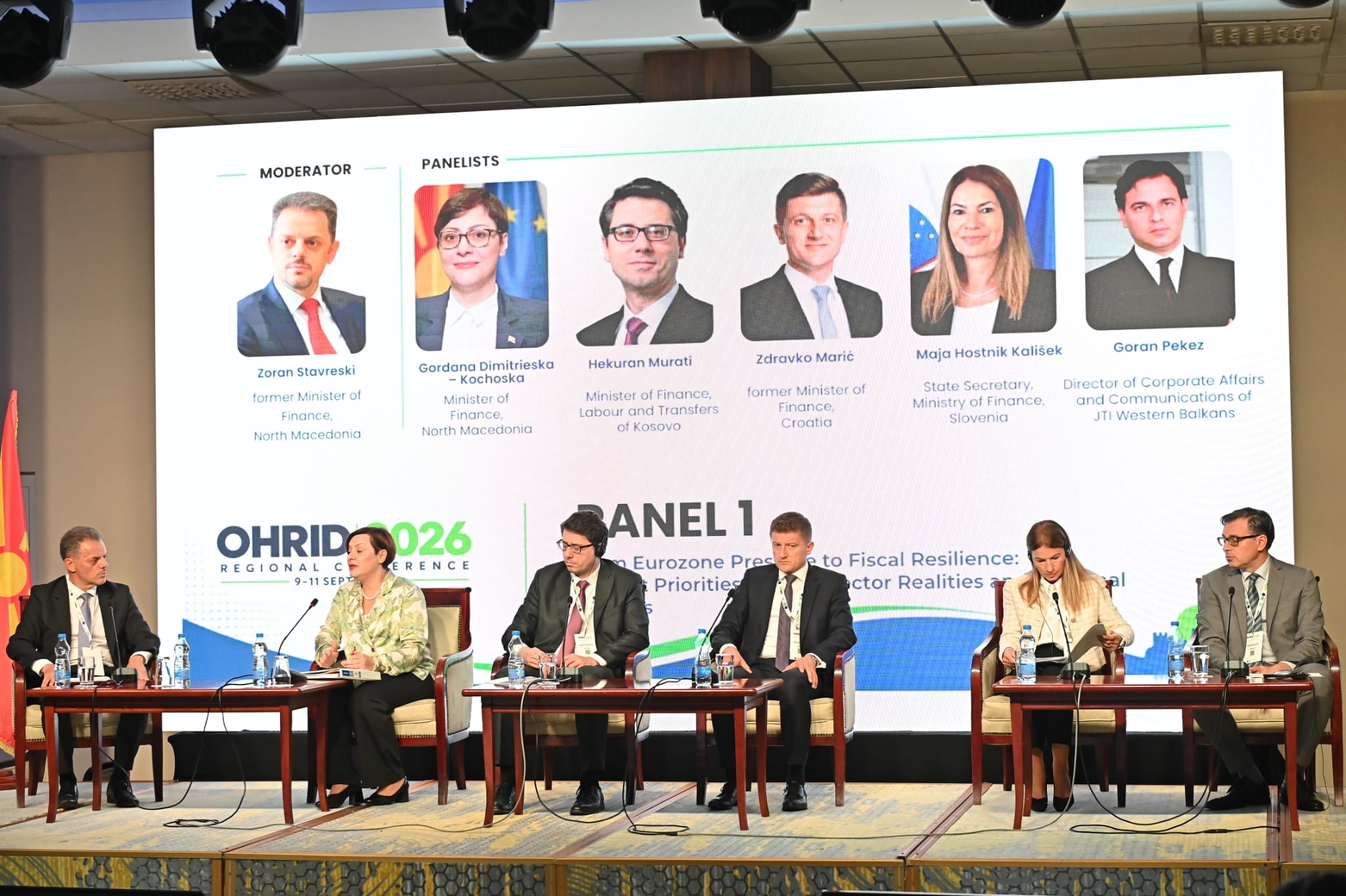
Former Croatian Finance Minister Zdravko Marić said governments across the region were facing the difficult task of maintaining sustainable public finances while supporting economic expansion.
“All countries are now under additional pressure because defence allocations have increased,” Marić said. “That is inevitable, but it puts additional pressure on the limited fiscal space available to every country.”
He said the long-standing challenge for finance ministers remained finding the right balance between fiscal sustainability and policies that stimulate gross domestic product growth.
Defence spending narrows room for governments
The pressure is becoming more acute as European governments increase military expenditure in response to heightened geopolitical risks.
For the Western Balkans, where public finances are generally more constrained than in richer EU economies, additional spending on defence can directly compete with investment in transport, education, healthcare and energy infrastructure.
That creates a policy dilemma: governments need to preserve macroeconomic stability while avoiding spending cuts that could undermine future growth.
Conference participants said fiscal space should therefore be used selectively, especially during external shocks.
Support for households and businesses should be targeted, temporary and proportionate rather than broad and permanent, they said.
Businesses want stable tax rules, not just lower rates

Tax policy emerged as another central theme.
Participants said businesses care not only about headline tax rates but also about whether tax and regulatory rules remain stable over time.
Predictable rules allow companies to plan investment, hiring and expansion with greater confidence, while abrupt tax changes can discourage long-term commitments and increase the cost of doing business.
Greater predictability can also improve tax compliance and help governments reduce the size of the informal economy.
Goran Pekez, executive director for corporate affairs and communications at Japan Tobacco International, said the private sector should have a direct role in discussions on tax policy.
He said JTI paid 925 million euros in taxes across the region last year and expected the figure to reach 1 billion euros this year.
In North Macedonia, he said the company contributes around 6% of total tax revenues each year, while in Kosovo the figure is about 9%.
“Because we contribute significantly, we hope this conference will allow us to jointly plan gradual and stable policies that will help keep those tax revenues stable,” Pekez said.
The comments underline the broader fiscal importance of large corporate taxpayers in smaller Western Balkan economies, where a limited number of companies can account for a significant share of government revenues.
Informal economy remains a major regional challenge
The conference also focused on tax compliance, the tax gap and the informal economy.
These remain persistent problems across the Western Balkans.
Large informal sectors weaken government revenue, distort competition and make it harder for governments to fund public services without increasing the burden on compliant businesses and workers.
Improved digital tax administration, stronger enforcement and simpler regulation have become central elements of fiscal reform across the region.
But participants stressed that compliance also depends on trust.
Businesses are more likely to invest and comply when tax systems are transparent, rules are applied consistently and changes are communicated well in advance.
EU money could become the next growth engine
European financing is expected to play an increasingly important role as Western Balkan countries move closer to the EU.
But conference participants said the main challenge should not be simply absorbing available funds.
Instead, governments should direct financing toward projects and sectors that generate the highest productivity gains and economic returns.
That includes transport links, energy infrastructure, digitalisation, education and projects that improve regional connectivity.
The issue is becoming more important as Brussels increases financial support for the Western Balkans through pre-accession funding and the EU Growth Plan.
For economies with limited domestic capital, access to European funds can significantly accelerate investment.
But weak project preparation, administrative capacity and political delays often reduce the ability of governments to use available money effectively.
Regional cooperation could lower costs
Regional cooperation was another recurring theme.
The six Western Balkan economies remain relatively small individually, making cross-border cooperation particularly important for attracting investment and improving competitiveness.
Common infrastructure, more integrated markets and regulatory coordination can lower costs for companies operating across the region.
This is also closely linked to EU integration.
Brussels has increasingly encouraged the Western Balkans to build a common regional market as preparation for eventual participation in the EU single market.
For governments, this means economic policy can no longer be designed entirely within national borders.
Tax competition, investment incentives, labour mobility and infrastructure increasingly have regional consequences.
Growth without fiscal discipline carries risks
The debate in Ohrid reflects a broader challenge facing Europe.
Governments are under pressure to spend more on defence, infrastructure, the green transition and social protection at the same time.
But higher borrowing costs and elevated public debt in many economies limit how much additional spending can be financed through deficits.
For smaller Western Balkan economies, those constraints are even tighter.
Excessive borrowing can increase debt-servicing costs and reduce room for future investment.
Too much austerity, however, can suppress growth.
That leaves governments trying to find a narrow middle path: controlling deficits while protecting investment that raises productivity.
Western Balkans still face productivity gap
The region’s long-term challenge remains convergence with the European Union.
Western Balkan economies have grown over the past two decades, but income and productivity levels remain well below the EU average.
Emigration has also reduced labour supply, while ageing populations are beginning to increase pressure on pension and healthcare systems.
That makes productivity growth increasingly important.
Governments will need to generate more economic output from smaller workforces while improving public services and maintaining fiscal stability.
Tax reform, better public investment and stronger institutions will therefore matter as much as headline growth rates.
Ohrid conference seeks common regional approach
The Ohrid 2026 regional conference was organised by the Balkan Economic Forum under the patronage of North Macedonia’s Finance Ministry and with support from JTI.
The event brought together policymakers, economists, financial institutions and private-sector representatives to discuss fiscal policy, economic growth, tax compliance and the informal economy.
The central message was that Western Balkan governments face less room for policy error.
They need to finance security and social needs, improve infrastructure, attract investment and move closer to EU standards – while keeping public finances sustainable.
That makes predictability increasingly valuable.
For investors, it means knowing that tax and regulatory rules will not change suddenly.
For governments, it means protecting fiscal credibility.
And for the region as a whole, it means using limited resources more strategically.
The choice facing the Western Balkans is therefore not simply between spending more or spending less.
It is about spending better, taxing more predictably and using regional and European integration to generate higher long-term returns.