


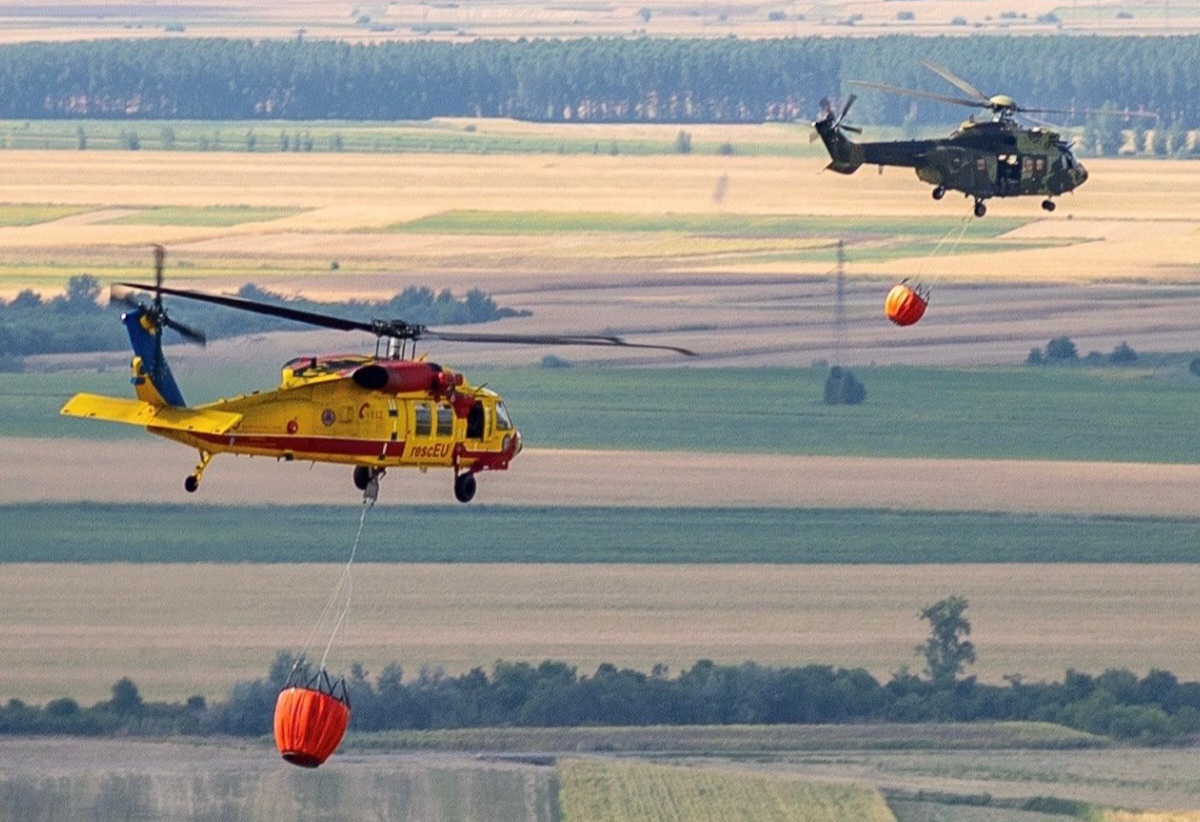
BRUSSELS, Aug. 24 (BalkanView) — The European Union has deployed helicopters and firefighting teams to Serbia after severe wildfires burned more than 3,500 hectares of the Deliblato Sands Special Nature Reserve, the European Commission said on Monday.
Serbia activated the EU Civil Protection Mechanism on Aug. 21, requesting international assistance as fires that have been burning for more than two weeks intensified amid strong winds, difficult terrain and challenging firefighting conditions.
Within hours, the EU mobilised four helicopters from its rescEU strategic reserve based in the Czech Republic, Romania and Slovakia. Ground firefighting teams from Germany and Romania were also sent to reinforce Serbian emergency services.
The aircraft and teams remain deployed, according to the Commission.
An EU liaison officer has also arrived in Serbia to coordinate between Serbian authorities, the EU’s Emergency Response Coordination Centre and international firefighting teams.
Satellite support began even before Serbia formally requested additional assistance. The EU’s Copernicus Emergency Management Service was activated on Aug. 8, providing satellite imagery and analysis to support emergency assessment and operational planning.
One of Serbia’s key natural areas under threat
The fires have threatened the Deliblato Sands, a protected natural area in Serbia’s northern province of Vojvodina.
More than 3,500 hectares have already been affected, according to the Commission.
“Civil Protection Mechanism in action: firefighting teams from Czechia, Germany, Romania, Slovakia have joined the fight against wildfires in Serbia, working alongside local responders,” EU Commissioner for Crisis Management Hadja Lahbib said.
“In times of challenge, Europe stands strong.”
Western Balkans among areas hit by exceptional fire season
Serbia is not alone.
The European Commission described the 2026 wildfire season as exceptionally severe, saying that by Aug. 12 the area burned across Europe was already more than twice the average recorded for that point of the year.
The EU Civil Protection Mechanism has been activated 10 times by countries seeking assistance during this year’s fire season.
The Commission said it has coordinated and co-financed the deployment of more than 700 firefighters, over 200 vehicles and 38 aircraft.
Copernicus satellites have meanwhile produced 391 emergency maps.
Mapping operations are currently supporting Albania, Montenegro and Serbia in the Western Balkans, as well as Italy, Germany, Belgium and Croatia.
That makes the escalating wildfire emergency increasingly regional rather than national, with European countries relying on shared aircraft, firefighters and satellite capabilities as extreme fire conditions stretch domestic emergency services.
Belgium, for example, activated the mechanism on Aug. 15. The EU subsequently coordinated two firefighting aircraft from Sweden, six helicopters from the Netherlands, Germany and Norway, and specialised teams from the Netherlands and Spain.
Climate-era test for Europe’s emergency system
The growing number and geographic spread of wildfires are putting the EU’s common emergency-response architecture under increasing pressure.
Under the Civil Protection Mechanism, participating countries facing an emergency can request assistance, triggering coordination by the EU’s Emergency Response Coordination Centre.
The system includes all EU member states as well as 10 additional participating countries, allowing personnel and equipment to move rapidly across national borders when domestic capacity is insufficient.
The latest Serbian emergency illustrates the practical significance of that mechanism for the Western Balkans.
While EU enlargement remains dominated politically by negotiations over reforms, rule of law and membership criteria, disasters such as this summer’s wildfires demonstrate another side of European integration: aircraft from one country can be fighting fires in another within hours of a request for assistance.
For Serbia, where more than 3,500 hectares of a major protected natural area have already been affected, that cooperation has become an immediate necessity rather than an abstract political concept.