


SKOPJE/BELGRADE/TIRANA, Aug. 31 (Balkan View) – A 60-square-metre apartment in Skopje now costs about €129,000 at average asking prices, equivalent to roughly 164 average monthly net salaries — or nearly 14 years of earnings if a worker spent every cent on housing.
A Balkan View comparison of Skopje, Belgrade, Sarajevo, Pristina, Tirana and Sofia shows why property prices alone tell only part of the housing story across the region.
Belgrade and Sofia have more expensive apartments in absolute terms. But higher local wages mean that buying a home can be less burdensome relative to income. Tirana, meanwhile, emerges as one of the toughest markets in the comparison because salaries have struggled to keep pace with property prices.
The calculation is deliberately theoretical. It assumes that a worker devotes 100% of their average net salary to buying a 60-square-metre apartment, with nothing spent on food, utilities, taxes, transport, children or interest on a mortgage.
In reality, buying a home would take considerably longer.
The Balkan housing affordability gap
* Estimated net equivalent based on Sofia’s official average gross wage.
** Pristina has no single sufficiently updated official citywide average for 2026. The figure is a market benchmark; prices vary substantially by neighbourhood.
Skopje: 164 salaries for 60 square metres
Skopje’s average asking price reached around €2,153 per square metre on Aug. 30, according to CenaKvadrat market data. The platform measures asking rather than completed transaction prices.
At that level, a 60-square-metre apartment costs approximately €129,200.
North Macedonia’s official average monthly net salary stood at 48,381 denars, or about €786, in June.
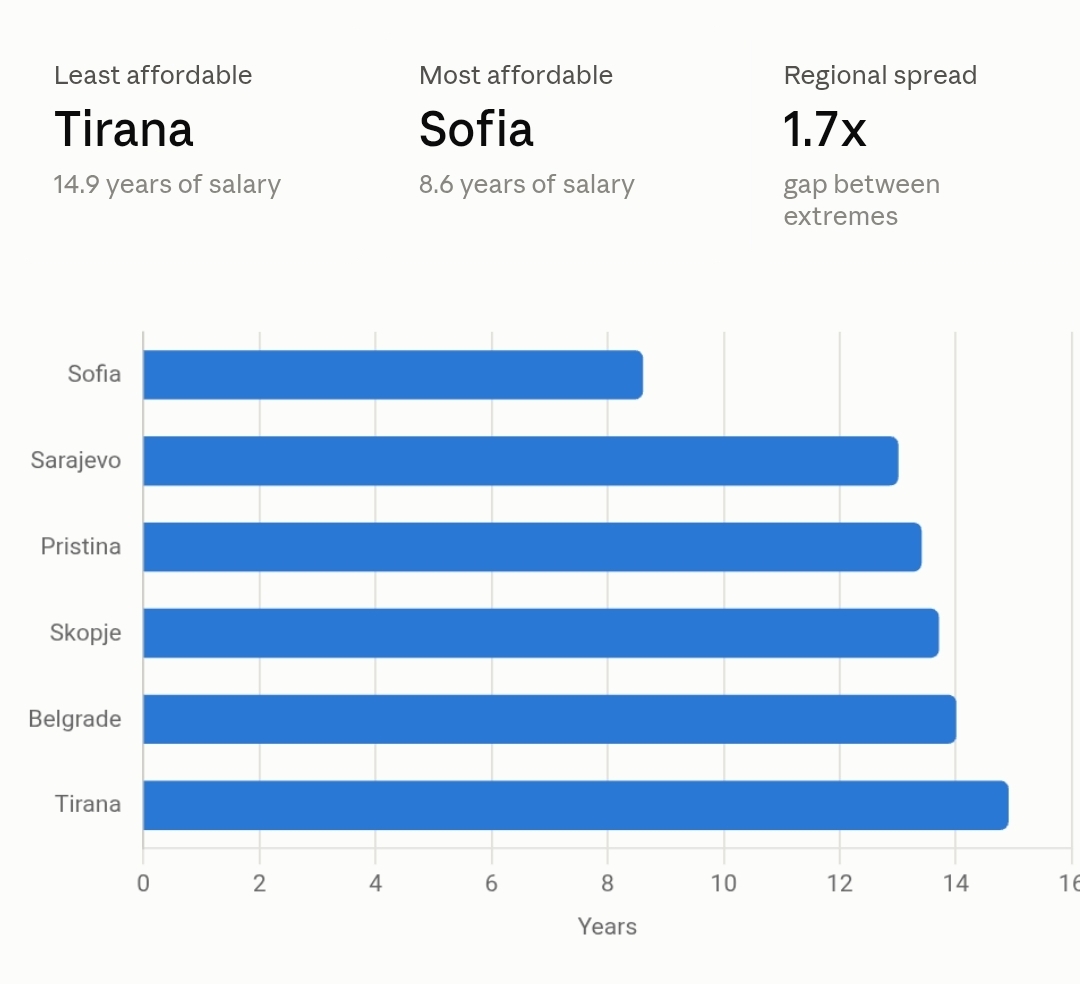
That puts the price of the hypothetical apartment at around 164 monthly salaries — 13.7 years of total earnings.
And that assumes not a single euro is spent on anything else.
The figure illustrates how sharply the housing equation has changed in North Macedonia. Property prices have risen to levels increasingly difficult to reconcile with local wages, particularly for younger people trying to enter the market without substantial family support or inherited property.
Belgrade: far more expensive, but wages soften the blow
Belgrade has the highest nominal housing prices among the six capitals in this comparison.
Average asking prices of roughly €3,100 to €3,300 per square metre put a 60-square-metre apartment at between €186,000 and €198,000.
That is up to €69,000 more than the equivalent apartment in Skopje.
But Belgrade also pays substantially higher wages.
Serbia’s average national net salary stood at 120,401 dinars in June, while the average in the Belgrade region was 148,687 dinars.
The result is a paradox familiar across the Balkans: Belgrade property is dramatically more expensive than Skopje property, but the affordability gap between the two cities is much smaller than their property prices suggest.
Sarajevo performs better than Skopje and Tirana
The Sarajevo benchmark stands at around 4,450 convertible marks, or €2,275 per square metre, based on official sales records covering four central Sarajevo municipalities.
That values a 60-square-metre apartment at roughly €136,500.
With Bosnia and Herzegovina’s average monthly net wage at 1,706 marks, or about €872, the apartment represents approximately 13 years of average salaries.
Sarajevo therefore performs slightly better than Skopje on this crude affordability measure despite having a higher price per square metre.
Again, wages make the difference.
Tirana: the region’s affordability warning
Tirana provides perhaps the clearest warning about what happens when property prices outrun local incomes.
The average price in the second quarter of 2026 is estimated at around €2,116 per square metre, putting a 60-square-metre apartment at roughly €127,000.
That is slightly cheaper than Skopje.
But Albania’s latest available wage data before the publication of second-quarter figures point to an estimated average net salary of around 72,210 lek, or approximately €708.
The result is nearly 15 years of entire average salaries to purchase the apartment.
On this measure, Tirana is among the least affordable capitals in the comparison despite having property prices far below Belgrade or Sofia.
Pristina: cheaper homes collide with lower wages
Pristina illustrates the other side of the Balkan housing problem.
Housing is cheaper in nominal terms, but incomes are also lower.
Prices vary significantly across the Kosovo capital. Apartments in peripheral neighbourhoods can be advertised at roughly €1,100-€1,400 per square metre, while properties closer to the centre can exceed €2,500.
Using a working benchmark of €1,700 per square metre, a 60-square-metre apartment would cost around €102,000.
Kosovo’s latest official annual statistics put the average net salary at €636 in 2025.
That translates into roughly 13.4 years of entire average salaries.
For private-sector employees earning below the overall average, the affordability burden would be greater.
Sofia shows why price per square metre can mislead
Sofia provides the most striking contrast.
Median asking prices were around €2,585 per square metre in late August, making a 60-square-metre apartment worth approximately €155,100.
That is around €26,000 more than in Skopje.
Yet Sofia’s official average gross salary reached approximately €1,943 per month in the second quarter. Using an estimated net equivalent of around €1,500, the hypothetical apartment represents roughly eight to nine years of average earnings.
In other words, a Sofia apartment can cost substantially more in euros while being considerably more affordable for a local worker than a cheaper apartment in Skopje or Tirana.
That may be the most important finding of the comparison.
A Balkan problem bigger than property prices
The housing squeeze across the Balkans is not simply a story of expensive apartments.
It is a story about the widening distance between property values and local purchasing power.
Capital cities attract investment, migrants from smaller towns, diaspora money and buyers seeking property as a store of value. New construction can command prices increasingly detached from the wages earned by people living and working locally.
That helps explain why simply comparing prices per square metre can produce a distorted picture.
A €2,100 square metre does not impose the same burden on somebody earning €700-€800 per month as it does on somebody earning €1,500.
Skopje illustrates that divide particularly clearly.
At current asking prices, a modest 60-square-metre apartment represents around 164 average North Macedonian net salaries.
And even that is the most optimistic possible calculation.
If a household could realistically devote only one-third of one average salary to purchasing a home, the theoretical 14-year calculation would stretch towards four decades — before mortgage interest and other ownership costs are taken into account.