



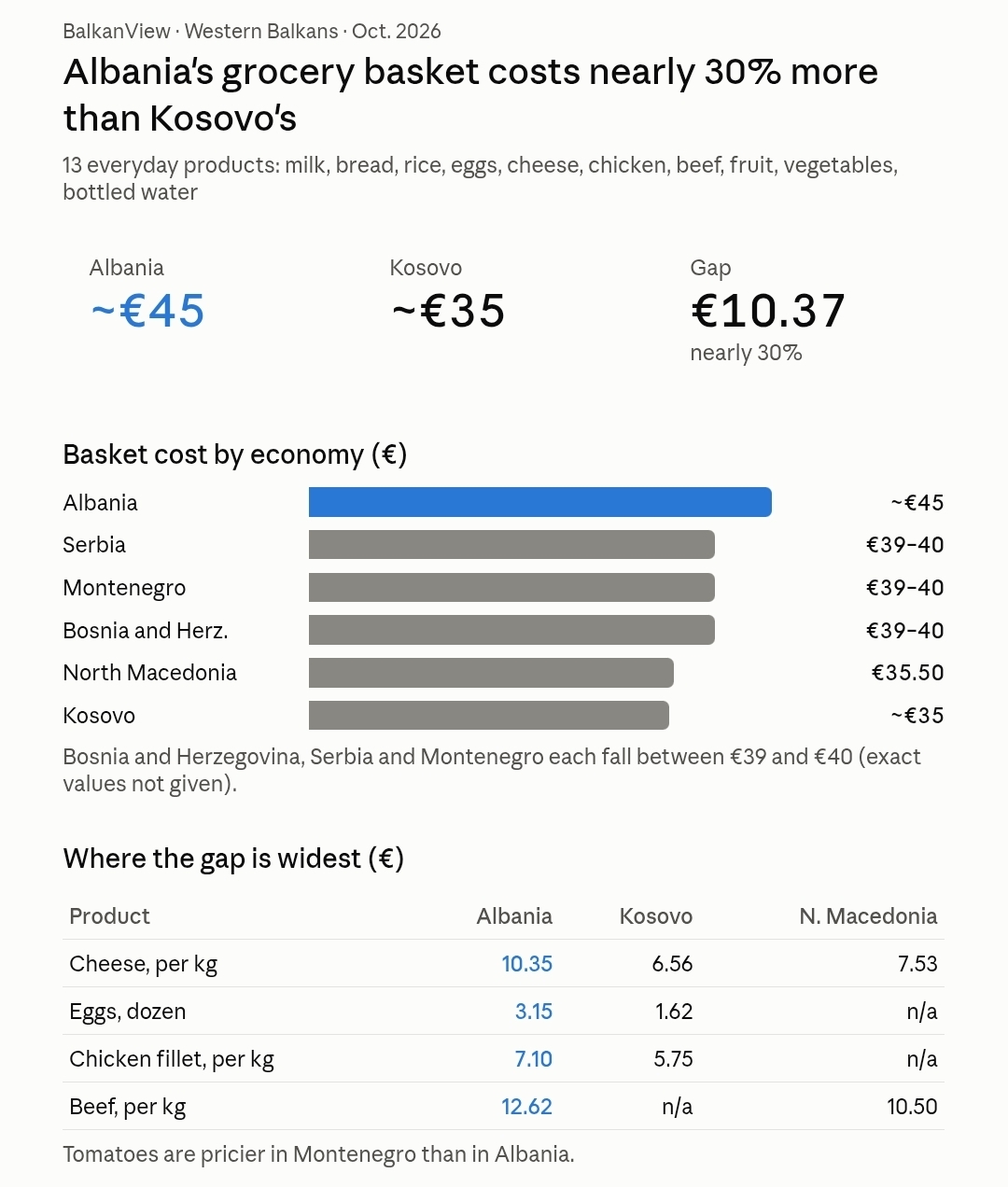
A basic food basket costs around €45 in Albania but just €35 in Kosovo, highlighting a striking divide in grocery prices across the Western Balkans. Official European statistics show that food in Albania is even more expensive than the EU average.
SKOPJE, Oct. 19 (BalkanView) — Albania has the highest food prices among the Western Balkan economies covered by official European comparisons, while Kosovo and North Macedonia have the cheapest baskets in a separate survey of 13 everyday grocery products.
A comparison based on indicative Numbeo prices from May and June 2026 puts the cost of a basket containing milk, bread, rice, eggs, cheese, chicken, beef, fruit, vegetables and bottled water at around €45 in Albania, compared with approximately €35 in Kosovo and €35.50 in North Macedonia.
The gap between Albania and Kosovo amounts to €10.37, or nearly 30%, underscoring differences in household food costs across six economies with close trade links.
Bosnia and Herzegovina, Serbia and Montenegro occupy the middle of the ranking, with the same basket costing between €39 and €40.
The sharpest differences are found in dairy products, eggs and meat.
A kilogram of locally produced cheese costs approximately €10.35 in Albania, compared with €6.56 in Kosovo and €7.53 in North Macedonia.
A dozen eggs costs €3.15 in Albania, almost twice Kosovo’s €1.62. Chicken fillets average €7.10 per kilogram in Albania against €5.75 in Kosovo.
However, prices vary considerably between products. Beef is cheapest in North Macedonia at approximately €10.50 per kilogram, compared with €12.62 in Albania, while tomatoes are more expensive in Montenegro than in Albania.
Albania’s food prices exceed EU average
Official European price-level statistics reinforce the finding that Albania is a relatively expensive market for groceries.
Preliminary Eurostat figures for 2025, published in June 2026, show that Albania’s food and non-alcoholic beverage price index stood at 103.8, with the European Union average set at 100.
That means food prices in Albania were 3.8% above the EU reference level, despite the country’s lower overall consumer price level.
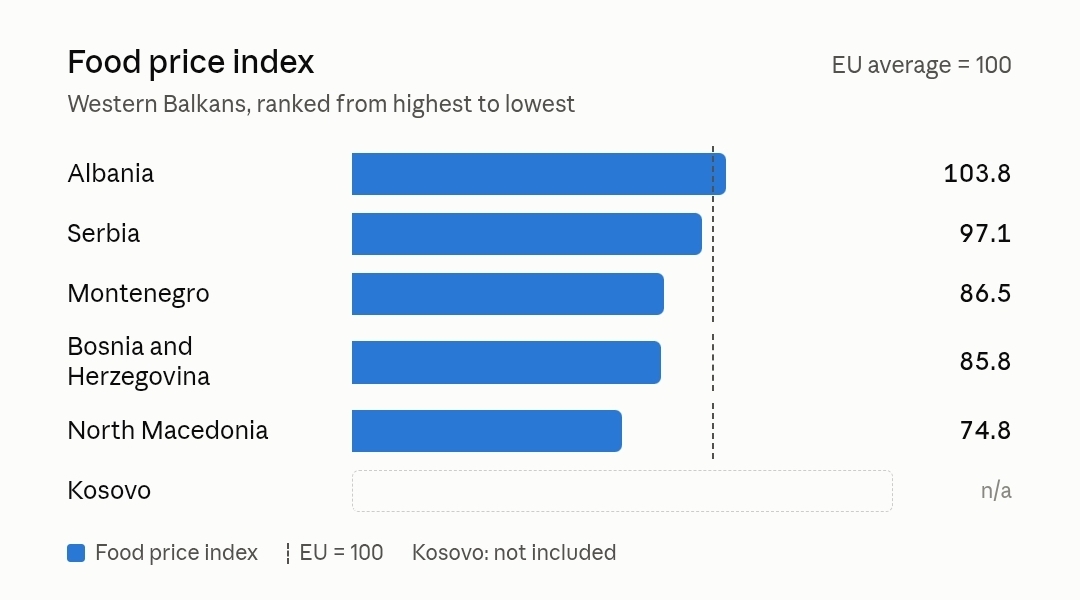
Albania’s official food price level was approximately 39% higher than North Macedonia’s and about 7% higher than Serbia’s.
Unlike the Numbeo comparison, Eurostat’s figures cover a much broader range of food products and follow a standardised methodology, making them a stronger measure of overall differences between national markets.
Kosovo is not included in this particular Eurostat comparison, meaning its position among the cheapest markets is based on the smaller Numbeo basket rather than the official index.
Why is food more expensive in Albania?
Taxation is one possible explanation for part of the price difference.
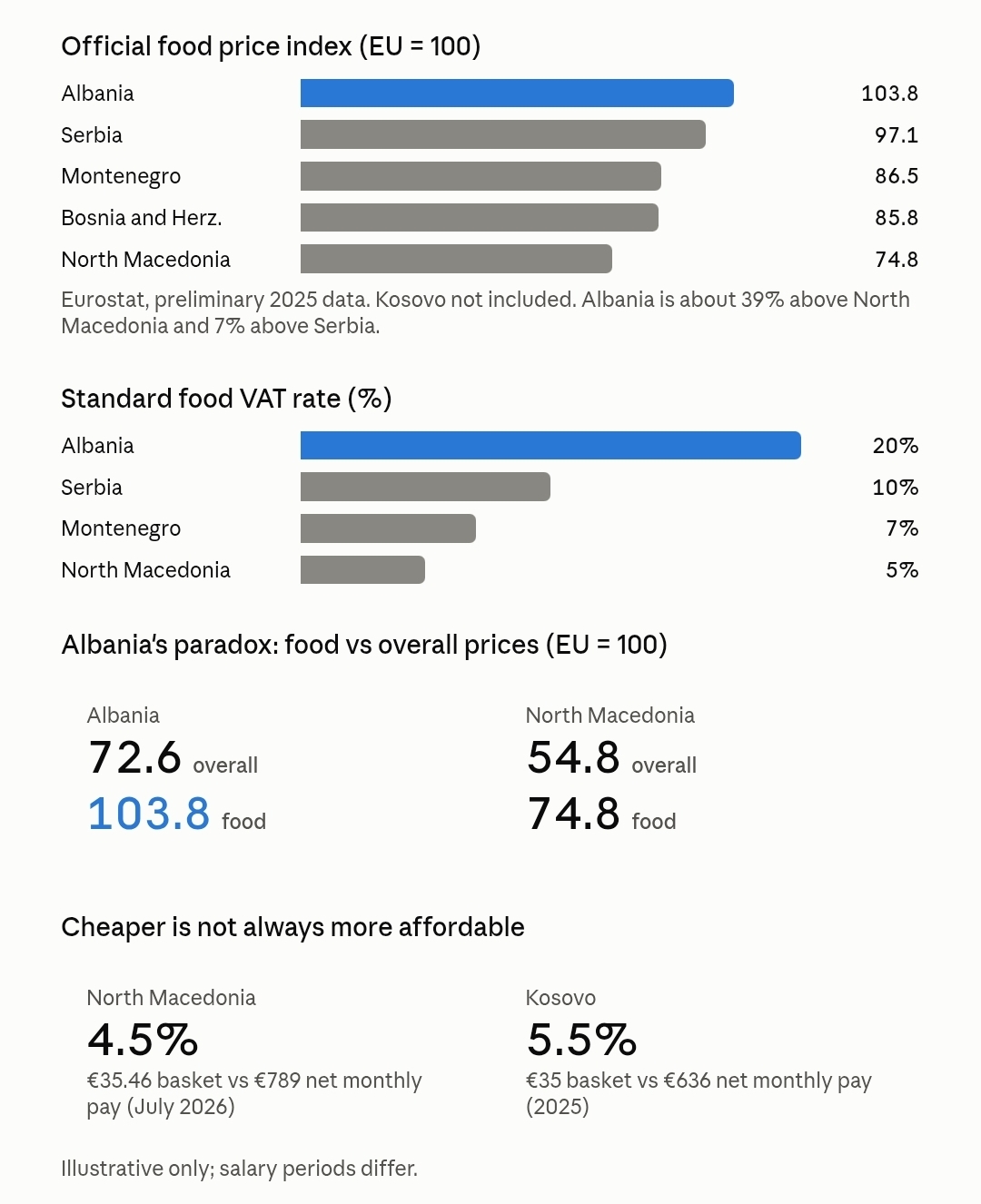
Albania applies a standard value-added tax rate of 20% to most food products, while North Macedonia has a reduced rate of 5% for basic foodstuffs.
Serbia applies a reduced rate of 10% to certain food categories, while Montenegro uses a reduced rate of 7%.
Import dependence, transport costs, domestic production, seasonal supply and competition among retailers may also influence prices.
However, the comparison does not establish how much each factor contributes to the gap. Additional evidence on retailer margins, production costs and imports would be needed to determine whether weak competition or excessive profits are responsible.
Cheaper groceries do not always mean greater affordability
The price of food tells only part of the story. Household purchasing power also depends on wages and other living expenses.
North Macedonia’s average net monthly salary reached 48,499 denars, or approximately €789, in July 2026, according to the State Statistical Office.
The indicative €35.46 basket represents around 4.5% of that salary.
In Kosovo, where the average net salary was €636 in 2025, the €35 basket represents approximately 5.5% of monthly earnings.
These percentages are illustrative rather than measures of actual monthly food expenditure. The salary figures also refer to different periods.
The comparison highlights an important distinction: consumers may face lower prices but still struggle to afford groceries if their incomes are substantially lower.
Albania’s food-price paradox
Albania presents a particularly striking contrast between grocery prices and the broader cost of living.
Its overall household consumption price index stands at 72.6 against the EU benchmark of 100, while its food index reaches 103.8.
In North Macedonia, the corresponding figures are 54.8 for overall household consumption and 74.8 for food.
The figures suggest that food is unusually expensive relative to other consumer goods and services in Albania, making grocery costs an important economic concern even when the country’s overall price level remains below the EU average.
For Western Balkan governments, the challenge goes beyond keeping supermarket prices under control. It also involves strengthening competition, supporting domestic agricultural production, improving supply chains and raising real household incomes.