


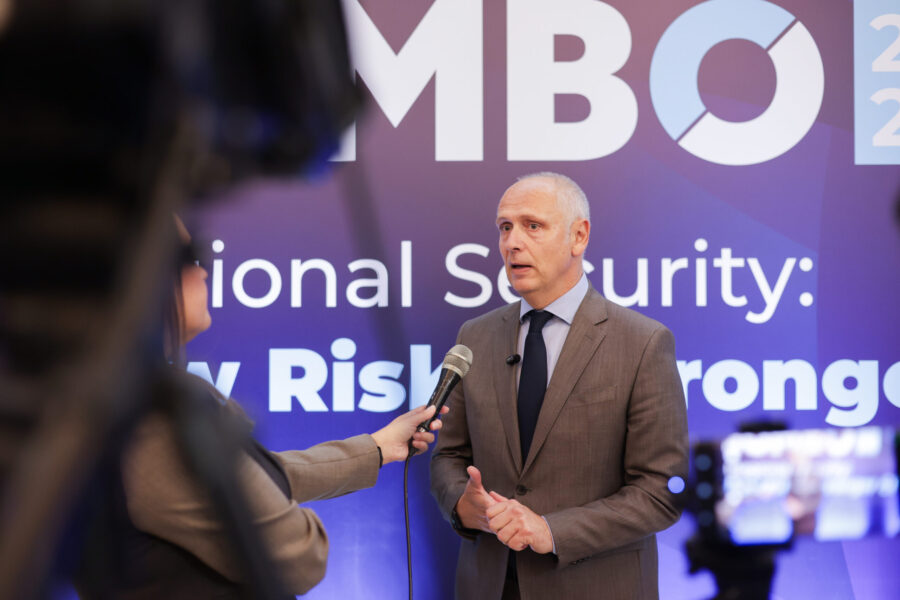
From organised crime and migrant smuggling to cyberattacks, drones and hybrid threats, Western Balkan security officials are confronting increasingly complex cross-border challenges. At a major regional conference in Tirana, RCC Secretary General Amer Kapetanović warned that cooperation must produce measurable results, not just political commitments.
TIRANA, Nov. 10 (BalkanView) – Western Balkan countries must strengthen intelligence sharing, coordinate investigations and deliver practical security improvements as criminal networks increasingly operate across national borders, Regional Cooperation Council (RCC) Secretary General Amer Kapetanović said on Tuesday.
Opening the 11th Annual Regional Security Coordination Conference (JUMBO 2026) in Tirana, Kapetanović urged regional institutions to move beyond declarations and demonstrate tangible progress in combating organised crime, cyber threats and other emerging security risks.
“By the next JUMBO, we should be able to point to specific improvements: a procedure that works better, a contact that leads to a timely response, or a gap in preparedness that has been addressed,” Kapetanović said.
“Our citizens should be able to benefit from the cooperation we discuss here.”
The two-day conference, held under the theme “Regional Security: New Risks, Stronger Cooperation”, has brought together more than 150 senior officials, security practitioners, experts and representatives of European Union institutions, international organisations, academia and civil society.
Criminal networks increasingly operate across borders
Kapetanović warned that organised criminal networks were operating across multiple jurisdictions, making traditional national responses insufficient.
He identified timely information exchange, coordinated investigations and stronger institutional cooperation as essential tools for confronting transnational security threats.
The conference is addressing organised crime, migrant smuggling, corruption, illicit weapons trafficking and the growing use of drones and emerging technologies by criminal networks.
Cybersecurity, hybrid threats and climate-related security risks are also among the main priorities.
Kapetanović emphasised that sustained cooperation between security professionals could strengthen regional trust and stability even when political relations between governments remained difficult.
EU-Western Balkans security partnership in focus
The conference is organised by the RCC with support from Italy’s Ministry of Foreign Affairs and International Cooperation, Italy’s Ministry of the Interior and the European Union, in partnership with Albania’s Ministry of Interior.
The opening session included Albanian Interior Minister Ervin Demo, Colonel Selvaggio Sarri of Italy’s Ministry of the Interior, Italian Deputy Ambassador Pierluigi Simonetti and Andre Rizzo, head of the political section at the EU Delegation to Albania.
Igor Malchiodi of the Italian Ministry of the Interior delivered a keynote address on the future priorities of the EU-Western Balkans security partnership on behalf of Stefano Gambacurta, director of Italy’s Anti-Mafia Prevention Unit.
The discussions come as regional governments and European institutions seek closer cooperation in addressing threats that increasingly cross both physical and digital borders.
Counterterrorism and violent extremism remain priorities
Kapetanović highlighted the RCC’s Security Governance Hub as a mechanism for strengthening regional coordination and supporting the implementation of the EU-Western Balkans Joint Action Plan on Counter-Terrorism and Prevention of Violent Extremism 2026–2030.
The initiative aims to improve cooperation between security institutions and strengthen regional responses to terrorism and violent extremism.
The RCC chief stressed that effective coordination depended on institutions being able to communicate quickly and act together when threats emerged.
Cybercrime, drones and climate risks reshape the security agenda
JUMBO 2026 reflects the expanding range of threats confronting Western Balkan security institutions.
Beyond conventional organised crime, the conference is examining criminal activity in the digital environment, cyber and hybrid threats, the misuse of new technologies and security risks associated with climate change.
Participants will also consider preliminary findings from the RCC’s SecuriMeter 2026 survey, which examines citizens’ perceptions of security challenges.
The survey is scheduled to be officially presented next week at the Belgrade Security Conference.
Its findings are expected to inform discussions on how regional institutions can better respond to public security concerns.
Four working groups to develop practical recommendations
The conference’s second day will focus on translating regional discussions into concrete recommendations.
Four thematic working groups will examine migration and regional coordination, organised crime in the digital environment, cyber and hybrid threats, and climate-related security risks.
Participants are expected to identify practical measures to improve institutional preparedness, information sharing and cross-border cooperation.
Now in its eleventh year, JUMBO has become one of the RCC’s principal platforms for connecting regional security institutions with European and international partners.
Tribute to Italian EUFOR personnel
During the opening session, Kapetanović also paid tribute to four Italian personnel serving with EUFOR Althea who died in a helicopter crash near Brčko on October 29.
He extended condolences to their families, colleagues and the people of Italy.
From security dialogue to measurable results
The conference’s central message is that regional security cooperation must be judged by its effectiveness rather than the number of meetings or political declarations.
As criminal networks exploit differences between national jurisdictions and increasingly use digital technologies, the RCC is calling for closer operational coordination and faster institutional responses.
For Kapetanović, the measure of success will be whether the region can demonstrate stronger preparedness, more effective procedures and practical improvements before the next JUMBO conference.
The challenge for Western Balkan governments is no longer simply recognising that security threats cross borders. It is ensuring that their institutions can respond just as quickly.