


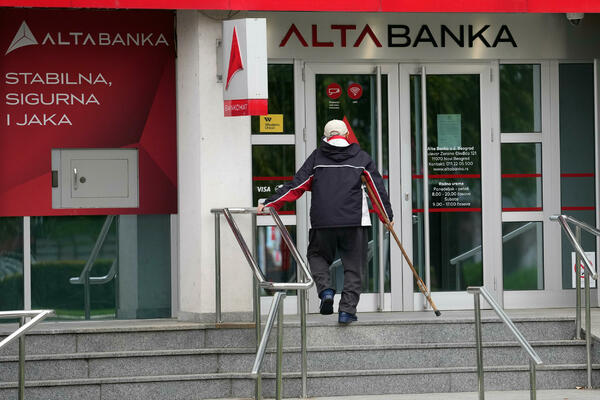
Russian expatriates in Serbia struggle to recover their savings, investigators examine hundreds of millions of euros in suspected irregularities, and rival political parties in North Macedonia trade accusations over the failed bank’s regional expansion.
BELGRADE/SKOPJE, Nov. 11, 2026 (BalkanView) – The collapse of Serbia’s Alta Banka has triggered a widening financial and political crisis, leaving Russian expatriates struggling to access their savings, raising questions over hundreds of millions of euros in public deposits and fuelling accusations over the bank’s expansion into neighbouring North Macedonia.
Serbian authorities revoked Alta Banka’s banking licence on Oct. 30 after its financial condition deteriorated, and a Belgrade court opened bankruptcy proceedings on Nov. 3.
The failure has exposed the vulnerability of businesses and depositors who relied on the lender, while prompting scrutiny of banking supervision, politically connected financial transactions and the management of public funds.
The crisis has also crossed Serbia’s borders.
In North Macedonia, where the Serbian lender acquired a controlling stake in a bank in Bitola in 2025, the central bank has imposed temporary administration while insisting that the Macedonian institution remains liquid and well capitalised.
Russian expatriates caught in the collapse
For Russian expatriates who moved to Serbia and established businesses there, the bank’s sudden closure has disrupted everyday life.
Alexandra Yakusheva, who runs Auditorija, a combined bookstore, café and events venue in Belgrade, discovered the problem when her bank card stopped working as she attempted to pay for a delivery ahead of a Halloween celebration.
According to an account she gave to The Moscow Times, employees pooled their cash to pay the supplier after the delivery driver refused to release the goods without payment.
Yakusheva subsequently learned that Alta Banka, where she maintained her account, had ceased operating.
The bank had become popular among Russian expatriates because it offered relatively straightforward account-opening procedures.
Its collapse left some customers unable to access savings or money needed for business operations.
Auditorija temporarily switched to cash-only payments, while Yakusheva sought to open another bank account.
Other expatriates faced potentially greater losses.
Yelena Artemenkova, who owns the Sunrise restaurant in Novi Sad, told independent Russian outlet Meduza that more than 50,000 euros of her family’s savings had become inaccessible.
Artemenkova, who moved to Serbia with her husband and four children two years earlier, said the money represented the family’s life savings.
Her restaurant continued operating but faced difficulties paying rent and processing card transactions.
Local residents organised support for affected businesses, encouraging customers to pay in cash and raising assistance for those temporarily deprived of access to their funds.
Depositors await November 13 payouts
Serbia’s Deposit Insurance Agency has announced that payments of insured deposits will begin on Nov. 13 through Banka Poštanska štedionica.
Under Serbia’s deposit protection system, eligible deposits are insured up to 50,000 euros per depositor, covering the combined balance of qualifying accounts held at the failed bank.
The scheme covers eligible individuals, entrepreneurs and micro, small and medium-sized enterprises.
Depositors with balances exceeding the insured limit may seek recovery of the remaining funds through bankruptcy proceedings, although the amounts and timing of any additional payments remain uncertain.
The fact that funds are currently inaccessible does not necessarily mean they have been permanently lost.
Public deposits raise questions over political influence
Beyond individual customers, the bank’s collapse has raised concerns about the exposure of Serbian public institutions.
According to an investigation by the Balkan Investigative Reporting Network (BIRN), based on a decision by Serbia’s central bank, approximately 400 million euros belonging to public-sector institutions, state-owned enterprises and banks undergoing bankruptcy proceedings were deposited with Alta Banka at the end of September.
The amount represented roughly one-quarter of the bank’s total deposits.
It does not represent an established financial loss, but it has raised questions about how public institutions selected the bank and assessed the risks of keeping substantial sums there.
Former JUBMES shareholder assembly chairman Slobodan Ilić, whose institution preceded Alta Banka, has called for an investigation into why some public entities managed to withdraw their deposits before the collapse while others did not.
Novi Sad said it had withdrawn 5.2 billion Serbian dinars before bankruptcy proceedings began, according to Serbian media reports, although some municipal companies still had inaccessible funds.
The cities of Vranje and Leskovac reportedly had outstanding claims of 177 million and 78 million dinars respectively.
Ilić said investigators should establish whether the different outcomes reflected contractual arrangements, payment deadlines, the bank’s liquidity or unequal access to information.
He did not claim that the differences alone established preferential treatment.
Missing cash allegations put bank supervision under scrutiny
The investigation has also focused on the bank’s owner, Davor Macura, who is suspected of abuses involving approximately 390 million euros, according to reporting by Serbian investigative outlet KRIK.
KRIK reported that a prosecution document raised suspicions that much of the amount had been recorded as cash received from Alta Pay without the money actually entering the bank’s vault.
Macura has denied wrongdoing.
The allegations remain under investigation and have not been established by a final court judgment.
Former Serbian central bank governor Dejan Šoškić has criticised the regulatory authorities, arguing that the bank’s collapse might have been prevented through more independent and effective supervision.
Speaking on N1 television’s Utisak nedelje programme, Šoškić questioned whether the bank’s owners had undergone sufficiently rigorous checks.
He also raised concerns about reports that between 20% and 25% of the bank’s assets had been recorded as vault cash.
“We still do not know whether the money was actually there or was merely fictitiously recorded,” Šoškić said.
He identified two possible scenarios requiring investigation: the physical removal of cash or the falsification of records to show money that did not exist.
Neither scenario has been established as fact.
Šoškić also called for scrutiny of potentially unsecured loans and any links between borrowers, shareholders and bank management.
Serbia’s central bank has said supervisory measures preceded the licence withdrawal, while information about certain inspections remains confidential.
North Macedonia becomes part of the investigation debate
The fallout has intensified in North Macedonia, where Alta Banka’s Serbian parent acquired control of the former Stopanska Banka Bitola in 2025.
The Macedonian central bank placed the Bitola institution under temporary administration following the Serbian lender’s collapse.
Governor Trajko Slaveski has said the Macedonian bank remains liquid and highly capitalised, distinguishing its financial position from that of its bankrupt Serbian parent.
He has also said six potential investors expressed interest in acquiring the Macedonian institution.
The two banks are separate legal entities, and the collapse of the Serbian lender does not automatically establish insolvency or wrongdoing at the Macedonian bank.
Nevertheless, Serbian lawyer Ivan Ninić has called for investigators to examine the group’s financial operations in North Macedonia and Montenegro.
Speaking on N1, Ninić alleged that the bank may have been used for cross-border financial arrangements, including guarantees and financing for companies with political or business connections.
He also raised suspicions involving fictitious companies and money laundering.
Ninić did not present evidence in the interview establishing those allegations, and there has been no publicly established finding that the Macedonian bank participated in illegal transactions.
Political battle erupts over the Bitola takeover
The financial crisis has become a political confrontation between North Macedonia’s governing VLEN coalition and the opposition Democratic Union for Integration (DUI).
VLEN has accused former DUI officials of bearing political responsibility for developments involving Alta Banka and has demanded an investigation into transactions linked to the company AS Senjak.
The coalition alleged that AS Senjak acquired shares in Stopanska Banka Bitola in October 2024.
It further claimed that another company partly owned by AS Senjak obtained a five-million-euro loan from Alta Banka Belgrade in June 2025, before shares in the Bitola bank were sold to the Serbian lender in September.
VLEN has called on prosecutors to investigate the transactions and the roles of those involved, citing alleged links between AS Senjak and the family circle of DUI leader Ali Ahmeti.
The claims have not been independently established by the documentation presented.
The available materials do not include the underlying loan agreements, complete ownership records or share-sale contracts.
Even if the transactions are confirmed, the existence of a loan or share sale would not, by itself, demonstrate illegality.
DUI has rejected the political accusations as false and misleading.
What a 2023 government document actually shows
At the centre of the dispute is an extract from a government meeting held on Oct. 24, 2023, when DUI was part of the governing coalition.
VLEN representatives Bekim Qoku and Adnan Azizi have pointed to the document while questioning the role of former Finance Minister Fatmir Besimi and other DUI officials.
However, the extract concerns shares in Alta Banka Belgrade held by North Macedonia’s Finance Ministry, rather than authorisation for the Serbian bank to acquire Stopanska Banka Bitola.
The document refers to a government instruction for the State Attorney’s Office to consider legal proceedings before Serbian authorities to protect the ministry’s rights and interests regarding the disposal of its shares.
It does not explicitly approve the subsequent acquisition of the Bitola bank.
DUI says the 2023 decision was intended to protect state property from unauthorised disposal.
The extract supports the conclusion that legal action was contemplated to protect the ministry’s interests, but it does not establish the circumstances of earlier share transactions or the outcome of any proceedings.
The authenticity and completeness of the photographed documents have not been independently verified.
The distinction is significant because political responsibility for the 2023 government decision cannot automatically be equated with responsibility for the 2025 banking acquisition.
Calls for a wider parliamentary investigation
Ilić has compared the need for a broader institutional inquiry into Alta Banka with the lessons of Italy’s Banco Ambrosiano scandal, which exposed connections between financial institutions, political power and weak oversight.
His comparison does not establish that the two cases involved the same conduct.
He has proposed that Serbia’s future parliament establish an investigative committee to examine the bank’s ownership changes, business model, relationships with public institutions and the withdrawal of major deposits before its collapse.
In North Macedonia, the case has also prompted questions about the due diligence undertaken before the Serbian investor was allowed to acquire control of the Bitola bank.
Reports have additionally circulated that the Macedonian central bank and its governor filed criminal complaints against opposition figures Venko Filipče, Aleksandar Saša Dimitrijević and Andrej Žernovski.
Those reports had not been confirmed by the central bank or prosecutors in the material reviewed, and no details of any alleged offences were available.
They therefore remain unverified media claims rather than confirmed criminal proceedings.
The bigger question: Who was watching the money?
The collapse of Alta Banka has created two immediate challenges.
For depositors, including Russian expatriate families and small businesses, the priority is recovering their savings and restoring access to banking services.
For regulators and governments, the questions are more complex.
Investigators must determine what happened to the money allegedly recorded in the bank’s vault, whether public deposits were managed appropriately and whether supervisory authorities identified and responded to financial risks in time.
The cross-border dimension adds another layer of scrutiny, particularly in North Macedonia, where authorities are seeking to preserve confidence in a bank whose Serbian parent has entered bankruptcy.
For now, allegations of criminal conduct and political involvement remain subject to investigation or independent verification.
What is already clear is that the failure of one Serbian lender has become a regional test of financial oversight, institutional accountability and public trust.