


SKOPJE, Sept. 3 (Balkan View) – Serbia has established a clear lead in international university rankings among the six Western Balkan economies, while universities in Albania, Bosnia and Herzegovina, Kosovo, Montenegro and North Macedonia struggle for visibility in the world’s main academic league tables.
The gap highlights a broader challenge for the region as governments and universities seek to improve research output, international cooperation and their ability to retain students and academics.
The Western Balkans Six, or WB6, comprise Albania, Bosnia and Herzegovina, Kosovo, Montenegro, North Macedonia and Serbia. Croatia and Slovenia, whose universities generally perform better internationally, are not part of the group.
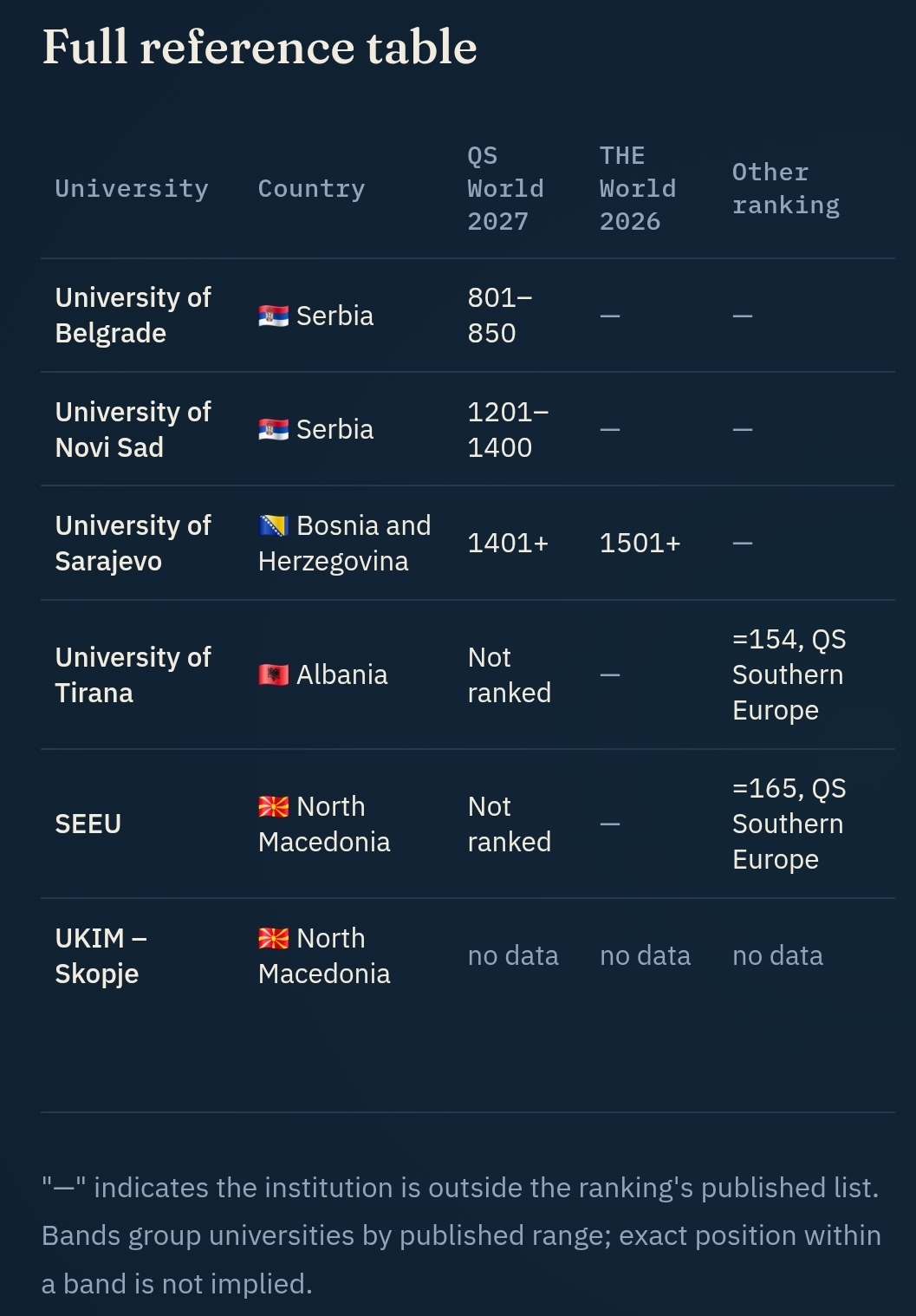
According to the latest ranking editions reviewed, the University of Belgrade is the strongest WB6 institution in the QS World University Rankings 2027, placed in the 801–850 band.
The University of Novi Sad, also in Serbia, is ranked 1201–1400, giving Serbia two institutions in the main QS global table.
The University of Sarajevo is ranked 1401+ by QS and 1501+ in the Times Higher Education World University Rankings 2026.
WB6 university comparison
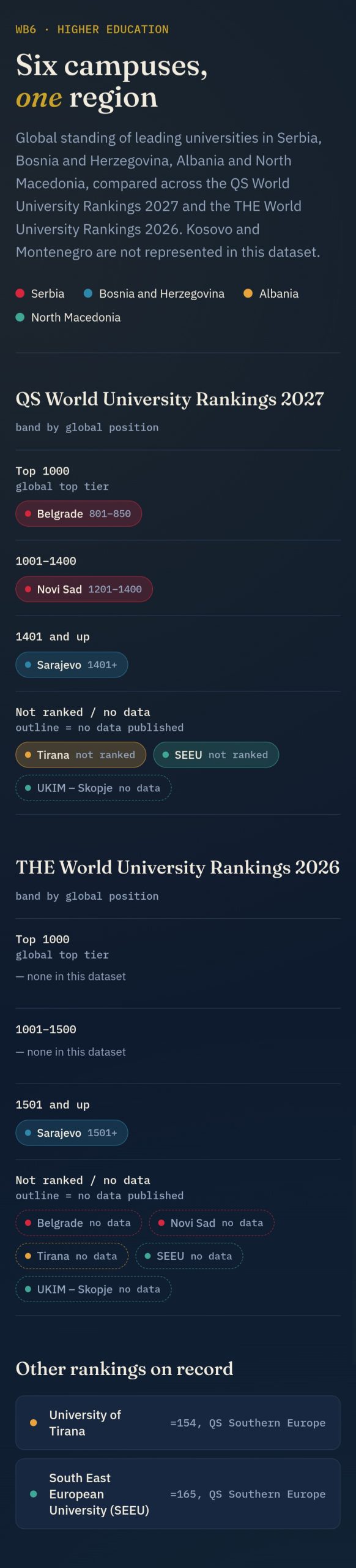
Comparable current QS and THE positions for universities in Kosovo and Montenegro were not available in the data reviewed, making it difficult to place them accurately in the same table.
Serbia sets the WB6 benchmark
Belgrade’s position makes it the clearest international benchmark for universities across the Western Balkans.
Its ranking also illustrates the distance that separates the region’s strongest institution from universities that have yet to enter the main global tables.
Novi Sad reinforces Serbia’s advantage. Its position in the 1201–1400 band means Serbia has two universities represented in the QS global ranking covered by the comparison.
Bosnia and Herzegovina follows through Sarajevo, although its flagship university sits significantly lower in both QS and THE.
The picture is different in Albania and North Macedonia, where some universities have established regional ranking positions without yet breaking into the main QS World University Rankings.
Tirana and SEEU separated by just 11 places
One of the closest comparisons is between the University of Tirana and South East European University (SEEU) in Tetovo.
In the QS Southern Europe 2026 ranking, Tirana is =154, while SEEU is =165 — a difference of just 11 places.
That makes Tirana a particularly relevant benchmark for SEEU.
Rather than comparing itself exclusively with Belgrade, which already has a substantially stronger international ranking profile, SEEU could view institutions such as Tirana as more immediate competitors in efforts to improve regional standing and eventually enter the main global rankings.
Within North Macedonia, separate July 2026 Webometrics data place SEEU third nationally, behind Ss. Cyril and Methodius University in Skopje and Goce Delčev University in Štip.
Webometrics uses a different methodology from QS and THE, however, meaning the results should not be combined into a single ranking.
Global visibility remains the challenge
The comparison points to a wider weakness in Western Balkan higher education: relatively few universities from the region have secured prominent positions in the world’s most recognised ranking systems.
Serbia is the exception in the data reviewed, with Belgrade and Novi Sad both appearing in the QS global ranking.
Sarajevo has also secured global visibility, although in the lower ranking bands.
For universities such as SEEU and Tirana, the next significant milestone would be moving from regional recognition into the main global tables.
For SEEU, which is currently =165 in QS Southern Europe, reaching the region’s top 100-120 universities would provide one possible medium-term benchmark.
Entering the main QS or THE world rankings would be a more significant international milestone.
Achieving that would depend on improvements across indicators used by international ranking organisations, including research output and citations, academic and employer reputation, internationalisation and research collaboration.
The numbers nevertheless show that the Western Balkans do not form a single academic tier.
Serbia has developed a clear advantage in global ranking visibility, Sarajevo maintains an international presence, while universities in the rest of the region are still trying to turn domestic and regional standing into broader international recognition.