


SKOPJE, Aug. 24 (BalkanView)— A worker earning the average salary in Montenegro can theoretically buy more than 550 litres of diesel with one month’s pay, while an average wage in Albania buys only about 330 litres, highlighting sharp differences in fuel purchasing power across the Western Balkans.
A comparison of the six Western Balkan economies — Albania, Bosnia and Herzegovina, Kosovo, Montenegro, North Macedonia and Serbia — shows why looking at fuel prices alone can be misleading. For households, the more revealing measure is how pump prices compare with earnings.

Using the latest available average net salaries and recent retail fuel prices, Montenegro has the strongest diesel purchasing power among the six economies, while Albania ranks last.
The calculation is hypothetical — households do not spend their entire monthly income on fuel — but it offers a simple measure of affordability in a region where private cars remain an important means of transport.
Montenegro leads despite expensive fuel
Montenegro has some of the region’s highest diesel prices, at around €1.88 a litre during the Aug. 18-24 price period. The government has temporarily reduced diesel excise duties to soften the impact of higher international oil prices.
Yet Montenegro’s average monthly net salary of about €1,036 means a worker earning the average wage could theoretically buy around 551 litres of diesel.
That puts Montenegro at the top of the regional affordability ranking despite its relatively high pump prices.
The result underlines a central point: cheaper fuel does not necessarily mean more affordable fuel.
Serbia: higher wages offset high prices
Serbia ranks second.
With an average net salary of around €1,010 and diesel costing approximately €1.94 per litre, an average monthly wage buys roughly 521 litres.
The Serbian government has also intervened to contain fuel costs, extending a temporary reduction in motor-fuel excise duties as authorities across the region seek to shield consumers from volatile international energy prices.
Despite diesel being more expensive than in Bosnia and Herzegovina, North Macedonia and Kosovo, Serbia’s higher wages give workers stronger fuel purchasing power.
Bosnia performs better than its wage level suggests
Bosnia and Herzegovina ranks third.
An average net salary of about €872 can purchase approximately 513 litres of diesel at a reference price of around €1.70 per litre.
Prices vary considerably between filling stations and cities, with diesel available below 3 convertible marks per litre in some locations and at 3.60 marks or more elsewhere.
Bosnia therefore illustrates another feature of the regional market: moderate wages can still translate into relatively strong fuel affordability when pump prices remain below those of neighbouring countries.
North Macedonia: cheapest does not mean most affordable
North Macedonia provides perhaps the clearest example of why pump prices tell only part of the story.
At around €1.59 per litre, diesel is cheaper than in Montenegro, Serbia, Bosnia and Herzegovina, Kosovo and Albania.
But with an average net salary of approximately €787, a worker earning the average wage could buy about 495 litres of diesel.
That places North Macedonia fourth among the WB6 economies.
A Macedonian driver therefore pays substantially less for each litre than a driver in Montenegro, but Montenegro’s higher wages more than compensate for the difference.
Kosovo falls below the 400-litre mark
Kosovo’s maximum prices for Aug. 23-24 put diesel at €1.79 per litre and petrol at €1.53.
Using an average salary indicator of approximately €713, one monthly wage would theoretically buy about 398 litres of diesel.
That leaves Kosovo substantially behind the four northern Western Balkan economies in this comparison.
The difference is notable: an average salary in Montenegro buys about 153 litres more diesel than an average salary in Kosovo.
Albania faces the toughest combination
Albania ranks last because it combines comparatively modest earnings with the highest fuel prices in the region.
Recent price tracking puts diesel at around €2.23 per litre and petrol at approximately €2.04, while Albanian media had already reported diesel reaching about 219 lek per litre several days earlier.
Using an estimated average net salary of approximately €740, derived from the latest official gross-wage statistics, an average Albanian worker could theoretically buy only around 332 litres of diesel.
That is about 219 litres fewer than in Montenegro.
Put another way, the average monthly wage in Montenegro buys roughly 66% more diesel than the estimated average wage in Albania.
Albania has also intervened in the fuel market, cutting fuel excise duties and using price-control mechanisms as international energy markets came under pressure.
Petrol tells a similar story
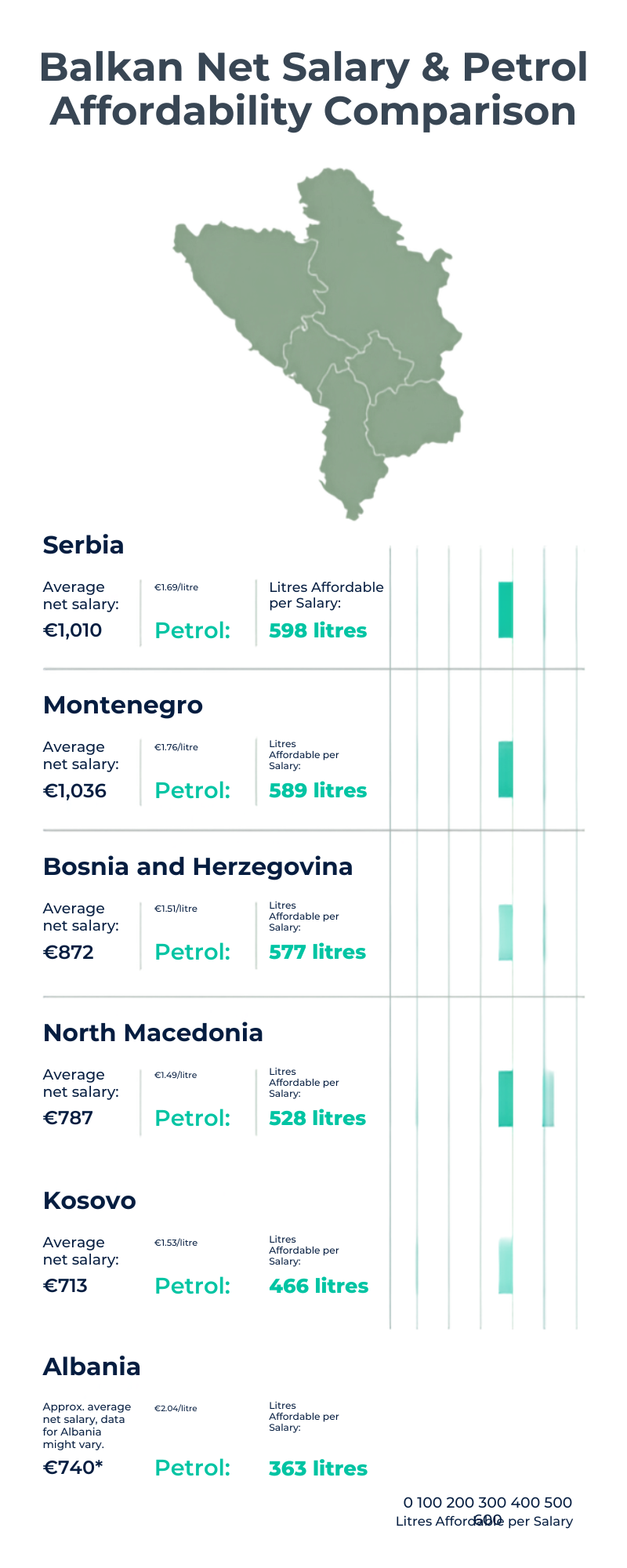
The ranking changes slightly when Euro 95 petrol rather than diesel is used.
Serbia overtakes Montenegro because its petrol price is lower, while Albania remains firmly at the bottom.
An average Serbian salary can theoretically buy almost 600 litres of petrol, compared with about 360 litres in Albania.
A regional divide hidden by pump prices
The figures expose a broader economic divide across the Western Balkans.
If countries were ranked only by the price displayed at the pump, North Macedonia would appear among the most favourable places for motorists.
Once wages are included, however, Montenegro and Serbia move ahead.
The reverse is true in Albania. Fuel is already expensive in nominal terms, but the burden becomes considerably heavier when measured against earnings.
The gap between the two ends of the diesel ranking is substantial. An Albanian earning the estimated average wage would need about 1.66 months of income to buy the same amount of diesel that an average Montenegrin wage can purchase in one month.
The regional divide is therefore not simply an energy-price story.
It is also a wage story.
Governments can temporarily use excise reductions, price caps and other measures to cushion sudden fuel-price increases. But over the longer term, affordability depends heavily on whether wages rise fast enough to keep pace with the cost of energy and other essentials.
For Western Balkan households, that difference can translate into hundreds of litres of fuel — and a markedly different standard of living — over the course of a year.
Methodology: The calculation divides the latest available average monthly net salary by the recent retail price of one litre of diesel or Euro 95 petrol. Figures are rounded to the nearest litre. Salary reference periods are not identical across all six economies, while Albania’s net figure is an estimate derived from the latest official gross-wage data. Fuel prices can also vary by station and location, particularly in Bosnia and Herzegovina. The comparison should therefore be read as an indicator of relative purchasing power rather than a fully harmonised statistical index.