


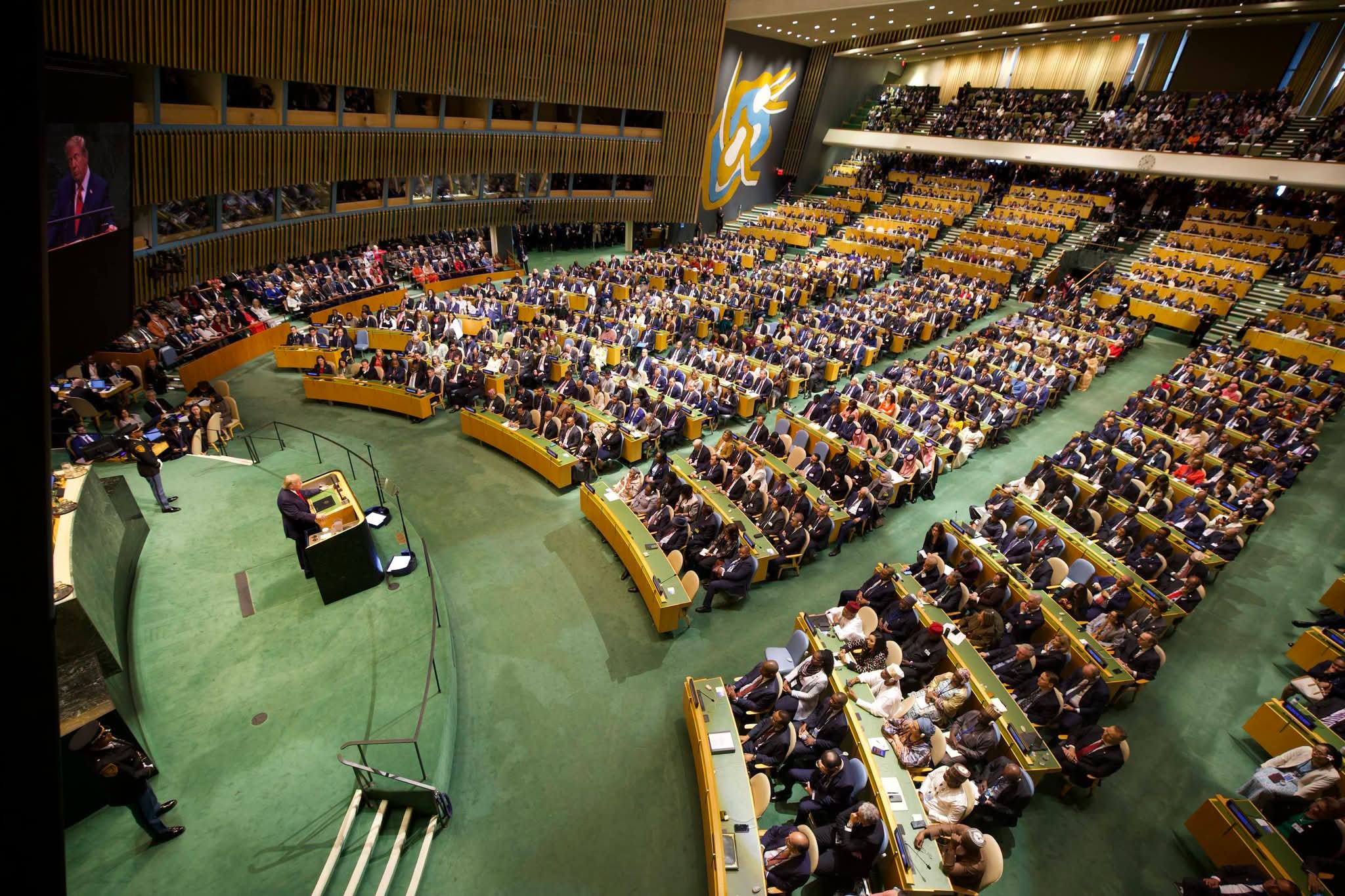
NEW YORK, Sept 22 – From critical minerals and U.S. investment to Kosovo, NATO membership, European Union enlargement and the legacy of the Srebrenica genocide, Western Balkan leaders are using the United Nations General Assembly in New York to pursue markedly different national agendas.
The general debate of the 81st session of the U.N. General Assembly opened on Tuesday, Sept. 22, and runs through Sept. 26 before concluding on Sept. 28. This year’s theme is “Restoring trust, managing transformation: a United Nations that delivers for all.”
For the six Western Balkan governments, however, much of the consequential diplomacy is taking place outside the General Assembly hall – in bilateral meetings, regional gatherings, receptions and side events that bring together political leaders who might otherwise take months to meet.
The first days in New York have also exposed how differently the six countries define their immediate foreign-policy priorities.
North Macedonian Prime Minister Hristijan Mickoski is combining the country’s stalled EU accession agenda with efforts to deepen ties with Washington and attract U.S. investment.
Serbian President Aleksandar Vučić is putting international law, Kosovo and relations with the EU at the centre of his diplomacy.
Kosovo Prime Minister Albin Kurti, whose country is not a U.N. member, is using the gathering for bilateral diplomacy focused on security, NATO membership and international recognition.
Bosnia and Herzegovina is putting Srebrenica, international court judgments and sovereignty high on its agenda, while Montenegro is stressing EU accession. Albania, meanwhile, has coupled its U.N. diplomacy with outreach to its large diaspora in the United States.
MICKOSKI: WASHINGTON TIES, EU ACCESSION AND INVESTMENT
For Mickoski, the U.S. trip has developed into a combination of security diplomacy, economic promotion and an attempt to raise North Macedonia’s stalled EU accession process with international partners.
The clearest confirmed high-level U.S. meeting so far was with U.S. Deputy Secretary of State Christopher Landau in New York on Sept. 21.
According to Mickoski’s office, the U.S. side also included Brendan Hanrahan, Assistant Secretary of State for European and Eurasian Affairs, and Daniel Lawton, a Deputy Assistant Secretary of State whose portfolio includes the Balkans.
The talks covered the U.S.-North Macedonia strategic partnership, economic cooperation, investment, regional security and North Macedonia’s role as a NATO ally.
Mickoski had earlier spoken with U.S. Secretary of State Marco Rubio in New York.
That contact should, however, be described more cautiously than the Landau meeting.
Mickoski published photographs and video of his conversation with Rubio, but no corresponding formal bilateral meeting was listed in the publicly available U.S. material reviewed for this article. The encounter therefore should not automatically be given the same diplomatic status as the formally announced meeting with Landau.
That distinction became a political issue in Skopje, where the opposition accused the government of exaggerating the importance of the Rubio encounter.
Mickoski also met Slovenian Prime Minister Janez Janša in New York on Tuesday.
Contrary to some earlier uncertainty over Janša’s title, Slovenian government records confirm that he was elected prime minister on May 22, 2026 and that his government took office on June 4. He is also heading Slovenia’s delegation to UNGA81.
According to Mickoski’s account of their meeting, the two discussed North Macedonia’s European prospects, political and economic cooperation and security challenges.
Mickoski reiterated his government’s position that EU integration should be based on merit, fulfilled criteria and measurable results rather than additional bilateral conditions.
The Slovenian government says Janša will address the General Assembly on Sept. 24 and hold several bilateral meetings during his Sept. 21-25 stay in the United States.
Behind Mickoski’s political meetings is a broader economic pitch.
His government has promoted potential U.S.-linked projects involving antimony, energy infrastructure and data centres. But a distinction remains necessary between investment discussions, political announcements and projects backed by signed contracts and committed financing.
That distinction will ultimately determine the economic significance of Mickoski’s U.S. visit.
VUČIĆ: EU TALKS AND KOSOVO
Vučić has used New York for a dense series of contacts ahead of his address to the General Assembly on Wednesday, Sept. 23, which is confirmed by his office.
His contacts have included European leaders and senior EU officials.
Vučić spoke with European Commission President Ursula von der Leyen and said afterwards that he believed Serbia would remain on its path towards EU membership regardless of the outcome of forthcoming elections.
He also encountered French President Emmanuel Macron in New York. Vučić himself described that contact as an unscheduled encounter between meetings, an important qualification when assessing the diplomatic weight of the exchange.
Vučić also met EU foreign policy chief Kaja Kallas. According to his account, he pressed for implementation of the Brussels Agreement, particularly the establishment of the Community of Serb Municipalities in Kosovo.
He attended the Partners for Multilateralism, International Law, Peace and Prosperity summit, where he was photographed speaking with Spanish Prime Minister Pedro Sánchez, Mickoski, European Council President António Costa and Council of Europe Secretary General Alain Berset.
The summit itself was launched by the EU together with Australia, Barbados, Brazil, Canada, India and Kenya to promote multilateralism, international law, peace and cooperation.
For Belgrade, the U.N. gathering provides an opportunity to pursue two parallel tracks: maintaining Serbia’s relationship with the EU while keeping Kosovo and Serbia’s interpretation of international law prominent in its international diplomacy.
Vučić’s General Assembly speech on Wednesday will provide a clearer indication of how heavily he intends to emphasise Kosovo.
KURTI: DIPLOMACY WITHOUT A U.N. SEAT
Kosovo is in a fundamentally different position.
It is not a member of the United Nations and therefore cannot use the General Assembly platform in the same way as the other five Western Balkan countries.
Kurti is instead using the concentration of world leaders in New York for bilateral diplomacy.
One of his most significant meetings so far has been with Turkish President Recep Tayyip Erdoğan.
According to Kosovo’s government, they discussed defence cooperation, Kosovo’s emerging defence industry, its ambition to join NATO and Turkey’s contribution to the NATO-led KFOR mission.
Kurti also highlighted economic relations, saying bilateral trade had reached $1 billion.
Kurti met International Monetary Fund Managing Director Kristalina Georgieva on Sept. 21.
According to his office, they discussed economic reforms, investment, exports, employment and energy. Kurti told Georgieva that Kosovo’s economy had expanded by 5.4% in the first quarter and 4.1% in the second quarter of 2026.
Those figures in the meeting statement should be treated as figures cited by the Kosovo government rather than independent IMF estimates unless separately verified against IMF or official statistical data.
Kurti also met U.S. Congressman Joe Wilson, with security, defence cooperation, investment, the rule of law and Kosovo’s NATO ambitions on the agenda.
For Pristina, that illustrates the particular value of UNGA week: Kosovo does not have a seat in the General Assembly, but it can participate in the diplomatic ecosystem surrounding it.
BOSNIA: SREBRENICA RETURNS TO THE U.N.
Bosnia and Herzegovina has brought a markedly different agenda to New York.
Denis Bećirović, chairman of Bosnia’s tripartite presidency, met U.N. Secretary-General António Guterres at U.N. headquarters.
According to Bosnia’s presidency, Bećirović discussed the General Assembly resolution on the Srebrenica genocide, implementation of the resolution and the preservation of facts established by international courts.
He also raised the recent funeral in Serbia of Ratko Mladić, who was convicted of genocide, crimes against humanity and war crimes, and criticised public and institutional glorification surrounding it.
According to the same official statement, Guterres reiterated U.N. support for Bosnia and Herzegovina as an independent, sovereign and indivisible state and said the U.N. had condemned the glorification of Mladić.
Bećirović was scheduled to address the General Assembly on Sept. 22.
For Sarajevo, therefore, New York provides a platform for keeping Srebrenica, international judgments and Bosnia’s sovereignty within the wider international debate.
MONTENEGRO: 20 YEARS AT THE U.N., WITH THE EU IN SIGHT
Montenegrin President Jakov Milatović arrived in New York with a more straightforward message: Montenegro wants to complete its European integration.
Milatović is leading Montenegro’s delegation to the General Assembly and attended Tuesday’s opening of the general debate.
The visit also has symbolic importance.
Montenegro joined the United Nations on June 28, 2006, weeks after restoring its independence, becoming the organisation’s 192nd member. It is marking the 20th anniversary of its membership this year.
Milatović’s office says he will address the General Assembly, attend a meeting between EU and Western Balkan leaders and hold bilateral meetings with international officials.
It has explicitly identified Montenegro’s European future as one of the principal subjects of his meetings in New York.
That makes Montenegro’s agenda notably different from those of Serbia, Kosovo or Bosnia: Podgorica is seeking to use UNGA week partly to reinforce its case for completing EU accession.
RAMA: DIASPORA BEFORE NEW YORK
Albanian Prime Minister Edi Rama began his U.S. programme with the Albanian diaspora in Michigan before moving on to his UNGA engagements in New York.
Rama announced that Albania would soon open a consulate in Detroit, describing it as a way to strengthen Albania’s institutional presence and services for the sizeable Albanian community in Michigan.
The Albanian government’s official statement says the Michigan meeting was Rama’s first stop in the United States before his engagements in New York connected with the General Assembly.
At the time of this fact-check, the official Albanian government material reviewed did not yet provide enough detail on Rama’s substantive New York bilateral meetings to justify presenting a longer list as confirmed fact.
That is likely to change as the week progresses.
EUROPE TRIES TO KEEP THE SIX TOGETHER
Despite their divergent agendas, the six Western Balkan countries are also being brought together under the EU enlargement umbrella.
Italian Foreign Minister Antonio Tajani convened the six Western Balkan foreign ministers in New York on Sept. 21 with the “Friends of the Western Balkans” group – Austria, Croatia, the Czech Republic, Greece, Slovakia and Slovenia.
European Parliament President Roberta Metsola also attended.
Italy’s foreign ministry said the meeting formed part of its effort to accelerate the European integration of the region.
The Central European Initiative said discussions highlighted connectivity, security and the need to keep the Western Balkans high on Europe’s agenda.
That EU framework is one of the few places where the six national agendas converge.
SIX COUNTRIES, SIX OBJECTIVES
The first days of UNGA week illustrate how differently Western Balkan governments use the same diplomatic stage.
North Macedonia is trying to connect its U.S. strategic partnership with investment and its stalled EU accession process.
Serbia is simultaneously engaging Brussels and keeping Kosovo and international law prominent in its diplomacy.
Kosovo, without a U.N. seat, is using bilateral meetings to push security cooperation, NATO membership and its international position.
Bosnia and Herzegovina is emphasising Srebrenica, international court judgments and sovereignty.
Montenegro is foregrounding its bid to complete EU accession.
Albania is combining multilateral diplomacy with its U.S. relationship and diaspora outreach.
But New York also creates a diplomatic optical illusion.
A brief encounter in a corridor, a conversation at a reception, a scheduled bilateral meeting, negotiations over an investment and a signed agreement are not equivalent diplomatic outcomes.
That distinction is particularly relevant for North Macedonia.
The Mickoski-Landau talks can be documented as a formal meeting. The Mickoski-Rubio contact happened, but the available evidence does not establish it as an equivalent formal bilateral meeting. The Mickoski-Janša meeting is correctly described as a meeting between the prime ministers of North Macedonia and Slovenia.
Similarly, Vučić’s encounter with Macron should not be presented as equivalent to a scheduled bilateral simply because both leaders spoke in New York.
The eventual measure of the Balkan diplomatic week will therefore not be the number of photographs or handshakes.
For North Macedonia, it will include whether discussions about U.S. investment, critical minerals, energy and technology translate into financed projects – and whether diplomatic engagement changes anything in the country’s blocked EU accession process.
For Serbia, the question will be how Belgrade balances its Kosovo policy with its declared European trajectory.
For Kosovo, the concrete test will be whether its bilateral diplomacy produces additional international support for its Euro-Atlantic ambitions.
For Montenegro, attention will remain focused on whether political support translates into further progress towards EU membership.
And for Bosnia and Herzegovina, the issue is how international backing for its sovereignty and the established judicial record on Srebrenica translates into policy amid continuing domestic tensions.
UNGA therefore presents the Western Balkans to the world as a single region.
The diplomacy taking place behind that label tells a different story: six countries arriving in New York with six sets of priorities – and very different expectations of Washington, Brussels and the international system.