


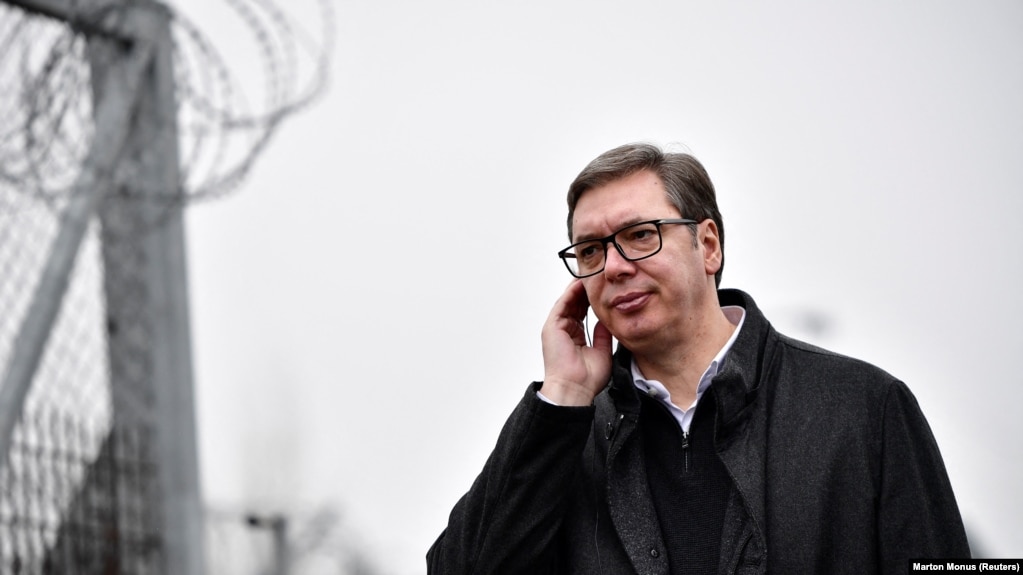
Aleksandar Vučić has resigned as Serbia’s president seven months before his term was due to end, clearing the way for his participation in an Oct. 25 parliamentary election and triggering an early presidential vote after nearly two years of student-led protests and political turmoil.
BELGRADE, Sept 28 (BalkanView) – Aleksandar Vučić handed presidential duties to parliamentary speaker Ana Brnabić on Monday after resigning as Serbia’s head of state, leaving the presidency but immediately entering another phase of the country’s increasingly intense electoral contest.
Vučić resigned on Sunday, about seven months before his second and final presidential term was due to expire, saying he wanted to participate in Serbia’s Oct. 25 snap parliamentary election as an ordinary citizen.
His departure also triggers an early presidential election that must be held within three months, giving Serbia two national electoral contests in the closing months of a year dominated by protests, corruption allegations and demands for political accountability.
Vučić has been either prime minister or president for more than a decade and was constitutionally barred from seeking a third consecutive presidential term.
His resignation therefore changes his office, but does not amount to a withdrawal from politics.
Under Serbia’s parliamentary system, a former president can become prime minister if nominated after an election and supported by a parliamentary majority.
Vučić previously served as prime minister from 2014 until becoming president in 2017.
Brnabić takes over as acting president
Brnabić, a longtime Vučić ally who previously served as prime minister before becoming speaker of parliament, assumed presidential duties following his resignation.
Vučić formally handed over the office on Monday.
Under Serbian law, the speaker of parliament exercises presidential powers when the presidency becomes vacant and may do so for no longer than three months.
The presidential election must be organised so that voting takes place no later than three months after the previous president’s mandate ends.
That means Serbia will have a new presidential contest before the end of December.
Until then, Brnabić will perform the functions of head of state.
Serbia votes for parliament first
The more immediate political contest comes on Oct. 25, when Serbia holds snap parliamentary elections.
The vote follows nearly two years of political and social unrest that began after the collapse of a concrete canopy at the renovated railway station in Novi Sad on Nov. 1, 2024, killing 16 people.
The disaster triggered student-led demonstrations that developed into a much broader protest movement demanding accountability, stronger institutions and action against corruption.
The protests became one of the most sustained political challenges Serbia had experienced in years.
Students subsequently moved from street protests towards electoral participation, backing a list that includes academics, professionals, teachers, athletes and other candidates.
The Oct. 25 election will therefore determine the composition of Serbia’s next parliament and which political forces are able to assemble a governing majority.
Vučić’s resignation allows him to campaign without simultaneously holding the office of president.
“I want to participate in the upcoming elections as an ordinary citizen,” he said when announcing his departure.
From president back towards government?
Vučić has not left much ambiguity about his intention to remain politically active.
After announcing his resignation, he said he would travel across Serbia and speak directly with citizens during the parliamentary campaign.
That has intensified discussion in Serbia about whether he could return to the premiership, the position he held before becoming president.
Such an outcome, however, would depend on the parliamentary election and the formation of a governing majority.
Under Serbia’s constitutional system, voters elect parliament rather than the prime minister directly. The president nominates a candidate for prime minister after consultations, and the government must secure parliamentary support.
Serbian sociologist Vladimir Vuletić told public broadcaster RTS that Vučić’s resignation speech sounded less like a political farewell than preparation for a campaign focused on the premiership.
That remains an analyst’s interpretation rather than a predetermined electoral outcome.
What is already clear is that Vučić intends to remain involved in the campaign.
A second race begins
The resignation simultaneously opens another contest: who will become Serbia’s next president.
The timing is already generating legal discussion.
Serbian law requires presidential voting to take place within three months of the early termination of the mandate, with between 30 and 60 days separating the calling of the election and polling day.
Some constitutional lawyers have argued that the timetable should also leave sufficient time for a possible second round and electoral disputes.
The precise date will therefore matter because Serbia uses a two-round system for presidential elections if no candidate wins the required majority in the first round.
Brnabić, as parliamentary speaker and acting president, has a central procedural role in calling the election.
49 pardons before departure
Vučić also used one of his final presidential powers to issue pardons or abolitions involving 49 people.
He said 23 of the cases were connected to events surrounding protests and political tensions during the previous year and a half.
The decision linked his final days in the presidency with the political crisis that followed the Novi Sad disaster.
The protests have repeatedly brought tens of thousands of people onto Serbian streets and placed questions of corruption, institutional accountability and the functioning of the state at the centre of political debate.
Vučić and his allies have rejected accusations that the government bears political responsibility for many of the problems cited by protesters and have defended their record on economic development and stability.
One resignation, two elections
Vučić’s departure has therefore produced an unusual political transition.
Serbia has an acting president and must elect a permanent successor before the end of the year.
Before that happens, voters will choose a new parliament.
And the politician who resigned from the presidency is participating in the political contest that will determine who controls the next government.
That makes the sequence of events important for foreign observers.
The Oct. 25 parliamentary election will determine the balance of forces in the legislature and the possibilities for forming a government.
The subsequent presidential election will decide who occupies an office Vučić held since 2017.
Only after both processes are completed will the institutional consequences of his resignation become clear.
For now, Serbia has entered a political transition in which the presidency has changed hands — while one of the country’s most prominent political figures remains actively engaged in the electoral contest.