


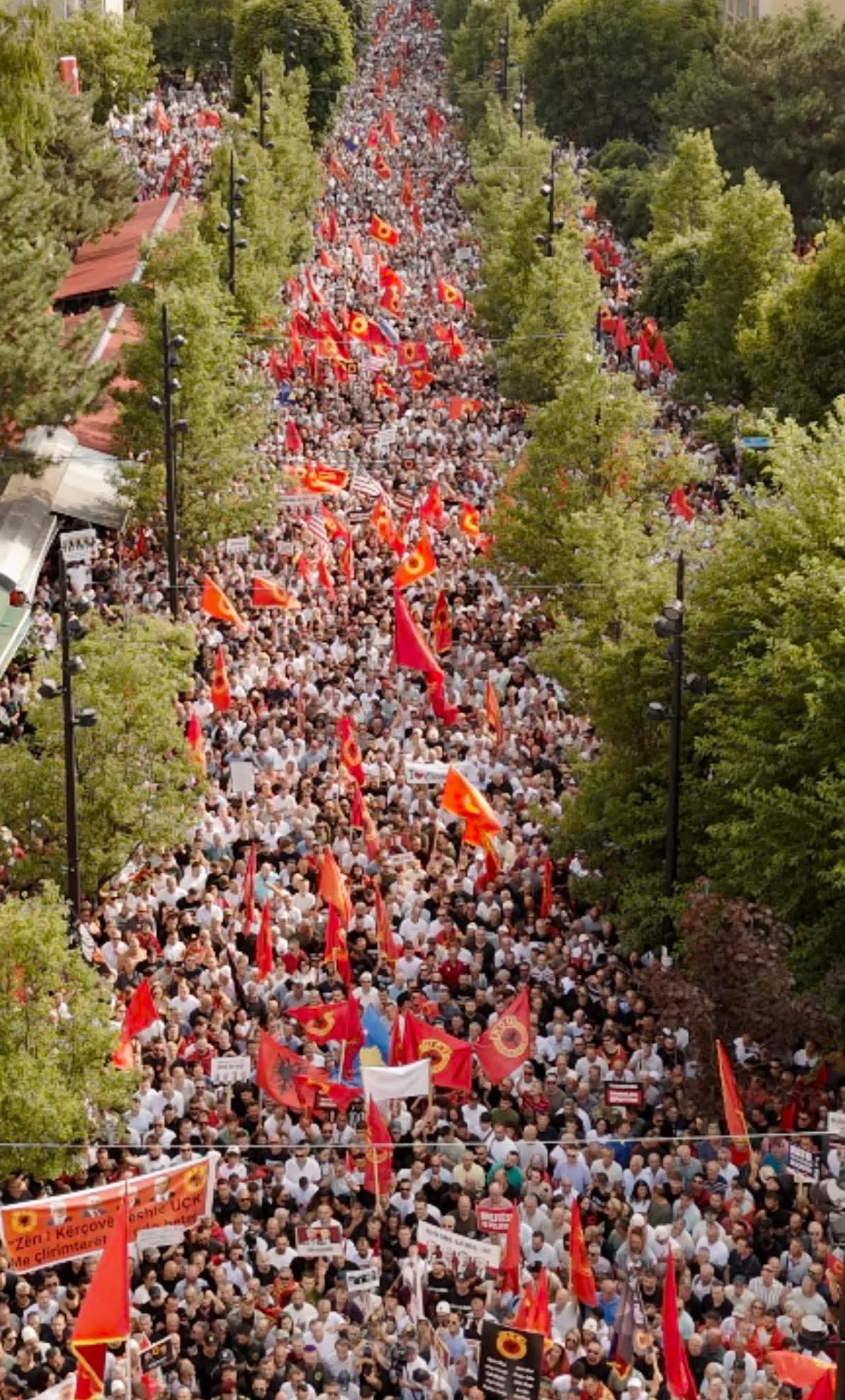
Thousands in Kosovo have rallied behind four former guerrilla leaders convicted of war crimes in The Hague. Far less visible are the hundreds of victims at the centre of the judgment — including ethnic Albanians, Serbs and Roma — exposing one of the most difficult questions facing Kosovo more than a quarter-century after the war.
PRISTINA, Sept 28 (BalkanView) – Thousands of people have taken to the streets in Kosovo to support former leaders of the Kosovo Liberation Army convicted of war crimes in The Hague.
Almost absent from the demonstrations are another group at the heart of the same case: the hundreds of people whom judges found were arbitrarily detained, tortured, subjected to cruel treatment or killed.
For many Kosovo Albanians, the Sept. 16 verdict against Hashim Thaçi, Kadri Veseli, Rexhep Selimi and Jakup Krasniqi has been perceived as touching something much larger than the guilt or innocence of four men — the legitimacy of the armed struggle against Serbian forces in 1998-99.
The Kosovo Specialist Chambers says the case was much narrower.
Its judges found the four men individually responsible for war crimes committed against people regarded as opponents of the KLA’s political or military objectives. Prosecutors have stressed that neither the KLA as an organisation nor Kosovo’s war for independence was on trial.
Between those two interpretations, the victims have struggled for public attention.
385 detained, 303 tortured, 96 killed
The Kosovo Specialist Chambers, a Kosovo court based in The Hague and staffed by international judges and prosecutors, convicted all four former KLA leaders of illegal or arbitrary detention, cruel treatment, torture and murder.
The Trial Panel found them criminally responsible for the arbitrary detention of 385 people, cruel treatment of 49, torture of 303 and murder of 96.
Thaçi, Kosovo’s former president and one of the most prominent political figures to emerge from the war, was sentenced to 25 years in prison. Krasniqi also received 25 years, Veseli 18 and Selimi 13.
Time already spent in detention will count towards their sentences. The judgment is at first instance and the judicial process has not ended.
The judges acquitted the four men of crimes against humanity because prosecutors had not proved beyond reasonable doubt that there had been a widespread or systematic attack directed against a civilian population. They were also acquitted in relation to several specific alleged war-crime incidents.
That distinction is crucial.
The judgment did not declare the KLA a criminal organisation. Nor did it rule on whether Kosovo’s armed struggle for independence was legitimate.
It determined the criminal responsibility of four individuals for specific crimes.
Who were the victims?
The answer complicates Kosovo’s established narratives about the war.
According to the judgment, the common criminal purpose targeted people perceived as opponents of the KLA’s political or military objectives.
They included Kosovo Albanians associated with rival political or military forces, including the Democratic League of Kosovo, or LDK, and the Armed Forces of the Republic of Kosovo, known as FARK.
Others were suspected of links to Serbian or Yugoslav authorities.
The victims also included members of ethnic minorities, among them Serbs and Roma.
Radio Free Europe/Radio Liberty reported that some victims were teachers, farmers, forestry workers and ordinary labourers. Women and children were also among those detained.
With limited exceptions, the judges found no evidence that the victims had engaged in criminal activity, actively participated in hostilities or otherwise posed a legitimate security threat to the KLA, RFE/RL reported.
Yet their names and personal stories remain largely peripheral to Kosovo’s public debate.
National heroes and largely anonymous victims
That imbalance helps explain the emotional gulf surrounding the verdict.
On one side are four men whose names are inseparable from Kosovo’s modern history.
Thaçi became prime minister and later president. Veseli headed Kosovo’s intelligence service before becoming parliament speaker. Krasniqi also served as parliament speaker, while Selimi became a senior politician after the war.
For supporters, they remain symbols of the struggle that ended Serbian rule and eventually led to Kosovo’s 2008 declaration of independence.
On the other side are hundreds of victims whose names and faces are far less familiar to the wider public.
Political analyst Agon Maliqi told RFE/RL that this asymmetry matters: society is being asked to compare nationally recognised figures with victims who, for many citizens, remain largely abstract.
Another factor is even more sensitive.
Some victims have long been portrayed or suspected as collaborators with Serbian authorities.
That label can diminish public empathy even when collaboration was never established.
In wartime conditions, however, suspicions could also arise from political rivalry, mistrust or personal disputes.
The judgment therefore confronts Kosovo with an uncomfortable distinction: being perceived as an opponent was not the same as being a legitimate military target.
The phrase that shook Kosovo
Particularly controversial was the judges’ finding that the four defendants significantly contributed to a common criminal purpose of targeting perceived opponents of the KLA’s political and military objectives.
For many in Kosovo, that language has been interpreted as extending beyond the four defendants and casting a shadow over the KLA itself.
The Specialist Prosecutor rejects that interpretation.
Prosecutor Kimberly West said after the judgment that the prosecution had sought accountability for individuals and had not prosecuted either the KLA or the war for Kosovo’s independence.
That distinction now lies at the centre of Kosovo’s argument over the verdict.
Can individual criminal responsibility be separated from the collective memory of a war regarded by most Kosovo Albanians as a struggle for liberation?
The court says it can.
Much of Kosovo’s political reaction suggests that separating the two emotionally is considerably harder.
Political support for the convicted leaders
Kosovo’s political leadership has strongly challenged the verdict, while emphasising the KLA’s role in the country’s liberation.
The response reflects how deeply the former guerrilla organisation is embedded in Kosovo’s state-building narrative.
But it has also prompted criticism that the victims identified by the court have received far less attention.
Political analyst Ilir Deda told RFE/RL that supporting an appeal should not become a denial of victims’ suffering.
Recognising those victims does not require Kosovo to accept collective guilt for the KLA, nor does it erase the wider historical context in which the organisation fought.
That context remains essential.
The other unresolved account: Serbian crimes
The 1998-99 Kosovo war produced widespread atrocities against Kosovo Albanian civilians, with Serbian and Yugoslav forces responsible for numerous killings, expulsions and other crimes.
For many Kosovo Albanians, the Hague verdict cannot be separated emotionally from frustration over what they regard as inadequate accountability in Serbia for crimes committed by Serbian forces.
The Humanitarian Law Center Kosovo acknowledged that anger over the Thaçi verdict was also connected to what it described as the near-total absence of prosecutions of senior Serbian officials before courts in Serbia.
But it warned against using that failure to dismiss the victims in the Hague case or automatically label them collaborators.
That exposes one of the most difficult problems of transitional justice.
Failure to prosecute one set of crimes does not make another set of victims disappear.
And acknowledging crimes committed by members of a liberation movement does not by itself criminalise the movement or invalidate the political objective for which it fought.
The battle over memory
There were 156 participating victims in the Thaçi case, and the court has opened separate reparation proceedings following the judgment.
Their presence in the courtroom has so far been much more visible than their place in Kosovo’s political debate.
That suggests two parallel battles are now unfolding.
One will continue in The Hague, where lawyers will challenge evidence, legal findings and sentences through the judicial process.
The other is taking place inside Kosovo and concerns something a court cannot decide: how a young state remembers the war from which it emerged.
Kosovo does not have to choose between recognising the overwhelming importance of the KLA in its independence struggle and acknowledging people who were unlawfully detained, tortured or killed by its members.
The court’s judgment concerns individual criminal responsibility, not collective guilt.
But the muted discussion of the victims shows how difficult that distinction remains when criminal justice intersects with a country’s founding narrative.
The figures in the judgment — 385 detained, 303 tortured, 49 subjected to cruel treatment and 96 murdered — are therefore more than judicial statistics.
Behind them are people whose experiences complicate a familiar story of Kosovo’s war.
More than 25 years after the conflict ended, the verdict has forced that part of the story back into view.