


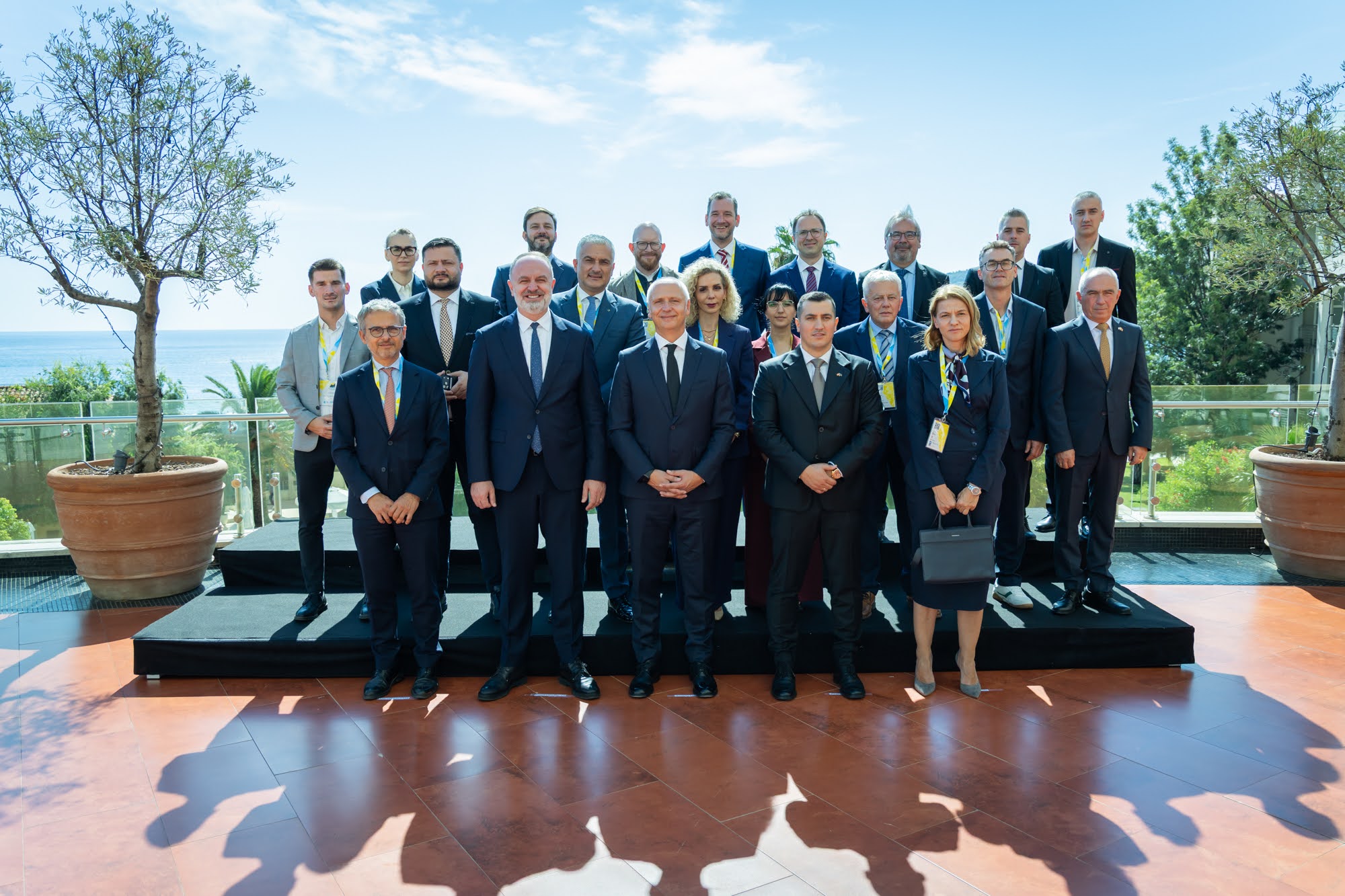
Seven industrial parks and business zones across the Western Balkans have signed cooperation agreements with six European Union partners, aiming to draw regional companies deeper into European supply chains and accelerate greener industrial development.
BUDVA, Montenegro, Sept 30 (BalkanView) — Seven industrial parks and business zones from the Western Balkans signed memoranda of understanding with six EU counterparts on Wednesday, launching a regional partnership designed to strengthen investment, industrial cooperation and access to European value chains.
The agreements, signed in the Montenegrin coastal town of Budva, form part of economic initiatives being prepared for the 2026 Berlin Process Summit and are intended to turn the Western Balkans’ already close trade relationship with the EU into more direct business partnerships.
The initiative is facilitated by the Regional Cooperation Council (RCC) and also supports the Common Regional Market Action Plan for 2025-2028.
Nearly 70% of goods exported by the six Western Balkan economies already go to the European Union, making the bloc by far the region’s most important market.
The new partnership seeks to build on that relationship by connecting companies operating in industrial parks with European suppliers, customers, investors and technology partners.
“Today, we are launching a partnership between industrial parks in WB6 and the EU with a clear purpose: to bring our businesses closer to European industry,” RCC Secretary General Amer Kapetanović said.
“The opportunity now is to take that connection further: to help more firms from the WB6 enter European value chains, and to help those already supplying European customers take on more work.”
From Bitola to Berlin’s industrial networks
The Western Balkan participants are TEDA Tirana in Albania, Technology Park Posušje and Business Zone Gradiška in Bosnia and Herzegovina, Industrial Park Suhareka in Kosovo, Business Zone Bijelo Polje in Montenegro, Industrial Zone Bitola in North Macedonia and CTPark Belgrade City in Serbia.
Their EU partners come from Austria, Germany and Slovenia and include Wirtschaftsagentur Burgenland, Innovation Centre W.E.I.Z, Ökopark Hartberg, Industrial Park Schwarze Pumpe, Development Agency Sora and Business and Industrial Zone Tezno/PPC Tezno Institute.
The agreements envisage cooperation in business matchmaking, supplier development, investment promotion, industrial park management, innovation and workforce skills.
A significant part of the initiative will focus on introducing so-called Eco-Industrial Park practices across the Western Balkans.
These include greater resource efficiency, circular-economy models, cleaner energy and more sustainable industrial infrastructure — areas that are becoming increasingly important for companies seeking to remain competitive in the EU market.
More than a ceremonial agreement
The RCC said the partnership was designed as a long-term platform rather than a one-off exchange between industrial zones.
Its initial phase is expected to include study visits, peer learning, direct business-to-business matchmaking and cooperation between park management organisations.
The network could later be expanded to additional industrial parks in both the Western Balkans and the EU.
The agreements were signed during the Economic Conference Montenegro 2026, ahead of the Berlin Process Economic Ministers’ Meeting. The event was organised by the RCC and the Chamber of Economy of Montenegro with support from the European Commission.
For the Western Balkans, the initiative comes as governments seek to narrow the economic gap with the EU while preparing their economies for deeper integration into the bloc’s single market.
The practical test, however, will come after the signatures: whether the new partnerships generate investment, contracts and supplier relationships for Western Balkan companies.
As Kapetanović put it: “Today, we make the introductions. Tomorrow, we build business links.”