


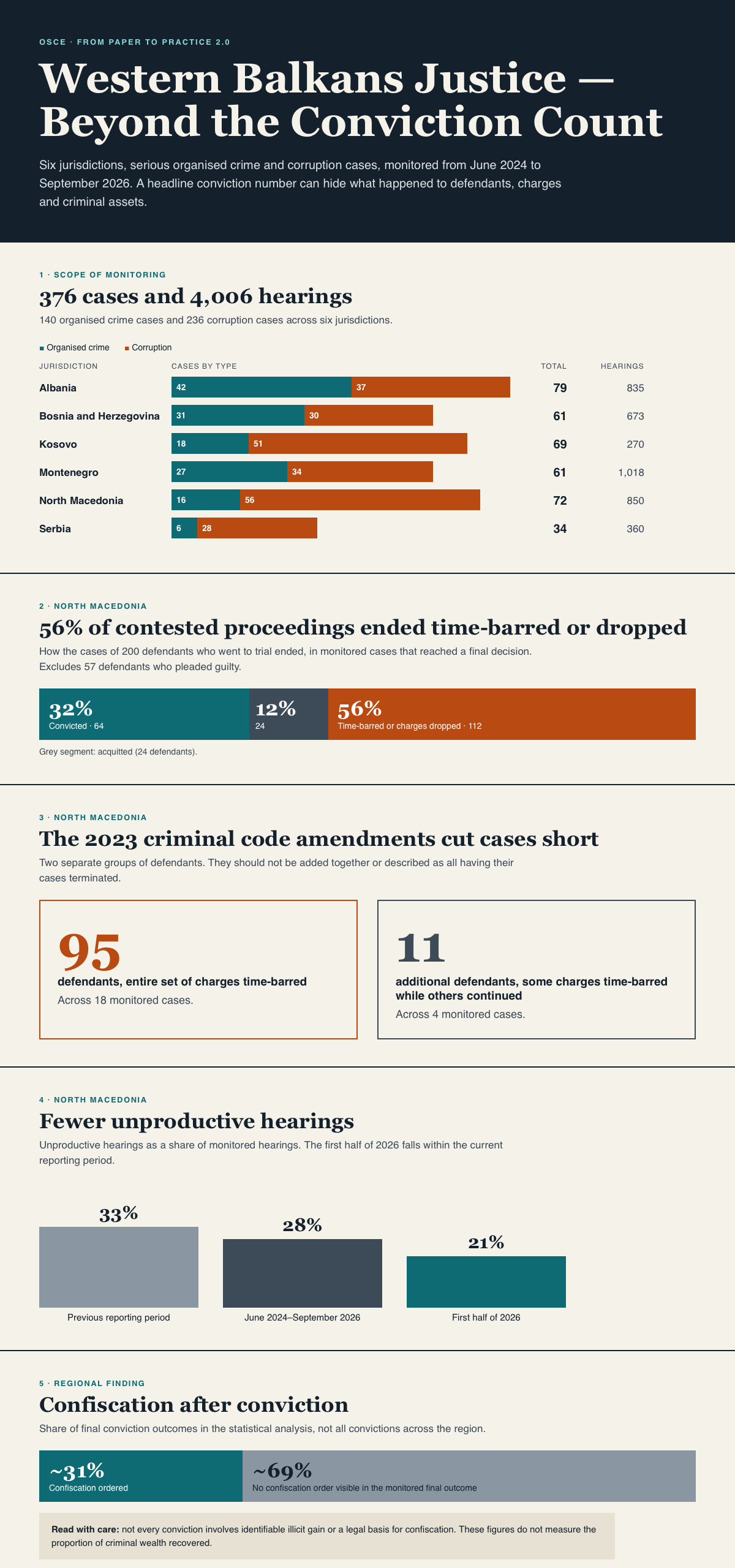
For 95 defendants in serious organised crime and corruption cases monitored in North Macedonia, proceedings ended without a determination of guilt: changes to the criminal code meant the time allowed for prosecution had run out.
Elsewhere in the Western Balkans, convictions brought another question into focus — whether finding someone guilty also meant recovering the proceeds of crime.
An OSCE report examining more than 350 cases across six jurisdictions describes a region where justice reform increasingly depends on what happens after laws are passed, strategies adopted and new institutions established.
The challenge, it finds, is turning those measures into cases that withstand scrutiny, judgments that survive appeal and financial consequences that address the incentives behind corruption and organised crime.
“The central question is no longer whether strategies, laws, guidelines, training, digital tools or institutional plans exist,” the report says.
Its findings suggest that counting indictments, convictions or completed cases can obscure weaknesses in how justice is delivered — and sometimes conceal improvements.
Produced through an EU-funded regional trial-monitoring project, From Paper to Practice 2.0 draws on courtroom observations, judicial decisions and institutional consultations covering June 2024 to September 2026.
It examines Albania, Bosnia and Herzegovina, Kosovo, Montenegro, North Macedonia and Serbia.
The cases were selected for their seriousness, complexity and public significance. They are not a representative sample of all criminal proceedings, and the OSCE cautions against treating the results as national conviction rates or a ranking of judicial systems.
Yet they offer a detailed view of what happens when institutions confront cases that test their expertise, independence and ability to work together.
WHEN TIME DECIDES THE OUTCOME
In North Macedonia, the consequences of legislative changes were particularly visible.
Among 200 defendants who contested charges in monitored cases that reached a final decision, 64 were convicted and 24 acquitted. Proceedings against the remaining 112 became time-barred or ended with rejection verdicts after prosecutors dropped charges.
For 95 defendants, the expiry of limitation periods was directly attributable to the 2023 criminal code amendments, the report says.
Those changes caused all charges against them to become time-barred across 18 monitored cases. Another 11 defendants saw some charges expire while proceedings continued on others.
The figures show how the fate of a prosecution can depend on decisions beyond the courtroom, even as judges improve the way trials are run.
Monitoring of 850 hearings in North Macedonia found that the proportion deemed unproductive fell to about 28%, from 33% in the previous reporting period. In the first half of 2026, it fell further, to 21%.
The report describes more structured proceedings, including firmer handling of health-related absences and more active judicial guidance of evidence presentation.
But those improvements did not resolve problems elsewhere in the process. Around half of first-instance verdicts in monitored high-level cases continued to be annulled, sending cases back for retrial.
Faster hearings, in other words, did not necessarily produce more durable judgments.
WHAT A CONVICTION COUNTS
Across the region, the OSCE challenges the use of conviction rates as a sufficient measure of success.
A conviction of a peripheral defendant on a lesser charge may enter the statistics alongside the conviction of a principal defendant on the most serious allegation. A negotiated guilty plea may be counted alongside a verdict reached after a contested trial.
Those outcomes can have different implications for the strength of a prosecution and the effectiveness of the justice system.
In Albania, a separate analysis of monitored cases with binding outcomes recorded convictions in 310 of 355 final charge-level outcomes, or 87.3%.
The report says this demonstrated significant capacity within the specialised jurisdiction to deliver final judicial results. It nevertheless identifies workload pressures, staffing shortages and procedural practices that continue to affect complex proceedings.
In Serbia, a smaller outcome-mapping sample illustrates how the unit being counted can change the picture. The final conviction rate was 50% when measured by case, but 26.9% when measured by individual charge.
A case containing several defendants and allegations may therefore appear successful in an aggregate count even when only a limited part of the prosecution results in conviction.
The figures from the two countries are drawn from different monitored samples and should not be read as a direct comparison.
Nor does an acquittal automatically signal failure, the OSCE stresses. It may show that a court properly upheld the presumption of innocence and required prosecutors to prove their case.
The recurring concern is whether evidence, factual allegations and the legal elements of an offence fit together — and whether responsibility is established for each defendant.
FOLLOWING THE MONEY
The gap between conviction and accountability is especially apparent in asset recovery.
Across monitored final conviction outcomes included in the report’s statistical analysis, confiscation was ordered in roughly 31%.
That does not mean assets should have been confiscated in every remaining outcome. Some convictions may involve no identifiable illicit gain or provide no legal basis for confiscation, the report cautions.
But the findings raise questions about whether financial investigations and asset tracing are sufficiently integrated into serious crime prosecutions.
A guilty verdict alone does not establish that criminal profits have been removed.
The report argues that institutions need to follow cases through the entire process: from the construction of charges to trial, appeal, sentencing and recovery of assets.
That requires more than training or another database. Judges and prosecutors need usable legal guidance, specialised support, adequate staffing and systems that allow them to learn from overturned judgments and failed prosecutions.
Public access to reasoned decisions matters too. Without clear explanations, citizens may struggle to distinguish a justified acquittal from a poorly prepared prosecution, or a complex appeal from avoidable delay.
The next test of reform, the report suggests, lies in that distinction: whether institutions can show not simply that a case has ended, but how it ended, why the result was reached and what consequence followed.