


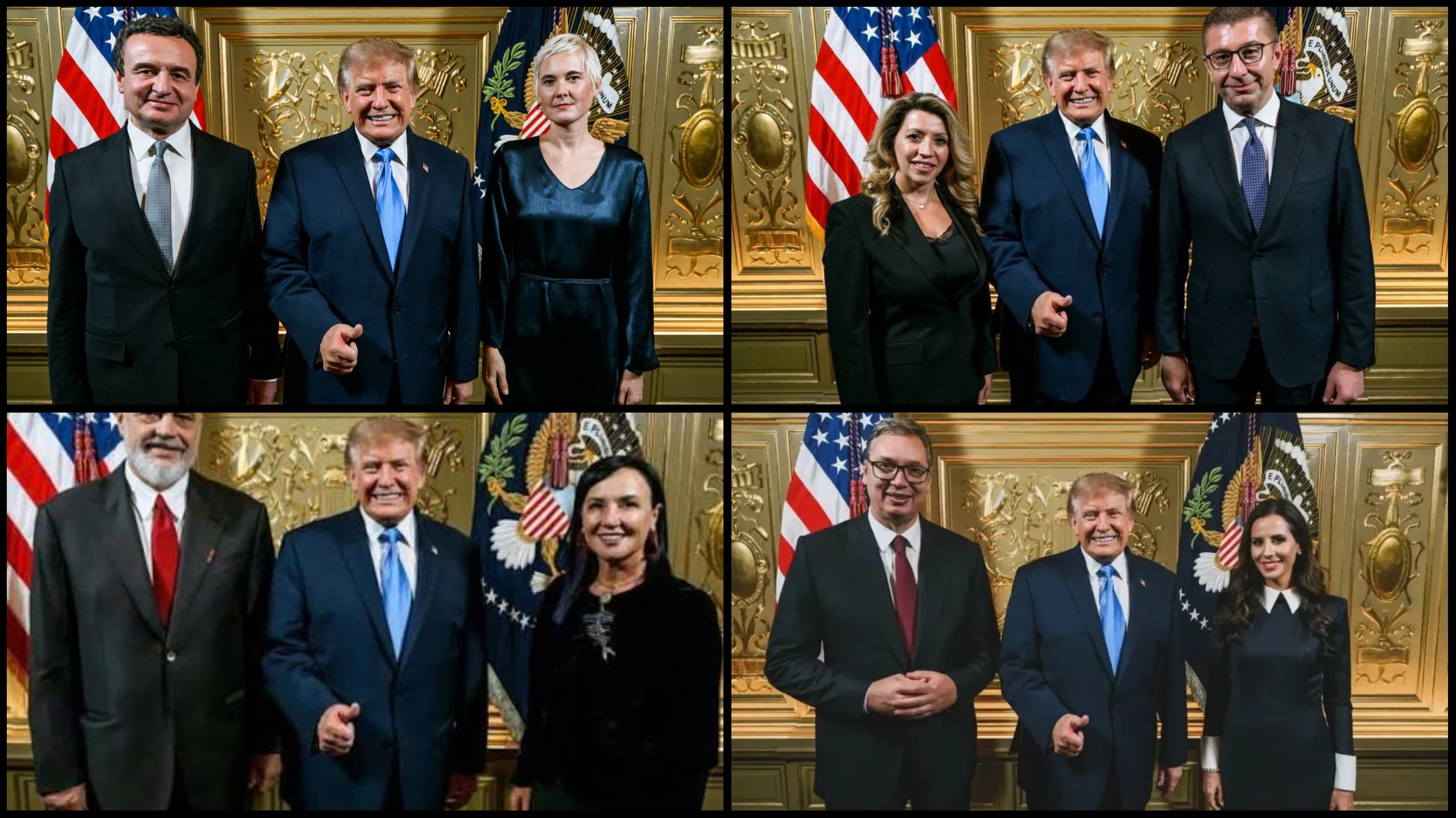
Kosovo’s Albin Kurti, Albania’s Edi Rama, North Macedonia’s Hristijan Mickoski and Serbia’s Aleksandar Vučić have now appeared in strikingly similar photographs with Donald Trump from a U.S. presidential reception in New York. Trump barely changes his pose. What changes is how each Balkan leader uses the image back home.
PRISTINA/TIRANA/SKOPJE/BELGRADE, Oct 2 (BalkanView) — Four Balkan leaders, four photographs with U.S. President Donald Trump and one almost identical presidential pose have provided an unusual illustration of the political value that access to the White House chief can carry across the region.
Kosovo Prime Minister Albin Kurti, Albanian Prime Minister Edi Rama, North Macedonian Prime Minister Hristijan Mickoski and Serbia’s Aleksandar Vučić have all appeared in photographs with Trump taken around the High-Level Week of the United Nations General Assembly in New York.
Placed alongside one another, the pictures are strikingly similar.
Trump stands facing the camera, smiling and giving his familiar thumbs-up gesture. Beside him are the Balkan leaders, in several cases accompanied by their wives.
Only the guests change.
The political messages accompanying the photographs, however, are very different.
Kurti: America as Kosovo’s indispensable ally
Kurti published his photograph on Oct. 2, around 10 days after the U.S. presidential reception.
He described the encounter as his first meeting with Trump and used the occasion to reiterate Kosovo’s close relationship with Washington and its ambition to join NATO.
“During the High-Level Week of the UN General Assembly, I had the honour of meeting for the first time the President of the United States of America, Mr Donald J. Trump,” Kurti wrote.
He said he had thanked Trump for encouraging increased defence investment in NATO, adding that Kosovo should also become a member of the alliance.
“The United States of America is the main ally, irreplaceable partner and special friend of the Republic of Kosovo,” Kurti said.
The photograph carries particular symbolism in Kosovo, where the United States remains central to the country’s foreign and security policy.
For Kurti, therefore, the image was presented not simply as a souvenir from New York but as a visual expression of Kosovo’s strategic relationship with Washington.
Rama: A photograph aimed at his critics
Rama used his photograph differently.
The Albanian prime minister published an image showing himself and his wife Linda alongside Trump after critics in Albania had questioned whether he had met the U.S. president during his American trip.
Rama responded with irony.
Since his opponents had claimed he could not meet Trump, Rama joked that he had been forced to create the photograph using artificial intelligence — before suggesting they should be careful because the image might turn out to be genuine after all.
The picture thus became part of Albania’s domestic political debate.
Rather than announcing a major diplomatic agreement, Rama used the image to challenge critics who had questioned his access to the U.S. president.
Mickoski: Trust, support and friendship
North Macedonia’s Mickoski attached another message to his photograph.
Appearing with Trump alongside his wife Rozi, Mickoski described relations between North Macedonia and the United States as “an alliance based on trust, support and friendship.”
The message fitted the North Macedonian government’s broader effort to emphasise its strategic relationship with Washington.
Skopje and Washington have been strengthening contacts in areas including defence, energy and trade, while North Macedonia remains a NATO member whose EU accession process continues to face political obstacles.
Mickoski therefore framed the photograph primarily through the language of bilateral partnership.
Then came Vučić
Serbia has now joined the sequence.
Tamara Vučić published a photograph showing herself and her husband, Aleksandar Vučić, alongside Trump from the U.S. president’s reception on the margins of the U.N. General Assembly.
Her accompanying message even acknowledged the visual pattern that had already attracted attention elsewhere in the Balkans.
“Some photographs are worth waiting ten days for,” she wrote.
She referred to Trump’s “recognisable pose for photographs” but said the picture could not capture the jokes that had produced the smiles.
The Serbian photograph adds another dimension to what initially looked like a coincidence involving three leaders.
Trump again appears in essentially the same position, complete with the familiar thumbs-up.
And, as with Kurti, the photograph emerged around 10 days after the reception rather than immediately after the event.
Four photographs, four political contexts
What makes the images notable is therefore not simply Trump’s repeated pose.
They show how the same ceremonial setting can acquire different political meanings once the photographs return to the Balkans.
For Kurti, the photograph became a statement about Kosovo’s alliance with the United States and NATO ambitions.
For Rama, it became an ironic answer to domestic critics.
For Mickoski, it underlined the strategic partnership between Skopje and Washington.
And in Serbia, the delayed publication documented Vučić’s encounter with Trump at a time when relations with Washington remain an important part of Belgrade’s broader diplomatic balancing.
The photographs themselves reveal little about the substance or duration of any conversations.
A posed photograph at a presidential reception is not automatically equivalent to a formal bilateral meeting, which would ordinarily involve scheduled talks, delegations and an official account of the issues discussed.
That distinction matters because political photographs can acquire a significance at home that goes considerably beyond the protocol event at which they were taken.
The political power of a presidential photograph
The phenomenon says something broader about U.S. influence in the Western Balkans.
Kosovo, Albania, North Macedonia and Serbia have sharply different relationships with Washington and different foreign-policy priorities.
Albania and North Macedonia are NATO members. Kosovo wants to join the alliance and regards Washington as its most important international partner. Serbia maintains military neutrality while balancing relations with the United States, European Union, Russia and China.
Yet political leaders across all four countries saw value in showing their encounter with the same American president.
That common denominator is significant.
Whatever their political differences, a photograph with the occupant of the White House remains a valuable piece of political communication in much of the Western Balkans.
Trump’s virtually unchanged pose makes that dynamic unusually visible.
Four Balkan leaders changed places beside him. Trump barely moved. But once the photographs reached Pristina, Tirana, Skopje and Belgrade, each image began telling a different political story.